

论文专题讲解:Score SDE:把扩散模型写成连续时间生成过程

这页先按“论文证据节点”读:先问它解决哪一个瓶颈,再看核心图表、实验 setting 和不能外推的边界。背景概念先回 论文专题讲解 和 扩散模型。
前置:知道 score 是 ,知道 DDPM 是逐步加噪和逐步去噪即可。
主线关系:这篇是扩散模型理论主线里的关键枢纽。后面的 DPM-Solver++、DMD、DMD2、CausVid 和 Phased DMD,都默认你已经接受“扩散采样可以看成 SDE/ODE 数值求解”这件事。
- 论文:
Score-Based Generative Modeling through Stochastic Differential Equations - 链接:arXiv:2011.13456
- 会议:ICLR 2021 Oral
- 代码:yang-song/score_sde
- 关键词:score-based generative modeling、SDE、reverse-time SDE、probability flow ODE、predictor-corrector sampler、NCSN++、DDPM++、VE / VP / sub-VP SDE
这篇论文最重要的贡献不是又提出一个单独的采样器,而是给扩散模型补了一套连续时间语言:先用一个固定的前向 SDE 把数据扩散成先验噪声,再用依赖 score 的反向 SDE 把噪声逆回数据;同时存在一条 probability flow ODE,它和反向 SDE 共享边缘分布,并让 likelihood、latent encoding 和高效 ODE 采样变得可操作。
它的效率贡献是什么
| Dimension | Contribution |
|---|---|
| Saved cost | Sampling and evaluation flexibility; not always fewer steps by default, but opens ODE solvers, adaptive NFE, PC samplers, and exact likelihood computation |
| Main mechanism | Reverse-time SDE + probability flow ODE + time-dependent score network |
| Training target | Continuous denoising score matching over |
| Architecture contribution | NCSN++ and DDPM++ recipes, plus continuous-time embeddings and deeper variants |
| Best reported CIFAR-10 sample result | NCSN++ cont. (deep, VE): FID 2.20, IS 9.89 |
| Best reported CIFAR-10 likelihood result | DDPM++ cont. (deep, sub-VP): 2.99 bits/dim |
| Main risk | Mathematical unification does not remove sampling cost; sampler and SDE choice still require tuning |
| Connect to | Score Matching 到 SDE、噪声日程与参数化、采样与推理加速 |
证据等级与外推边界
| Claim | Evidence | Evidence Level | What Transfers | What Does Not Transfer |
|---|---|---|---|---|
| SMLD and DDPM can be unified as SDE discretizations | VE / VP derivation and reverse-time SDE | Theory + empirical sampler comparison | Later papers can discuss diffusion in continuous time instead of only fixed Markov chains | Does not imply all SDEs are equally good for all domains |
| Predictor-Corrector sampling improves sample quality | CIFAR-10 sampler comparison, LSUN qualitative results | Benchmark + qualitative evidence | Pair a numerical predictor with score-based MCMC correction when NFE budget allows | Does not make sampling GAN-fast |
| Probability flow ODE enables likelihood and latent encoding | ODE derivation, CIFAR-10 NLL table, interpolation figure | Theory + benchmark | Allows exact likelihood under the learned continuous model and deterministic encoding/decoding | ODE sample quality depends on solver tolerance, SDE, architecture, and checkpoint |
| Architecture and training details matter a lot | NCSN++ / DDPM++ ablations and training settings | Ablation evidence | Use FIR, skip rescale, BigGAN blocks, continuous embeddings, EMA, PC sampler tuning as practical knobs | The exact CIFAR-10 recipe is not automatically optimal for video, text-to-image, or world models |
| Unconditional score models can support controllable generation | Conditional reverse SDE and inpainting/colorization/class examples | Method + demo | Inverse problems can often be solved by modifying the reverse process instead of retraining the score model | Class conditioning still needs an auxiliary time-dependent classifier |
论文位置
在这篇论文之前,扩散模型主要有两条看似不同的线:
- SMLD / NCSN:在不同噪声尺度上估计 score,然后用 annealed Langevin dynamics 采样;
- DDPM:定义一个离散 Markov 加噪链,再训练反向去噪 Markov chain。
这篇论文把二者放进同一个连续时间框架里。前向过程写成:
其中 是 drift, 是 diffusion coefficient, 是 Wiener process。只要知道每个时刻边缘分布 的 score:
就可以写出反向 SDE:
注意这里的 是从 到 的反向时间步。也就是说,训练模型的任务变成了:学一个时间条件 score 网络 ,让它近似每个噪声时刻的 。
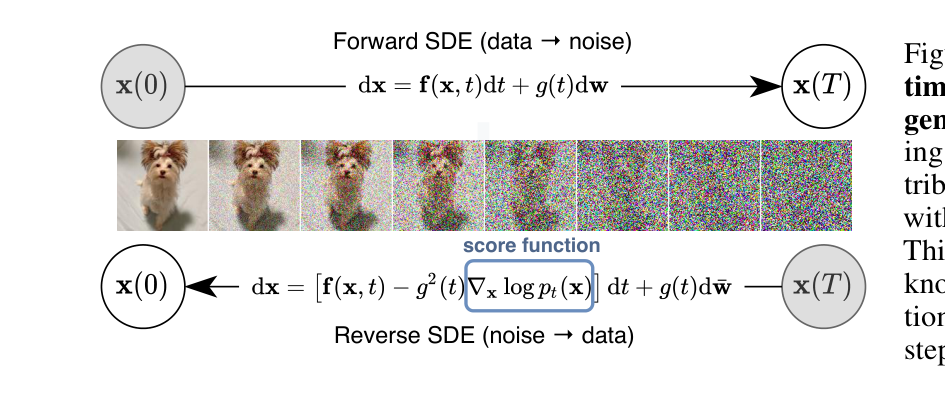
图源:Score-Based Generative Modeling through Stochastic Differential Equations,Figure 1。原论文图意:前向 SDE 把数据逐渐扩散为噪声;只要知道中间分布的 score,反向 SDE 就能从噪声生成数据。
输入输出:输入是数据分布与固定的加噪 SDE,输出是一个可从 prior 噪声反向生成数据的 SDE。
效率机制:它不是直接省掉训练,而是把采样问题变成可选择数值求解器的问题。
对主线意义:后续少步 solver、ODE sampler、distillation 和 flow matching 都是在这个连续时间视角里讨论“路径怎么走得更快”。
不能证明什么:一条漂亮的反向 SDE 不等于具体模型已低延迟、低 NFE 或可部署。
总体框架
论文 Figure 2 把三件事放在同一张图里:
- 前向 SDE:从 data 到 prior;
- 反向 SDE:从 prior 到 data;
- probability flow ODE:一条确定性路径,和 SDE 有相同的边缘分布。
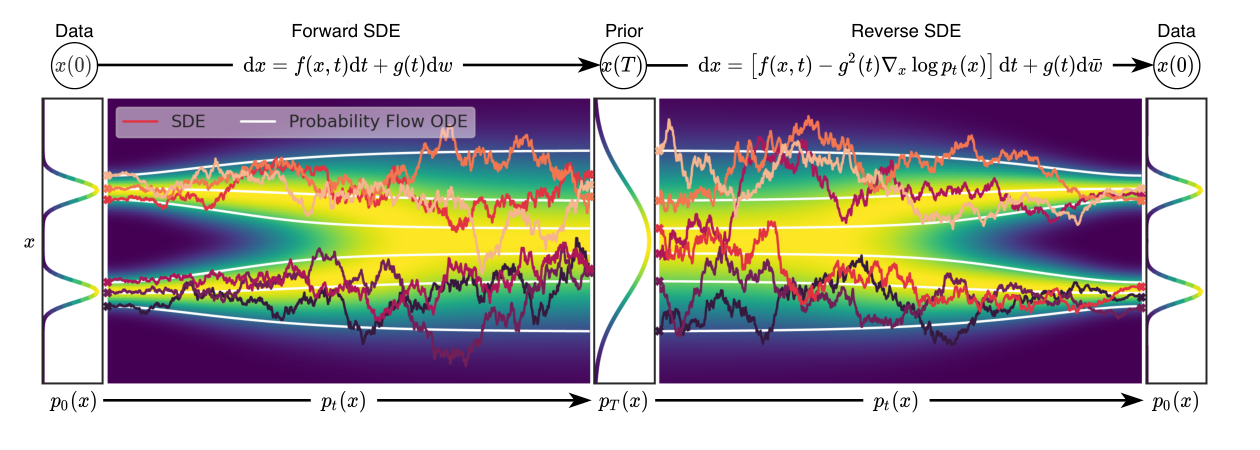
图源:Score-Based Generative Modeling through SDEs,Figure 2。原论文图意:数据可通过前向 SDE 映射到噪声 prior;反向 SDE 与 probability flow ODE 都可用 score 构造。
这张图里最容易忽略的是白色曲线:它代表 probability flow ODE。反向 SDE 是随机的,每次采样路径会被噪声扰动;probability flow ODE 是确定性的,但在每个时间点拥有同样的边缘分布 。因此它能做三件 SDE 路径不方便做的事:
| Capability | Why Probability Flow ODE Helps |
|---|---|
| Exact likelihood | Can use instantaneous change of variables as in neural ODEs |
| Latent encoding | A data point can be deterministically integrated to |
| Adaptive sampling | Black-box ODE solvers can trade tolerance for NFE |
对应 ODE 为:
和反向 SDE 相比,区别是 score 项前面的系数从 变成 ,并且没有随机 Wiener 项。
训练目标
训练时并不需要直接知道 的归一化密度。论文使用 denoising score matching 的连续时间形式:
这条式子的读法是:
| Term | Meaning |
|---|---|
| 随机抽一个连续噪声时刻 | |
| 从真实数据取 clean sample | |
| 按前向 SDE 加噪到时刻 | |
| 对这次 perturbation kernel 的真实 denoising score | |
| 神经网络预测的 time-dependent score | |
| 不同噪声时刻的 loss weight |
关键点:如果前向 SDE 的 transition kernel 是 Gaussian,训练就很方便,因为真实 denoising score 有闭式解。论文重点使用的 VE、VP、sub-VP SDE 都满足这个性质。
三类 SDE
论文把 SMLD 和 DDPM 分别解释成两类 SDE 的离散化,并引入 sub-VP SDE 改善 likelihood。
| SDE | Forward Process | Discrete Ancestor | Main Behavior | Practical Role |
|---|---|---|---|---|
| VE SDE | SMLD / NCSN | variance exploding; signal mean roughly fixed while noise grows | strong sample quality with NCSN++ | |
| VP SDE | DDPM | variance preserving when data variance is normalized | connects directly to DDPM-style training and sampling | |
| sub-VP SDE | proposed in this paper | lower variance than VP at intermediate times | stronger likelihood in reported CIFAR-10 setting |
这个表对工程判断很有用:**SDE 不是纯理论装饰,它会改变采样质量、likelihood 和最佳架构选择。**论文里 VE SDE 更偏向生成质量,sub-VP SDE 更偏向 likelihood。
采样:Predictor-Corrector
有了 score 网络后,可以用任意数值 SDE solver 近似反向 SDE。论文进一步提出 Predictor-Corrector sampler:
1 | predictor: |
直觉上,predictor 负责沿时间方向往回走,corrector 负责在当前噪声层上“横向校正”样本,让样本更贴近 。这解释了为什么 PC sampler 在同等或相近 NFE 下常常比只加 predictor 更稳。
论文 Table 1 比较了 CIFAR-10 上不同 reverse-time SDE solvers。下面按原英文列名重绘。
| Predictor | VE P1000 | VE P2000 | VE C2000 | VE PC1000 | VP P1000 | VP P2000 | VP C2000 | VP PC1000 |
|---|---|---|---|---|---|---|---|---|
| ancestral sampling | 4.98 ± .06 | 4.88 ± .06 | - | 3.62 ± .03 | 3.24 ± .02 | 3.24 ± .02 | - | 3.21 ± .02 |
| reverse diffusion | 4.79 ± .07 | 4.74 ± .08 | 20.43 ± .07 | 3.60 ± .02 | 3.21 ± .02 | 3.19 ± .02 | 19.06 ± .06 | 3.18 ± .01 |
| probability flow | 15.41 ± .15 | 10.54 ± .08 | - | 3.51 ± .04 | 3.59 ± .04 | 3.23 ± .03 | - | 3.06 ± .03 |
表源:Score-Based Generative Modeling through SDEs,Table 1。原论文表意:P1000 / P2000 是 predictor-only,C2000 是 corrector-only,PC1000 是 1000 predictor steps + 1000 corrector steps;指标是 CIFAR-10 FID,越低越好。
这张表不应该读成“某个 sampler 永远最好”。更稳的读法是:
- corrector-only 很贵而且效果差;
- PC 通常比只增加 predictor steps 更值得;
- probability flow 单独作为固定步 predictor 未必最好,但和 corrector 搭配时很强;
- sampler 的好坏依赖 SDE、模型、步数和 SNR 超参。
Probability Flow ODE
probability flow ODE 的价值有两层。第一,它把扩散模型和 neural ODE、normalizing flow 的工具连接起来,可以算 exact likelihood。第二,它给采样提供了 adaptive NFE 的空间。
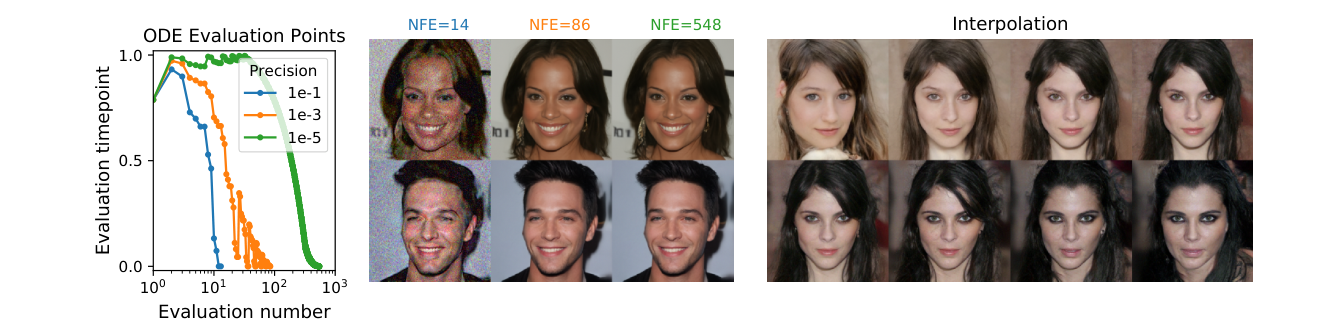
图源:Score-Based Generative Modeling through SDEs,Figure 3。原论文图意:ODE solver 的 evaluation points 可随数值精度变化;较少 NFE 仍可保持视觉质量;确定性 latent-to-image 映射支持 interpolation。
左图说明 ODE solver 会自动把函数评估集中到需要更高精度的时间段;中图显示从 NFE 548 降到 86 视觉质量仍接近,NFE 14 则明显退化;右图展示 deterministic encoding/decoding 支持 latent interpolation。它支撑的是“ODE 视角带来效率和表示能力”,不是“14 NFE 已经足够所有任务”。
论文 Table 2 报告了 probability flow ODE 用于 likelihood 和 ODE sampling 的结果。下面保留原英文表头。
| Model | NLL Test ↓ | FID ↓ |
|---|---|---|
| RealNVP (Dinh et al., 2016) | 3.49 | - |
| iResNet (Behrmann et al., 2019) | 3.45 | - |
| Glow (Kingma & Dhariwal, 2018) | 3.35 | - |
| MintNet (Song et al., 2019b) | 3.32 | - |
| Residual Flow (Chen et al., 2019) | 3.28 | 46.37 |
| FFJORD (Grathwohl et al., 2018) | 3.40 | - |
| Flow++ (Ho et al., 2019) | 3.29 | - |
| DDPM (L) (Ho et al., 2020) | ≤ 3.70* | 13.51 |
| DDPM (Lsimple) (Ho et al., 2020) | ≤ 3.75* | 3.17 |
| DDPM | 3.28 | 3.37 |
| DDPM cont. (VP) | 3.21 | 3.69 |
| DDPM cont. (sub-VP) | 3.05 | 3.56 |
| DDPM++ cont. (VP) | 3.16 | 3.93 |
| DDPM++ cont. (sub-VP) | 3.02 | 3.16 |
| DDPM++ cont. (deep, VP) | 3.13 | 3.08 |
| DDPM++ cont. (deep, sub-VP) | 2.99 | 2.92 |
表源:Score-Based Generative Modeling through SDEs,Table 2。* 表示 DDPM 原文的 ELBO 值是在 discrete data 上报告,论文正文特别说明这一点。
这里要注意一个很实际的 tradeoff:最佳 likelihood 不是最佳 FID。DDPM++ cont. (deep, sub-VP) 的 likelihood 最好,但 CIFAR-10 sample quality 最强的是 NCSN++ cont. (deep, VE)。
架构与训练细节
这篇论文的训练细节很值得单独看,因为它的结果不是“只改理论就赢了”,而是理论、采样器、架构和训练 recipe 叠加出来的。
基础训练设置
论文 Appendix H.1 给了架构探索设置:
| Item | Setting |
|---|---|
| Architecture exploration iterations | 1.3M unless otherwise noted |
| Checkpoint interval | every 50k iterations |
| VE datasets | CIFAR-10 32×32, CelebA 64×64 |
| VP architecture search | CIFAR-10 only, to save compute |
| FID evaluation | 50k samples, tensorflow_gan |
| Default architecture-search batch size | 128 |
| Sampler for architecture search | PC sampler with 1000 time steps |
| Predictor | reverse diffusion |
| VE corrector | one Langevin corrector step per predictor update, SNR 0.16 |
| VP corrector | usually omitted in architecture search to save doubled compute |
| Optimizer family | follows Ho et al. (2020): learning rate, gradient clipping, warm-up schedule |
官方代码里的 CIFAR-10 default config 进一步给出常用训练超参:
| Config Field | Value |
|---|---|
training.batch_size |
128 |
training.n_iters |
1300001 by default; deep continuous VE uses 950001 |
training.n_jitted_steps |
5 |
model.sigma_min / model.sigma_max |
0.01 / 50 for CIFAR-10 VE |
model.num_scales |
1000 |
optim.optimizer |
Adam |
optim.lr |
2e-4 |
optim.beta1 / optim.eps |
0.9 / 1e-8 |
optim.warmup |
5000 |
optim.grad_clip |
1.0 |
这些细节对复现很重要。比如同样叫 NCSN++ cont.,如果训练步数、EMA、SNR、predictor/corrector 选择或 continuous embedding 不一致,FID 差距可能非常明显。
NCSN++ / DDPM++ 的设计
论文在 DDPM U-Net 体系上测试了几类架构组件:
- FIR anti-aliasing upsampling/downsampling;
- skip connection 乘 做 rescale;
- 把 DDPM residual block 换成 BigGAN residual block;
- 每个 resolution 的 residual blocks 从 2 增到 4;
- 测试 input / output 的 progressive architecture。
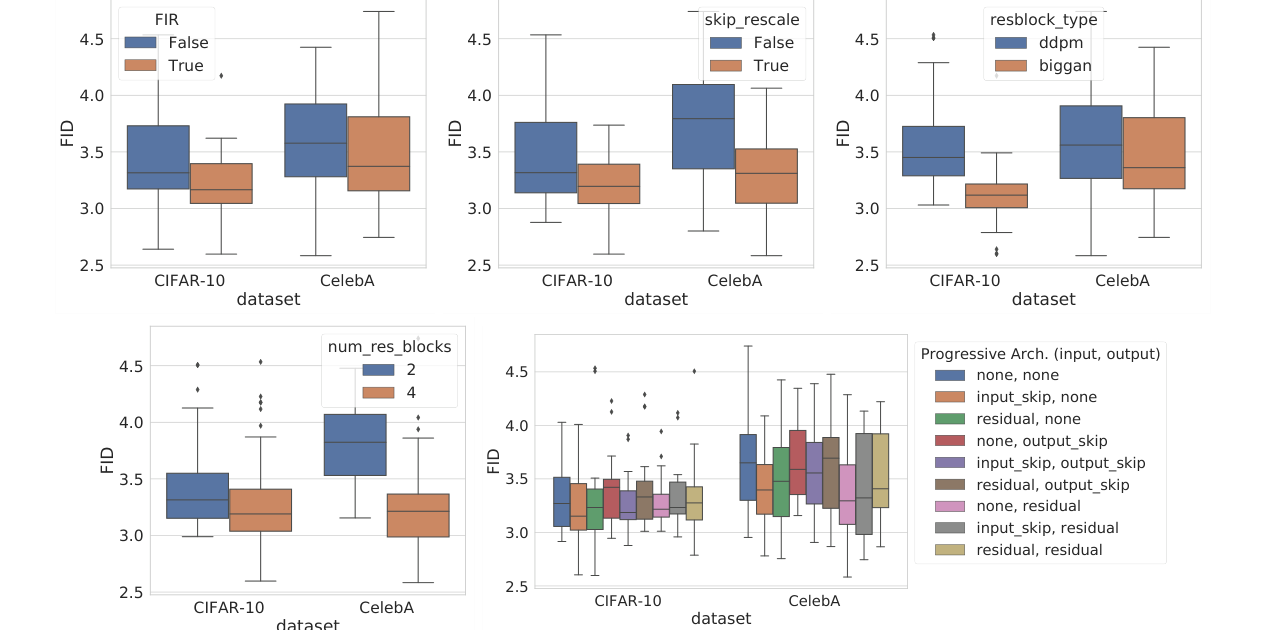
图源:Score-Based Generative Modeling through SDEs,Figure 10。原论文图意:在 VE perturbations 下,不同 architecture components 对 CIFAR-10 和 CelebA FID 的影响。
图里多数橙色配置比蓝色配置 FID 更低,说明这些组件不是装饰项:FIR、skip rescale、BigGAN block、更多 residual blocks 都能影响 score model 的质量。这里的结论更像训练配方筛选,而不是新的理论定理。
最终命名可以这样记:
| Model | Main Architecture Choice | SDE |
|---|---|---|
| NCSN++ | FIR + skip rescale + BigGAN residual block + 4 res blocks/resolution + residual progressive input | VE |
| DDPM++ | Similar search space, but best VP config drops FIR and progressive growing | VP / sub-VP |
| NCSN++ cont. | NCSN++ with continuous objective and random Fourier time embedding | VE |
| NCSN++ cont. (deep) | doubles residual blocks per resolution, trained 0.95M iterations |
VE |
| DDPM++ cont. (deep) | continuous DDPM++ with doubled depth | VP / sub-VP |
连续时间条件的实现细节也很关键。论文把离散 timestep positional embedding 改成 random Fourier feature embeddings,scale 固定为 16。官方 deep continuous VE config 中,NCSN++ cont. (deep) 使用 nf=128、ch_mult=(1,2,2,2)、num_res_blocks=8、attn_resolutions=(16,)、dropout=0.1、scale_by_sigma=True 和 ema_rate=0.999。
EMA、过拟合和 checkpoint 选择
论文强调 EMA 对性能影响明显:
| Setting | EMA |
|---|---|
| VE perturbations | 0.999 works better |
| VP perturbations | 0.9999 works better |
| 1024×1024 CelebA-HQ | 0.9999 |
还有一个容易漏掉的评测细节:Table 3 的 FID / IS 用的是训练过程中 FID 最低的 checkpoint;Table 2 的 likelihood 和 ODE FID 用的是最后 checkpoint。因此不能把两个表里的数字当成同一个 checkpoint 的全面画像。
CIFAR-10 sample quality
论文 Table 3 展示了最重要的 sample quality 结果。下面保留原英文表头。
| Model | FID ↓ | IS ↑ |
|---|---|---|
| BigGAN (Brock et al., 2018), Conditional | 14.73 | 9.22 |
| StyleGAN2-ADA (Karras et al., 2020a), Conditional | 2.42 | 10.14 |
| StyleGAN2-ADA (Karras et al., 2020a), Unconditional | 2.92 | 9.83 |
| NCSN (Song & Ermon, 2019) | 25.32 | 8.87 ± .12 |
| NCSNv2 (Song & Ermon, 2020) | 10.87 | 8.40 ± .07 |
| DDPM (Ho et al., 2020) | 3.17 | 9.46 ± .11 |
| DDPM++ | 2.78 | 9.64 |
| DDPM++ cont. (VP) | 2.55 | 9.58 |
| DDPM++ cont. (sub-VP) | 2.61 | 9.56 |
| DDPM++ cont. (deep, VP) | 2.41 | 9.68 |
| DDPM++ cont. (deep, sub-VP) | 2.41 | 9.57 |
| NCSN++ | 2.45 | 9.73 |
| NCSN++ cont. (VE) | 2.38 | 9.83 |
| NCSN++ cont. (deep, VE) | 2.20 | 9.89 |
表源:Score-Based Generative Modeling through SDEs,Table 3。原论文表意:NCSN++ cont. (deep, VE) 在 CIFAR-10 unconditional generation 上取得 FID 2.20 和 IS 9.89。
高分辨率训练
论文还把 NCSN++ 推到 CelebA-HQ。这里训练设置和 CIFAR-10 明显不同:
| Item | 1024×1024 CelebA-HQ Setting |
|---|---|
| Model | modified NCSN++ with continuous objective |
| SDE | VE SDE |
| Batch size | 8 |
| EMA | 0.9999 |
| Training length | around 2.4M iterations |
| Sampler | PC sampler with 2000 discretization steps |
| Predictor | reverse diffusion |
| Corrector | one Langevin step per predictor update |
| SNR | 0.15 |
| Fourier feature scale | 16 |
| Progressive architecture | input skip for input, output skip for output |
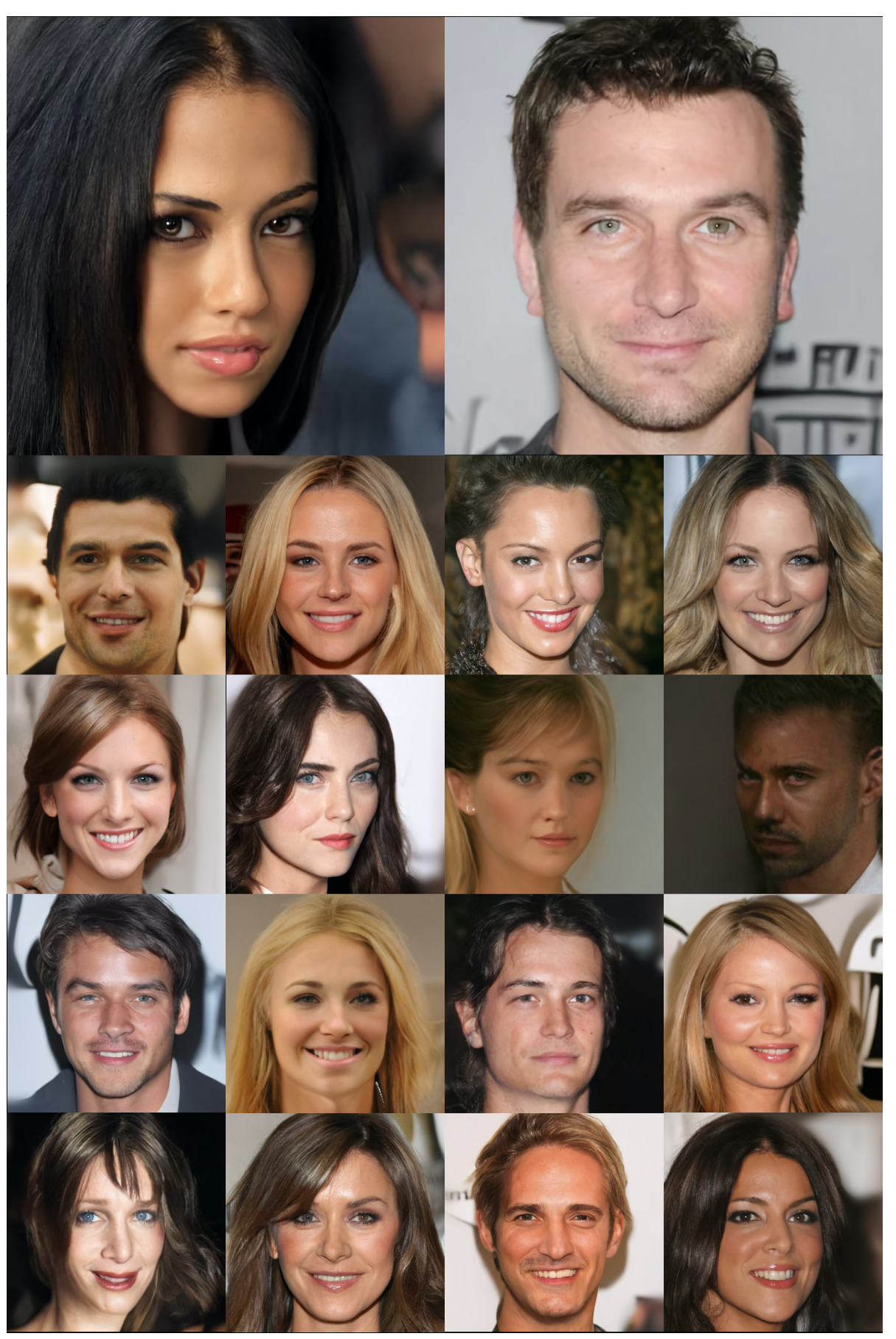 { width=“620” .atlas-figure-tall }
图源:Score-Based Generative Modeling through SDEs,Figure 12。原论文图意:使用 VE SDE 训练的 modified NCSN++ 在 CelebA-HQ 上生成的样例。
论文自己也承认这些高分辨率样本并不完美,比如人脸对称性仍有可见瑕疵。这个表述很重要:它证明了 score-based model 可以上到 1024 分辨率,但还不是说它在视觉质量、速度和可控性上全面超过 GAN。
Controllable Generation
这篇论文还展示了一个很强的接口:如果你知道条件 和当前 noisy state 的关系,就可以把反向 SDE 改成条件反向 SDE:
这和后来的 guidance 思想非常接近:基础 score 负责生成自然图像,条件梯度 负责把样本推向满足条件的区域。
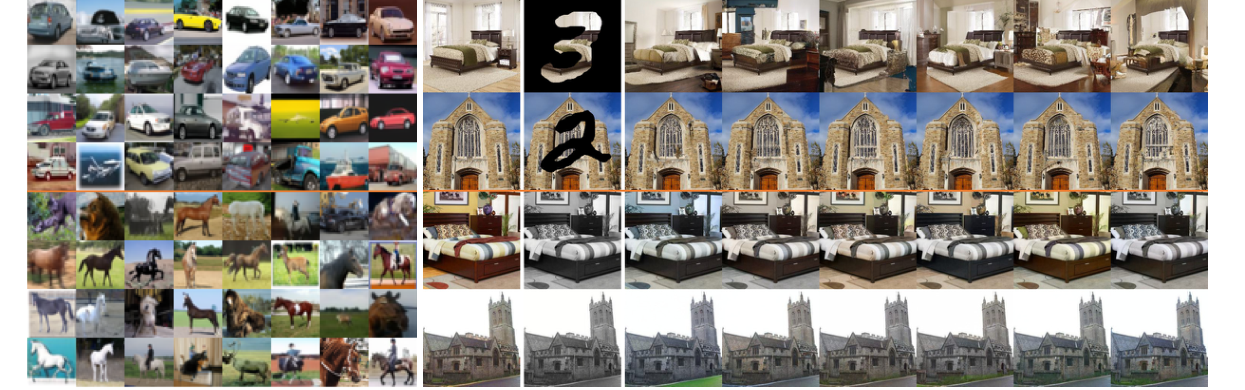
图源:Score-Based Generative Modeling through SDEs,Figure 4。原论文图意:左侧是 CIFAR-10 class-conditional samples;右侧是 LSUN 上的 inpainting 和 colorization。
三类应用分别是:
| Task | Conditioning Signal | Extra Training? | Mechanism |
|---|---|---|---|
| Class-conditional generation | class label | train time-dependent classifier | add to reverse SDE |
| Inpainting | known pixels | no new score model | constrain / resample known dimensions during reverse process |
| Colorization | grayscale observation | no new score model | transform channels to decouple known and unknown dimensions, then impute |
这部分对后续 diffusion guidance 很有启发:扩散模型的条件控制不一定要在训练阶段全部做完,很多条件可以在反向过程里以梯度或 projection 方式注入。
训练实现清单
如果要按这篇论文复现或迁移到新任务,建议把训练拆成下面这张 checklist。
| Stage | Decision |
|---|---|
| Choose SDE | VE for sample quality baseline; VP / sub-VP when likelihood or DDPM compatibility matters |
| Choose objective | continuous denoising score matching for modern SDE-style training |
| Time embedding | random Fourier features for continuous , scale 16 in reported configs |
| Network | U-Net family with residual blocks, attention at selected resolutions, EMA, dropout |
| Weighting | should balance score magnitude across noise levels |
| Sampler during eval | PC sampler for best quality; probability flow ODE for likelihood / latent / adaptive NFE |
| Corrector tuning | SNR is a real hyperparameter; official README notes typical 0.05-0.2 |
| Checkpointing | monitor FID across checkpoints, because the best sample checkpoint may not be the last |
| Report separately | sample FID / IS, ODE FID, NLL bits/dim, NFE, sampler steps |
这张清单的核心是:SDE、训练目标、架构和 sampler 不能分开调。只换 sampler 不改 SDE,或只换 SDE 不调 EMA/SNR/embedding,都可能得到完全不同的结论。
和后续论文的关系
| Later Direction | What It Inherits from Score SDE |
|---|---|
| DPM-Solver / DPM-Solver++ | diffusion sampling as solving ODE/SDE with better numerical integration |
| Consistency models / distillation | learn a faster mapping along a continuous-time generative path |
| DMD / DMD2 / Phased DMD | use score models and diffusion perturbations as distribution-matching signals |
| CausVid / video diffusion acceleration | treat video diffusion sampling as a path that can be causalized, cached, or distilled |
| Flow matching / rectified flow | asks whether the generative path can be made straighter or easier than diffusion paths |
可以把这篇论文看成扩散模型的“坐标系论文”。它未必是今天最快的生成方法,但它让后面很多方法都能在同一个坐标里比较:路径、score、noise schedule、ODE/SDE solver、NFE、likelihood、distillation。
局限与不可外推结论
- 论文提升了 score-based model 的质量和表达能力,但采样仍慢于 GAN,这是作者在结论里明确承认的限制。
- PC sampler 的效果依赖 predictor、corrector、SNR、步数和 SDE;不能只引用 Table 1 的最优数字。
- probability flow ODE 能算 likelihood,但最佳 likelihood 模型不等于最佳 FID 模型。
- 高分辨率 CelebA-HQ 结果证明了可扩展性,但样本仍有人脸对称性等瑕疵,不能外推出任意高分辨率域都稳定。
- class-conditional generation 需要额外训练 time-dependent classifier;inpainting/colorization 虽可用 unconditional score model,但仍依赖任务结构和 projection / approximation 设计。
- 这篇论文主要是图像生成和逆问题证据,不能直接推出视频、3D、机器人世界模型中的时序一致性、动作因果或闭环收益。
读完接哪里
- 想补数学主线:读 Score Matching 到 SDE。
- 想看训练细节:读 扩散训练与表示 和 扩散训练配方与排障。
- 想看采样加速:接 DPM-Solver++。
- 想看少步蒸馏:接 DMD、DMD2 和 Phased DMD。
这一页最后回到三个验收点:方法上,主公式是 forward SDE 加噪、reverse-time SDE 用 score 去噪,probability-flow ODE 则给出确定性采样和 likelihood 路径。实验上,图像生成、补全、上色和可控生成共同证明 score 不是只服务一种任务。诊断上,predictor-corrector、SDE/ODE 路径和 architecture component 的对比,才是理解后续 solver 与蒸馏论文的入口。
Score SDE 是扩散统一理论页:方法要抓 forward SDE、reverse-time SDE、probability-flow ODE 和 predictor-corrector 采样;实验说明同一 score 框架能覆盖图像生成、补全和可控任务。后续论文多是在这套公式上换参数化、求解器或蒸馏目标。
- Title: 论文专题讲解:Score SDE:把扩散模型写成连续时间生成过程
- Author: Charles
- Created at : 2026-05-19 09:00:00
- Updated at : 2026-05-19 09:00:00
- Link: https://charles2530.github.io/2026/05/19/ai-files-paper-deep-dives-diffusion-score-sde/
- License: This work is licensed under CC BY-NC-SA 4.0.