

论文专题讲解:MapAnything:统一前向 Metric 3D 重建骨干

这页先按“论文证据节点”读:先问它解决哪一个瓶颈,再看核心图表、实验 setting 和不能外推的边界。背景概念先回 论文专题讲解 和 具身智能。
前置:建议先读 相机、深度与机器人视觉 和 VGGT,知道 camera pose、depth、point map、ray、metric scale 分别是什么。
主线关系:MapAnything 不直接输出机器人动作,但它把多视图图像、相机、位姿、深度和局部重建统一成 metric 3D 状态,是 VLA、世界模型、SLAM、导航和抓取系统的感知状态层候选骨干。
- 论文:
MapAnything: Universal Feed-Forward Metric 3D Reconstruction - 链接:arXiv:2509.13414
- 项目页:map-anything.github.io
- 代码:facebookresearch/map-anything
- 模型:facebook/map-anything、facebook/map-anything-apache
- Checked date:2026-05-21
- 关键词:feed-forward 3D reconstruction、metric scale、camera calibration、SfM、MVS、depth completion、DINOv2、Alternating-Attention、factored scene representation
MapAnything 的核心价值,是把原本分散在 SfM、MVS、相机标定、深度估计、定位和补全里的几何问题,压到一个统一的前向模型里:输入可以只有图像,也可以额外带 intrinsics、poses、depth 或 partial reconstruction;输出则是一套可合成 metric 3D reconstruction 的 factored geometry。
它和 VGGT 很接近,但问题更“工程化”:VGGT 已经证明 camera、depth、point map、track 可以一起前向预测;MapAnything 继续追问,如果真实系统已经有一部分几何输入,比如机器人相机内参、SLAM 位姿、稀疏深度、RGB-D 深度,模型能不能把这些信息吃进去,并在同一个 metric scale 里输出更稳的重建。
它的效率贡献是什么
| Dimension | Contribution |
|---|---|
| Saved cost | 用一个 universal feed-forward model 覆盖 uncalibrated SfM、calibrated SfM、MVS、single-view calibration、camera localization、depth completion 等任务,减少为每种输入组合训练/维护 specialist model 的成本 |
| Core mechanism | factored scene representation:ray directions、ray depths、poses、metric scaling factor;几何输入和输出都用同一套分解表示 |
| Training contribution | 13 datasets 的监督标准化、covisibility-based multi-view sampling、geometric input probability augmentation、log-space losses、two-stage view curriculum |
| Embodied relevance | 机器人经常知道相机内参、局部 SLAM 位姿或稀疏深度;MapAnything 能把这些 partial geometric priors 接进 dense metric reconstruction |
| Main risk | 它仍是几何感知骨干,不建模动作、接触动力学、动态 scene flow 或控制安全;几何输入噪声和超大场景 memory 仍是限制 |
论文位置
传统 3D 重建常拆成一条长 pipeline:
1 | feature matching |
VGGT、DUSt3R、MASt3R 这类 feed-forward 方法把 pipeline 里的很多优化步骤前移到了模型里。MapAnything 的新增问题是:真实系统的输入不是固定的。机器人、AR、自动驾驶或扫描设备常常有不同程度的先验:
- 只有一组 RGB 图像;
- 有 camera intrinsics / ray directions;
- 有 camera poses;
- 有 metric depth 或 sparse depth;
- 有 partial reconstruction;
- 有上述信号的一部分视角,而不是所有视角。
这意味着模型不能只吃一种固定输入,也不能只输出 up-to-scale pointmaps。MapAnything 用 factored representation 同时解决两件事:输入端可选、输出端 metric。
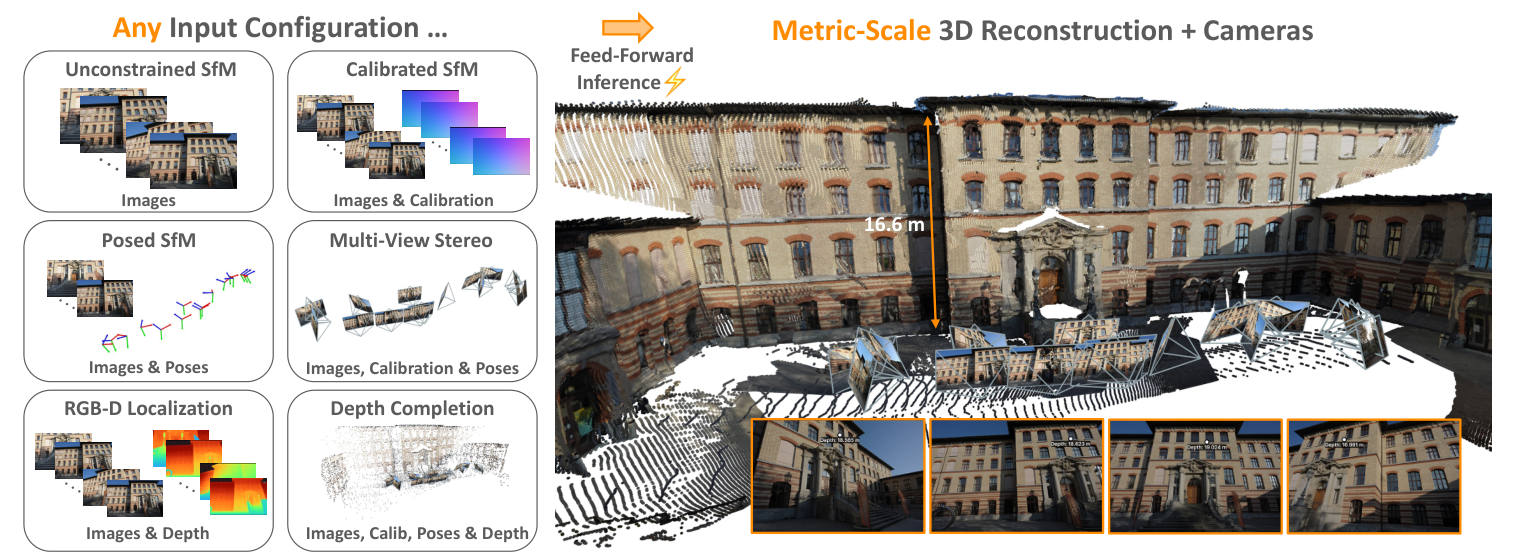
图源:MapAnything,Figure 1。原论文图意:MapAnything 用同一个 feed-forward 模型支持多种 input configuration,并输出 metric-scale 3D reconstruction 与 cameras;图中列出 unconstrained SfM、calibrated SfM、posed SfM、MVS、RGB-D localization 和 depth completion 等任务。
左侧不是简单的任务展示,而是在强调输入组合的可变性:Images、Calibration、Poses、Depth 都可能存在或缺失。右侧的关键是 Metric-Scale 3D Reconstruction + Cameras,说明论文想解决的不是相对几何漂亮不漂亮,而是能否把局部估计放进统一 metric frame。
对具身系统来说,这点很实用。真实机器人通常已经有相机内参,移动机器人可能有 SLAM pose,RGB-D 相机有深度但会有洞;一个能融合这些输入的几何 backbone,比只能从 RGB 重建的模型更容易进入 episode schema 和规划系统。
核心问题:为什么要 factored geometry
MapAnything 不把场景直接表示成一组耦合 pointmaps,而是输出:
其中:
| Symbol | Meaning |
|---|---|
| local ray directions,等价于每个像素沿哪个相机射线出发 | |
| up-to-scale ray depths | |
| pose of image in the frame of view 1,包含 quaternion 和 up-to-scale translation | |
| global metric scaling factor |
从这些量可以恢复局部点云和全局 metric 重建:
这里 由 quaternion 转成 rotation matrix。这个分解的好处有三层:
- camera calibration 与 depth 分开:ray directions 可以表达更一般的 central camera,而不只是假设标准 pinhole;
- pose 与 scale 分开:位姿的旋转、平移方向和 metric scale 不再强行耦合;
- partial supervision 更好用:有些数据集只有 up-to-scale geometry,有些有 metric depth,有些有 pose,factored output 让不同数据都能贡献监督。
总体架构
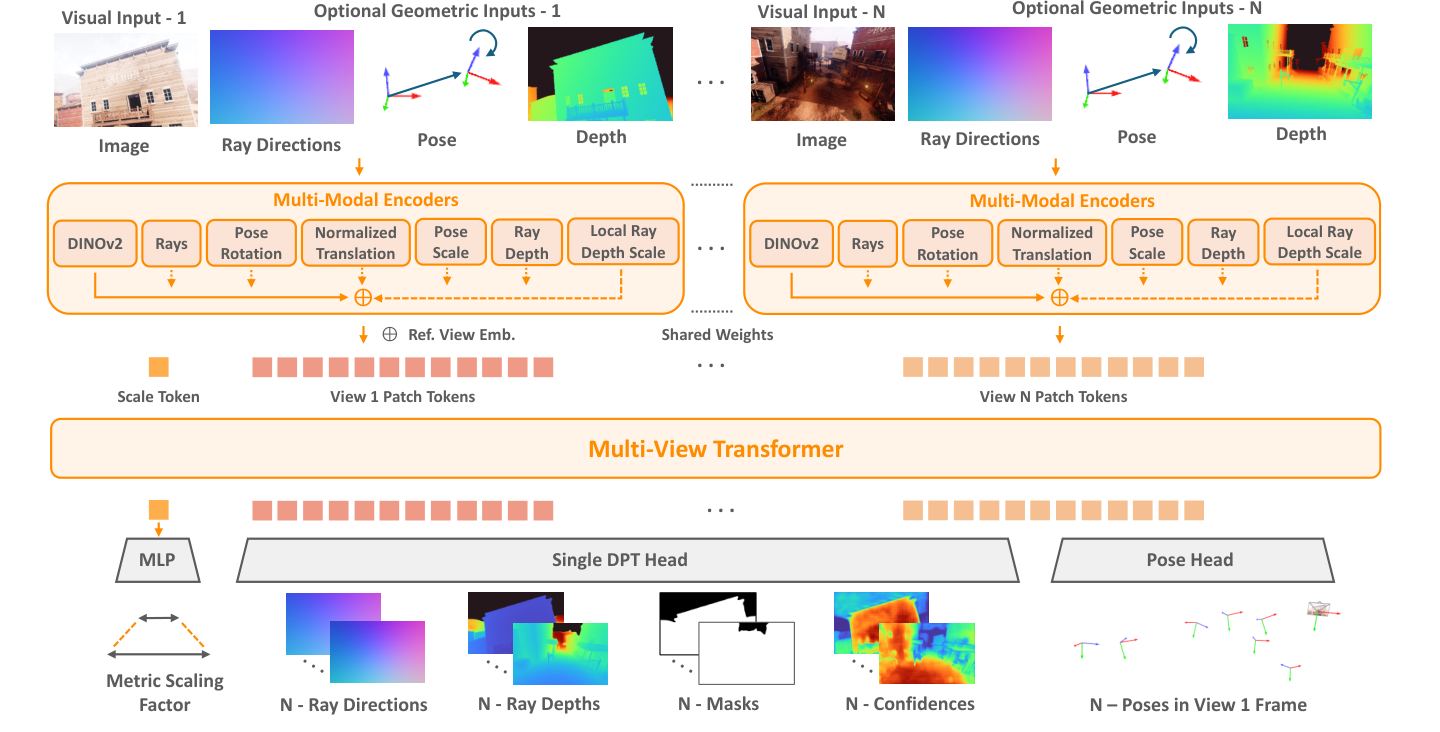
图源:MapAnything,Figure 2。原论文图意:模型把 RGB 图像和可选几何输入编码到共同 latent space,加入 reference view embedding 与 scale token,通过 multi-view transformer 融合多视角信息,再由 DPT head、pose head 和 scale MLP 输出 factored metric 3D geometry。
上方每个 view 都有 Visual Input 和可选的 Optional Geometric Inputs。图像走 DINOv2,ray / depth 走浅层 convolutional encoder,pose rotation、normalized translation、pose scale、ray depth scale 走 MLP。所有特征先对齐到同一个 latent space,再相加,而不是把几何信号只作为 prompt。
中间的 Scale Token 是 MapAnything 和普通 up-to-scale 重建的重要差异。局部几何和 pose 先在 up-to-scale 空间预测,scale token 再预测全局 metric scaling factor。这样既保留多视图相对几何,又能把结果拉回真实尺度。
Encoder
MapAnything 的 image encoder 使用 DINOv2 ViT-G 的第 24 层 normalized patch features,特征维度是 1536,patch stride 对应 14。论文比较过 CroCoV2、DUSt3R image encoder、RADIO 和随机 patchification,认为 DINOv2 在下游性能、收敛速度和泛化上最好。
可选几何输入被分成两类:
| Input factor | Encoder |
|---|---|
| ray directions | shallow convolutional encoder with pixel unshuffle size 14 |
| normalized ray depths | shallow convolutional encoder with pixel unshuffle size 14 |
| rotations as unit quaternions | 4-layer MLP with GeLU |
| normalized translation directions | 4-layer MLP with GeLU |
| depth scales | 4-layer MLP with GeLU after log-transform |
| pose scales | 4-layer MLP with GeLU after log-transform |
这种输入分解很适合机器人:相机内参通常可靠,深度可能只对部分帧可靠,位姿可能来自 SLAM/odometry 且有尺度问题。把它们拆开编码,模型就能在不同输入可用性下保持同一套接口。
Multi-View Transformer
所有 view 的 patch tokens 加上一个 learnable scale token 后,进入 multi-view transformer。论文使用:
| Setting | Value |
|---|---|
| Transformer type | 16-layer Alternating-Attention transformer |
| Attention heads | 24 |
| Latent dimension | 1536 |
| MLP ratio | 4 |
| Initialization | last 16 layers of DINOv2 ViT-G |
| Reference handling | constant reference view embedding added to view 1 tokens |
| RoPE | not used |
Alternating-Attention 继承了 VGGT 的核心直觉:跨帧 global attention 建立多视角几何关系,frame-wise attention 稳定每帧内部结构。MapAnything 的附录还用 ablation 说明,Global w/ View PE 在 50 views 上明显更差。
Heads
| Head | Output |
|---|---|
| Single DPT Head | -ray directions、-ray depths、-masks、-confidences |
| Pose Head | -poses in view 1 frame |
| Scale MLP | metric scaling factor |
DPT head 输出 local dense quantities;pose head 用 average-pooling-based convolutional design 输出 quaternion 和 up-to-scale translation;scale token 进入 2-layer MLP with ReLU,再通过 exponential scaling 得到 metric scaling factor。
训练目标
MapAnything 的训练目标很值得细读,因为它的“universal”不是靠一句多任务学习完成的,而是靠输出分解、loss 归一化、输入增强和数据标准化一起撑起来。
对于不依赖 scene scale 的量,直接监督:
quaternion 有 和 表达同一旋转的问题,所以 rotation loss 取二者较小值。
对于 ray depths、pose translations、local pointmaps、world-frame pointmaps,论文沿用 DUSt3R 风格的 scale-invariant normalization,并把 log-space loss 作为关键设计。论文定义:
f_\log(x) = (x / \|x\|)\cdot \log(1+\|x\|)
并强调 ray depths、pointmaps 和 metric scale factor 都要在 log-space 里算 loss。为了避免 scale loss 的梯度污染 up-to-scale geometry,它使用:
其中 表示 stop-gradient。
总 loss 为:
训练细节里有几个很工程化的点:
- global pointmap loss 权重设为
10,mask loss 权重设为0.1; - regression losses 使用 adaptive robust loss,参数
c = 0.05、\alpha = 0.5; - 每个 pixel loss 里 top
5%被剔除,用于降低训练数据噪声和异常值影响; - normal loss 和 multi-scale gradient matching loss 只用于 synthetic datasets,因为真实数据的几何可能粗糙或有噪声;
- mask 用 binary cross entropy,预测 non-ambiguous classes for depth。
这部分对具身系统的启发是:几何监督不是“有 depth 就直接 L1”。真实数据经常有洞、噪声、尺度不一致和标注不完整;如果不在 loss 和输入 schema 上处理,模型会把数据集误差学成几何规律。
训练输入增强
为了让一个模型支持多种输入组合,MapAnything 在训练时随机提供或隐藏几何输入:
| Training input choice | Value |
|---|---|
| Overall geometric input probability | 0.9 |
| Individual factor probability | 0.5 each for ray directions, ray depth, pose |
| Depth input mode | equal probability of dense depth or 90% randomly sparsified depth |
| Per-view input probability | 0.95 |
| Metric scale input dropout | not provide metric scale factors with probability 0.05 |
| Supported exhaustive combinations | 64 possible input combinations in supplement |
这里的关键不是做数据增强本身,而是让模型学会“几何输入是可选的”。这和机器人部署很像:某些帧有深度、某些帧深度失效;某些相机标定可靠、某些外参刚重标定;SLAM 位姿有时漂移,有时可用。训练时把输入可用性打散,能减少模型对单一传感器契约的依赖。
训练数据
Table 1 is redrawn below with the original English fields.
| Dataset | License | # Scenes | Metric |
|---|---|---|---|
| BlendedMVS [80] | CC BY 4.0 | 493 | ✗ |
| Mapillary Planet-Scale Depth [36] | CC BY-NC-SA | 71,428 | ✓ |
| ScanNet++ v2 [81] | Non-commercial | 926 | ✓ |
| Spring [37] | CC BY 4.0 | 37 | ✓ |
| TartanAirV2-WB [73, 86] | CC BY 4.0 | 49 | ✓ |
| UnrealStereo4K [59] | MIT | 9 | ✓ |
| Additionally used for our CC BY-NC model: | |||
| Aria Synthetic Environments [2] | Non-commercial | 103,890 | ✓ |
| DL3DV-10K [32] | CC BY-NC 4.0 | 10,109 | ✗ |
| Dynamic Replica [25] | Non-commercial | 523 | ✓ |
| MegaDepth [30] | CC BY 4.0 | 269 | ✗ |
| MVS-Synth [21] | Non-commercial | 120 | ✓ |
| ParallelDomain-4D [62] | Non-commercial | 1,528 | ✓ |
| SAIL-VOS 3D [20] | Non-commercial | 171 | ✓ |
| Unique held-out scenes for dense up-to-N-view benchmarking: | |||
| ETH3D [54] | CC BY-NC-SA 4.0 | 13 | ✓ |
| ScanNet++ v2 [81] | Non-commercial | 30 | ✓ |
| TartanAirV2-WB [73, 86] | CC BY 4.0 | 5 | ✓ |
表源:MapAnything,Table 1。原论文表格要点:训练数据覆盖真实室内、户外、合成、in-the-wild 和 metric / up-to-scale 场景;Apache 2.0 模型使用前 6 个数据集,CC BY-NC 4.0 模型额外使用后 7 个数据集。
论文还补了一个细节:Mapillary Planet-Scale Depth 原本是 monocular metric depth dataset,作者额外获取 pose 和 camera information,使其变成约 72K scenes 的 real-world multi-view metric scale dataset,并开源这部分 metadata。
Multi-View Sampling
训练时,作者对每个 dataset 预计算同一 scene 内所有 image pair 的 covisibility。covisibility 用 ground-truth depth 和 pose 做 reprojection error check 得到。训练采样时使用 25% covisibility threshold,通过 random walk sampling 得到单连通的 covisible view graph。
这一步对具身数据也很重要。如果直接随机抽图,模型可能拿到彼此几乎不重叠的视角,训练信号会混乱;如果只抽高度重叠视角,模型又学不到大 baseline、遮挡和场景覆盖。covisibility graph 是把“多视角可对齐”变成训练样本约束。
训练配方
Supplementary implementation details are redrawn below with the original English setting names.
| Setting | Value |
|---|---|
| Optimizer | AdamW |
| Peak LR for pre-trained DINOv2 encoder | |
| Peak LR for everything else | |
| LR schedule | 10% linear warmup, then half-cycle cosine decay to 100x lower value |
| Weight decay | 0.05 |
| AdamW | 0.9, 0.95 |
| Max image dimension | 518 pixels |
| Aspect ratio augmentation | randomized from 3:1 to 1:2 |
| Data augmentation | color jitter, Gaussian blur, grayscale conversion |
| Efficiency | mixed precision training, gradient checkpointing for DINOv2 encoder |
| Gradient clipping | norm threshold 1 |
| Batch scheme | dynamic batching based on number of views |
| Curriculum | two-stage curriculum, 420K steps |
| Stage 1 | 6 days on 64 H200-140GB GPUs, effective batch size 768-1536, views 4 to 2 |
| Stage 2 | 4 days on 64 H200-140GB GPUs, 10x lower peak LR, effective batch size 128-1536, views 24 to 2 |
| Ablation setup | same as above, but 8x lower effective batch size |
信息源:MapAnything,Supplementary Material B。原论文要点:训练采用 DINOv2 小学习率微调、其他模块较大学习率、动态 batch 和两阶段 view curriculum;先在少视图上建立能力,再扩到更多 views。
这份训练配方有三个值得记住的工程判断。
第一,DINOv2 不是冻死不用,而是用很小 LR 微调。几何任务需要保留视觉语义和纹理先验,但 ray、depth、pose 监督会改变特征的使用方式,小步微调比完全冻结更灵活。
第二,view curriculum 很关键。Stage 1 只在 2-4 views 上训练,先把局部多视图几何学稳;Stage 2 扩到最多 24 views,并降低 peak LR,让模型在更多视角下维持一致性。附录 Figure S.2 还显示,最多只训练到 4 views 的阶段模型,已经能泛化到更多 views,但最终模型明显更稳。
第三,动态 batch 不是小实现细节。多视图 Transformer 的 token 数随 views 增长,dense DPT head 还要输出每个 view 的像素级结果。固定 batch 很容易要么爆显存,要么浪费吞吐;按 views 调 batch 是这类模型训练的基本工程动作。
官方代码的 train.md 还把训练脚本拆成 Stage 1、Stage 2 和 Stage 3 confidence training。论文附录的主训练叙述是 two-stage curriculum;代码侧额外暴露 confidence 相关训练脚本,复现实验时应以具体 checkpoint / config 为准。
实验:重建质量与输入组合
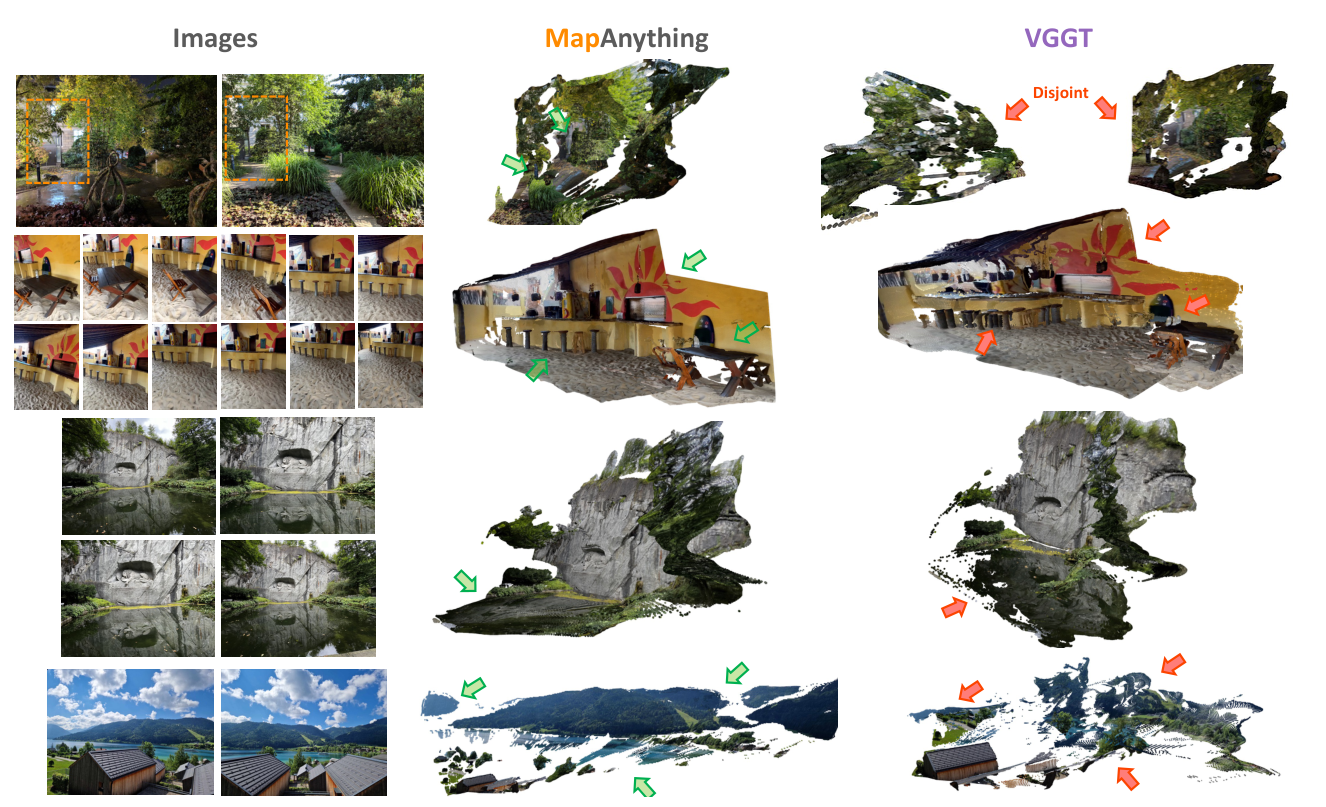
图源:MapAnything,Figure 3。原论文图意:只用 in-the-wild images 作为输入时,MapAnything 与 VGGT 的 qualitative comparison;论文说明 MapAnything 在大视差变化、季节变化、无纹理表面、水体和大场景上更稳。
这不是闭环机器人实验,而是几何重建鲁棒性样例。绿色箭头强调 MapAnything 在大场景和困难表面上的连续性,红色箭头指出 VGGT 的 disjoint 或几何断裂。它支撑的是 feed-forward metric reconstruction 的视觉质量证据,不能证明动作规划或动态交互能力。
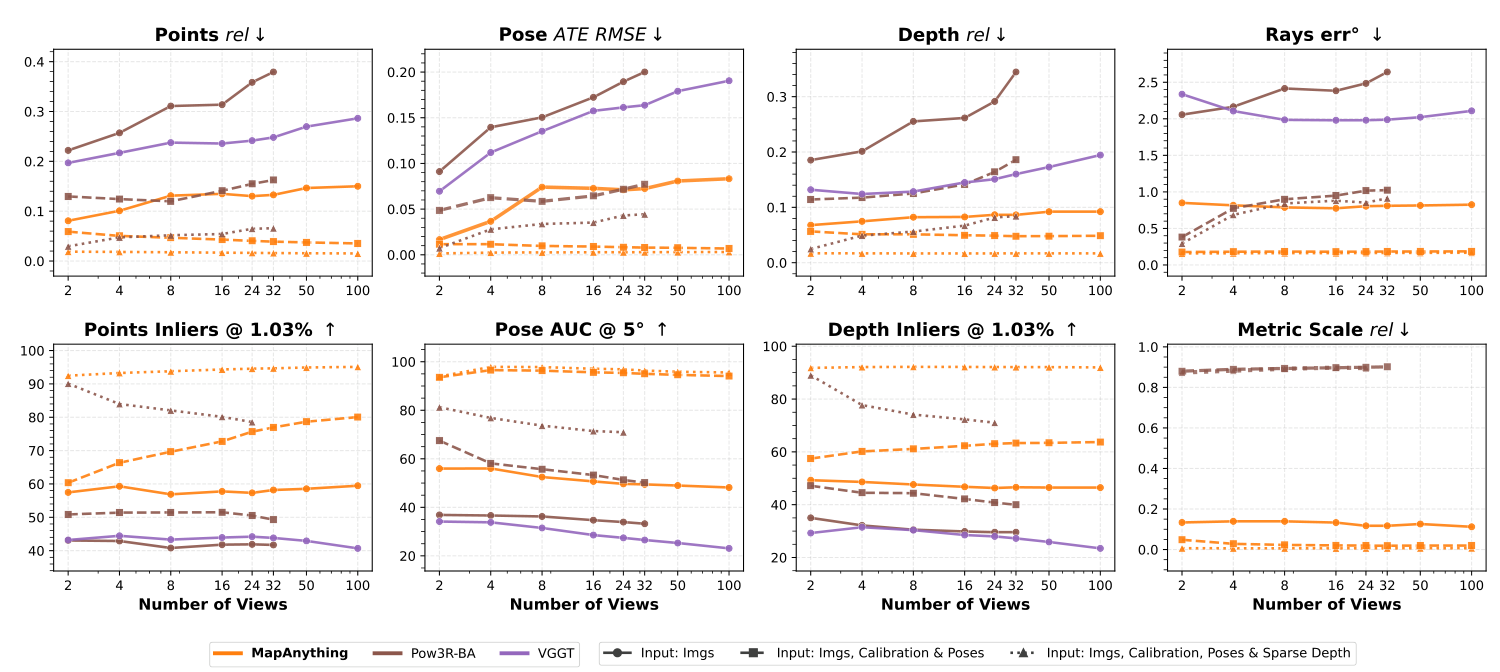
图源:MapAnything,Figure 4。原论文图意:MapAnything 在 2 到 100 views 以及不同 input configurations 下做 dense multi-view reconstruction,对比 VGGT 和 Pow3R-BA;指标覆盖 pointmaps、pose、depth、ray directions 和 metric scale。
先看横轴:views 从 2 增到 100。再看线型:同一个 MapAnything 在 Input: Imgs、Input: Imgs, Calibration & Poses、Input: Imgs, Calibration, Poses & Sparse Depth 下表现不同。结论不是“图像输入就够了”,而是模型能在同一 forward interface 里吸收额外几何信号;真实机器人越能提供可靠几何先验,MapAnything 越像一个融合器。
Two-View Dense Reconstruction
Table 2 is redrawn below with the original English fields.
| Average across ETH3D, SN++v2 & TAV2 | Methods | Scale rel↓ | Points rel↓ | Points τ↑ | Pose ATE↓ | Pose AUC↑ | Depth rel↓ | Depth τ↑ | Rays err°↓ |
|---|---|---|---|---|---|---|---|---|---|
| a) Input: Images | DUSt3R [72] | – | 0.21 | 43.9 | 0.08 | 35.5 | 0.17 | 32.6 | 2.55 |
| a) Input: Images | MASt3R [29] | 0.38 | 0.25 | 30.2 | 0.07 | 37.3 | 0.19 | 24.8 | 7.03 |
| a) Input: Images | Pow3R [23] | – | 0.22 | 43.1 | 0.09 | 36.9 | 0.19 | 35.0 | 2.06 |
| a) Input: Images | VGGT [67] | – | 0.20 | 43.2 | 0.07 | 34.2 | 0.13 | 29.3 | 2.34 |
| a) Input: Images | MapAnything | 0.13 | 0.08 | 57.5 | 0.02 | 56.0 | 0.07 | 49.3 | 0.85 |
| b) Input: Images & Intrinsics | Pow3R [23] | – | 0.20 | 46.0 | 0.08 | 51.3 | 0.15 | 43.2 | 0.40 |
| b) Input: Images & Intrinsics | MapAnything | 0.13 | 0.07 | 59.3 | 0.01 | 64.7 | 0.06 | 55.1 | 0.19 |
| c) Input: Images, Intrinsics & Poses | Pow3R [23] | – | 0.13 | 50.9 | 0.05 | 67.5 | 0.11 | 47.2 | 0.38 |
| c) Input: Images, Intrinsics & Poses | MapAnything | 0.05 | 0.06 | 60.4 | 0.01 | 93.6 | 0.06 | 57.5 | 0.18 |
| d) Input: Images, Intrinsics & Depth | Pow3R [23] | – | 0.13 | 77.9 | 0.04 | 66.5 | 0.07 | 77.3 | 0.29 |
| d) Input: Images, Intrinsics & Depth | MapAnything | 0.02 | 0.04 | 77.8 | 0.01 | 73.1 | 0.03 | 76.6 | 0.18 |
| e) Input: Images, Intrinsics, Poses & Depth | Pow3R [23] | – | 0.03 | 90.1 | 0.01 | 81.3 | 0.02 | 89.0 | 0.29 |
| e) Input: Images, Intrinsics, Poses & Depth | MapAnything | 0.01 | 0.02 | 82.0 | 0.00 | 94.8 | 0.02 | 81.5 | 0.16 |
表源:MapAnything,Table 2。原论文表格要点:在 two-view reconstruction 上,MapAnything 在 images-only 和带几何输入时整体优于或匹配 specialist baselines;额外几何输入尤其改善 scale、pose 和 dense geometry。
这张表最该关注的是输入组合。MapAnything 不是只在 Images 下和 VGGT 比,而是展示了一个统一模型如何随着 Intrinsics、Poses、Depth 增加而改变输出质量。这对具身智能的启发是:不要把几何模型只当 RGB 网络;如果系统已有 calibration、odometry、sparse depth,应该让模型把它们作为一等输入。
辅助几何输入为什么重要
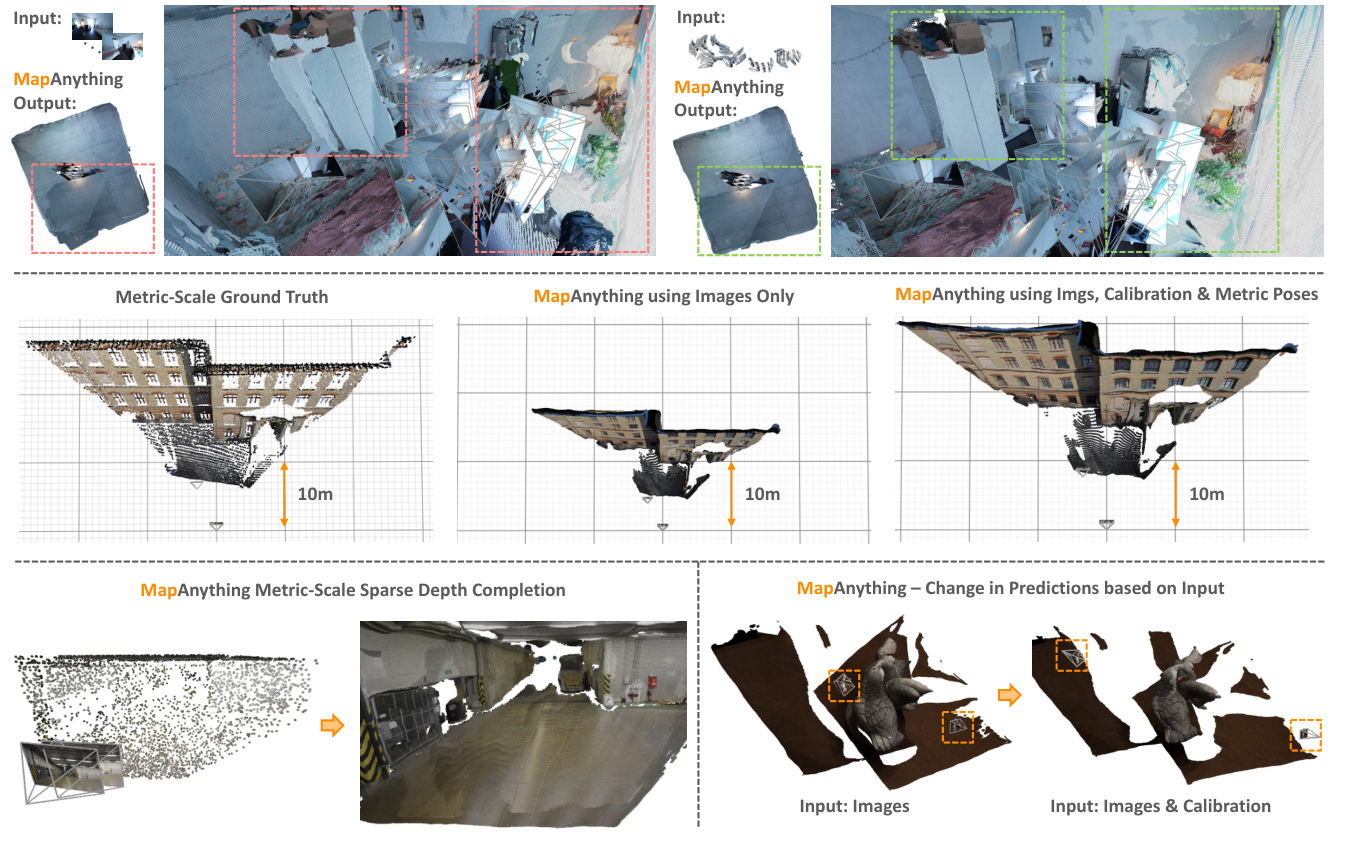
图源:MapAnything,Figure S.5。原论文图意:辅助几何输入可以改善 MapAnything 的 feed-forward performance;包括用 calibration 和 metric poses 改善 alignment / metric scale,用 sparse metric point cloud 做 dense metric depth completion,以及输入 calibration 后改变物体中心场景的预测。
上半部分说明,只靠 100 张图像时模型仍可能出现重复结构;加入 camera calibration 和 poses 后,几何对齐明显改善。中间展示 metric scale:images-only 的尺度估计不够准,加入 calibration 和 metric poses 后接近 ground truth。下半部分说明 sparse depth / calibration 不是装饰输入,它们会实际改变 dense reconstruction。
对机器人来说,这张图很关键:如果相机标定和局部位姿已经在系统里存在,就不该在模型输入层丢掉。MapAnything 的价值之一,就是把这些传统几何模块的输出重新变成 foundation model 的条件。
关键消融
Table 5 is redrawn below with the original English fields.
| (a) Scene Representation | Metric Scale rel↓ | Pointmaps rel↓ | Pointmaps τ↑ |
|---|---|---|---|
| Input: Images Only | |||
| Local PM + Pose | 0.14 | 0.32 | 33.2 |
| RDP | 0.17 | 0.33 | 32.6 |
| LPMP & Scale | 0.16 | 0.30 | 38.7 |
| RDP & Scale (ours) | 0.16 | 0.28 | 40.7 |
| Input: Images, Intrinsics & Metric Poses | |||
| Local PM + Pose | 0.04 | 0.08 | 53.5 |
| RDP | 0.06 | 0.09 | 46.7 |
| LPMP & Scale | 0.06 | 0.07 | 55.9 |
| RDP & Scale (ours) | 0.05 | 0.07 | 57.8 |
| (b) Expert vs Universal Training | Metric Scale rel↓ | Pointmaps rel↓ | Pointmaps τ↑ |
|---|---|---|---|
| Input: Images Only | |||
| Expert Training | 0.16 | 0.29 | 31.8 |
| Universal Training | 0.16 | 0.28 | 40.7 |
| Input: Images, Intrinsics & Metric Poses | |||
| Expert Training | 0.03 | 0.07 | 56.2 |
| Universal Training | 0.05 | 0.07 | 57.8 |
| Input: Images & Metric Depth | |||
| Expert Training | 0.06 | 0.24 | 53.0 |
| Universal Training | 0.06 | 0.25 | 54.0 |
表源:MapAnything,Table 5。原论文表格要点:RDP & Scale 的 factored representation 是关键;universal training 在多个输入配置上的表现接近或优于为特定输入配置训练的 expert models。
这张表支撑论文最核心的两个 claim:
- 表示法重要:只预测 local pointmap + pose,或者只做 RDP 而没有 metric scale,都不如
RDP & Scale稳; - universal training 不只是省事:一个统一模型不是明显弱于 specialist,反而在一些输入组合上更好。
Supplementary Table S.2 进一步显示:
| (a) Loss Scheme | Metric Scale rel↓ | Pointmaps rel↓ | Pointmaps τ↑ |
|---|---|---|---|
| Overall Factored Loss | 0.16 | 0.29 | 31.8 |
| No Log Loss | 0.17 | 0.39 | 27.3 |
| (b) Attention Scheme | Metric Scale rel↓ | Pointmaps rel↓ | Pointmaps τ↑ |
|---|---|---|---|
| Alternating [67] | 0.16 | 0.29 | 31.8 |
| Global w/ View PE [78] | 0.20 | 0.53 | 19.7 |
表源:MapAnything,Table S.2。原论文表格要点:log scaling 和 Alternating-Attention 对 50-view reconstruction 很关键,尤其是模型训练视角数少于评测视角数时。
推理速度与显存
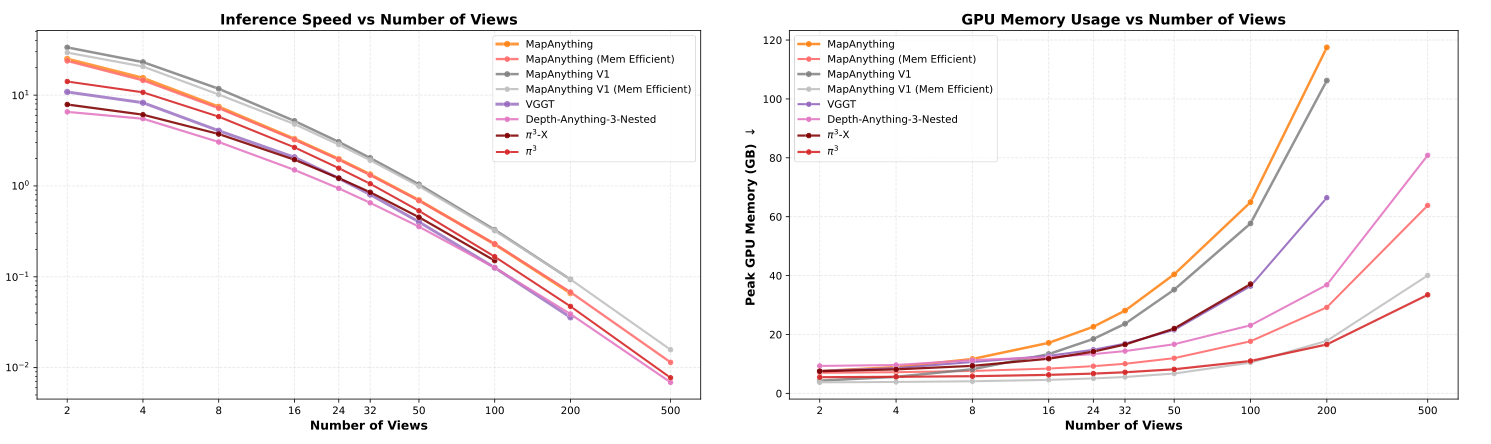
图源:MapAnything,Figure S.1。原论文图意:在 H200-140GB GPU 上对比多视图 feed-forward reconstruction 模型的 inference speed 和 peak GPU memory;MapAnything 的 dense per-pixel regression 存在显存瓶颈,Mem Efficient 版本用 per-view decoding mini-batch loop 显著降低显存,速度损失很小。
左图看 view 数增加后 inference frequency 如何下降;右图看 peak GPU memory 如何上升。MapAnything 不是没有显存压力,瓶颈主要来自 dense per-pixel DPT decoding across views。论文的工程处理是把 per-view decoding 放进 mini-batched loop,降低显存峰值。
这对机器人部署有现实含义:如果只是少量相机或短窗口,feed-forward geometry 很有吸引力;如果要把 100+ views、长期 map、dense depth 和在线规划放在一起,必须设计 memory-efficient decoding、滑动窗口、关键帧筛选或 scene memory。
它和 VGGT / Depth Anything 3 的关系
| Method | Main state | Input flexibility | Metric scale | Embodied use |
|---|---|---|---|---|
| VGGT | camera、depth、point map、tracks | 主要从多张 RGB 图像前向预测 | 通过训练规范和输出估计处理几何尺度 | 快速多视图几何状态和 tracking features |
| Depth Anything 3 | depth、ray、camera、3DGS-friendly geometry | 任意视角图像,强调 depth-ray / cross-view geometry | 面向多视角几何和渲染式输出 | 3D 几何底座、重建与渲染接口 |
| MapAnything | ray directions、ray depths、poses、metric scale | RGB + 可选 intrinsics / poses / depth / partial reconstruction | 显式 global metric scaling factor | 统一几何融合器,适合接机器人已有 calibration、odometry、RGB-D 或 sparse depth |
MapAnything 最值得补进具身主线的原因,是它承认真实系统并不是“纯 RGB benchmark”。一个实际机器人 episode 里,常见字段会长这样:
1 | timestamp |
VGGT 这类模型告诉我们多视角 feed-forward 几何可行;MapAnything 进一步告诉我们,模型接口应该允许这些几何字段缺失、部分存在、带 metric scale 或只 up-to-scale。这个接口设计比单个 benchmark 分数更值得工程系统吸收。
不能外推什么
MapAnything 的边界也很清楚:
- 不建模动作和动力学:它输出静态或准静态几何状态,不预测动作后果;
- 不处理 scene flow:论文明确说当前 scene parameterization 不捕获 dynamic motion 或 scene flow;
- 不显式建模输入噪声:几何输入可能来自 noisy SLAM、错误深度或漂移外参,论文把它列为未来方向;
- 大场景 memory 仍是问题:一对一的 input pixels 到 output scene representation 会限制 scalability;
- test-time compute scaling 未探索:虽然架构可支持 iterative inference,但论文没有证明 test-time compute 如何稳定提升 3D reconstruction;
- 不能替代控制器:metric geometry 能帮助 planning,但速度、力、碰撞、安全回退仍要由 planner/controller/safety layer 处理。
项目启发
如果把 MapAnything 接入具身系统,我会把它放在“几何状态融合器”位置,而不是直接当策略。
flowchart LR
    A["RGB / RGB-D / multi-camera"] --> B["MapAnything geometry backbone"]
    C["camera intrinsics / rays"] --> B
    D["SLAM poses / odometry"] --> B
    E["sparse depth / partial map"] --> B
    B --> F["metric pointmaps + poses + confidence"]
    F --> G["VLA state encoder / planner / world model"]
    G --> H["controller + safety checker"]
最有价值的工程动作不是“替换掉所有传统几何模块”,而是把传统几何输出变成模型输入:
| System signal | How MapAnything can use it |
|---|---|
| calibrated camera intrinsics | encode as ray directions |
| known / estimated camera poses | encode as pose rotation and normalized translation |
| RGB-D or LiDAR-projected sparse depth | encode as dense or 90% sparsified depth-style input |
| partial reconstruction | condition dense metric completion |
| uncertain geometry | current paper does not explicitly model it; should add uncertainty filtering before input |
对 VLA 和世界模型来说,MapAnything 的输出可以作为 state,而不是直接作为 action。比如抓取前先把多相机 RGB-D 转成统一 metric pointmap,再让 planner 判断可达性、遮挡和碰撞;或者在世界模型里把 metric geometry state + candidate action 作为预测条件,而不是只用 RGB latent。
MapAnything 属于“前沿但很工程化的几何 foundation model”。它的成熟证据主要来自官方论文、开源代码/模型、跨数据集 benchmark、输入组合消融、训练配方和速度显存 profiling;它尚未证明真实机器人闭环收益。
最值得复用的是三件事:factored scene representation、geometric input probability augmentation、two-stage view curriculum。如果做具身项目,可以先把它作为几何状态层 baseline,而不是把它包装成完整具身智能方案。下一步最需要的证据,是带 noisy sensor / SLAM drift 的真实机器人 episode、与 planner/VLA/world model 的闭环 ablation,以及动态场景和失败恢复数据。
MapAnything 的方法证据来自 factored scene representation、几何输入增强和 view curriculum;实验要看多视图重建、速度显存和辅助输入消融。把它接入机器人时先作为几何状态层验收,再接 planner/VLA,不要直接当动作策略。
- Title: 论文专题讲解:MapAnything:统一前向 Metric 3D 重建骨干
- Author: Charles
- Created at : 2026-05-20 09:00:00
- Updated at : 2026-05-20 09:00:00
- Link: https://charles2530.github.io/2026/05/20/ai-files-paper-deep-dives-embodied-ai-mapanything/
- License: This work is licensed under CC BY-NC-SA 4.0.