

论文专题讲解:InCoder-32B:工业代码基础模型与执行验证训练

论文题名: InCoder-32B: Code Foundation Model for Industrial Scenarios。
作者: Jian Yang、Wei Zhang、Jiajun Wu、Junhang Cheng、Shawn Guo、Haowen Wang、Weicheng Gu、Yaxin Du、Joseph Li、Fanglin Xu 等(共 28 人)。
机构: Beihang University、IQuest Research、Shanghai Jiao Tong University、University of Manchester。
时间 / 主题: 2026-03;技术报告。
arXiv / 官方报告: arXiv:2603.16790。
GitHub / 项目: GitHub:github.com/CSJianYang/Industrial-Coder。
元数据来源与核验口径: 来源:arXiv;GitHub API / repo;Checked Date:2026-06-15;Repro Status:Paper / official materials reviewed, independent reproduction not claimed。
原论文故事线
研究背景
InCoder-32B 报告关注 industrial code foundation model。通用代码模型在 Python、JavaScript、算法题上进步很快,但工业场景包含 Verilog、CUDA kernel、嵌入式、编译器优化、CAD / 3D 建模等任务,代码正确性不仅是语法和单元测试,还涉及硬件约束、性能、仿真、接口规范和长上下文工程文件。
问题(Challenge)
论文要解决的问题是:如何训练一个面向工业代码场景的 32B 基础模型。挑战在于工业代码数据稀缺、噪声高、许可证和重复问题复杂;评测不能只用普通 HumanEval;长工程上下文可能超过常规 8K;很多任务需要执行、编译或仿真验证,静态文本 loss 不足以代表真实可用性。这个问题有价值,因为工业代码模型若能处理硬件、系统和性能约束,才接近真实研发流程。
Finding
报告的 finding 是:工业代码能力不能只靠扩大通用代码数据,而要把“领域数据构造 + 长上下文 + 执行验证”作为训练主线。也就是说,模型不是先学完通用代码再自然泛化到芯片和 CUDA;必须在数据召回、清洗、增强、退火和后训练中显式纳入工业约束,并用编译/执行反馈筛掉看似合理但不可运行的答案。
方法
方法包括工业代码数据引擎、从零预训练、长上下文 mid-training 和执行验证训练。报告构建多来源工业代码语料,进行去重、过滤和增强;使用约 15T token 级别训练,并加入工业代码退火;上下文长度从 8K 扩展到 32K / 128K;后训练阶段结合指令数据、代码任务数据和执行/编译反馈。模型输入是自然语言需求、代码上下文或工程文件,输出是补全、修复、生成或优化代码。
结论
实验覆盖通用代码 benchmark、工业代码任务、长上下文代码理解、硬件/系统相关任务和执行验证设置。报告显示 InCoder-32B 在多个工业方向上相对通用 code model 有更好表现,执行验证训练能减少不可运行代码,长上下文训练提升跨文件和长工程理解。边界是工业代码 benchmark 仍难完全覆盖真实项目,官方结果不等同独立复现,且性能优化类任务需要硬件/编译环境一致才能严格比较。
关键术语
- Industrial Code(工业代码):面向芯片、系统、嵌入式、编译器、CAD 等工程场景的代码
- Execution Verification(执行验证):通过运行、编译、仿真或测试来判断代码答案是否满足约束
- Annealing(退火训练):预训练后期提高高质量/领域数据比例以强化特定能力
- Long-context Mid-training(长上下文中期训练):在预训练后扩展上下文长度并适配长序列任务
- Code Foundation Model(代码基础模型):面向多语言、多任务代码生成、理解和修复的基础模型
- 仿真/编译/测试/性能验证驱动的 2.5M SFT
-> 一个面向工业场景的 32B dense code foundation model
- 仿真/编译/测试/性能验证驱动的 2.5M SFT
1 |
|
它覆盖的场景包括 RTL / Verilog / SystemVerilog、Triton / CUDA、C / C++ / Rust kernels、HLS / Vivado、Tcl / Python CAD 和 embedded firmware;推理类型包括 timing、area/power/latency、memory safety、concurrency correctness、numerical precision;任务上下文包括 waveform debugging、assertions、kernel tuning、synthesis error、HW/SW co-design 和 DFT。
Stage 3:execution-grounded post-training
Post-training 是 InCoder 最贴近工业现场的一段。报告说最终 SFT 数据有 2.5M samples,来自真实工业任务和执行验证链路,训练约 4.9K steps,global batch size 为 512。
| Post-training Detail | Reported Setting |
|---|---|
| SFT Samples | 2.5M |
| Steps | about 4.9K |
| Global Batch Size | 512 |
| Sample Types | direct solution, defect repair, performance / structural optimization |
| Domains | hardware design, GPU kernel development, systems programming, embedded firmware |
| Verification | compilation, simulation, tests, unit tests, profiling, formal checking |
这段数据不是普通“题目-答案”格式,而是带执行反馈的闭环:
1 | task seed spec |
这正是 InCoder 和普通 instruction tuning 的差别。工业代码的正确答案经常要经过多轮修复:第一次可能编译失败,第二次语义不对,第三次过 correctness 但性能慢,第四次才达到任务要求。把这些失败、反馈和修复轨迹放进 SFT,模型才可能学到“看日志 -> 定位问题 -> 改代码 -> 再验证”的工程行为。
执行环境:评价也是训练信号的一部分
报告花了不少篇幅说明工业 benchmark 的执行环境,因为这些环境决定了“正确”怎么被定义。
| Domain | Execution / Validation Environment | What It Measures |
|---|---|---|
| chip design | Icarus Verilog, Verilator, Yosys | syntax, simulation, synthesis, functional behavior |
| GPU optimization | A100 GPU, PyTorch runtime compilation, nvcc, Triton compiler | correctness, speedup, valid launch, kernel performance |
| 3D modeling | CadQuery, OpenCascade, STEP / STL comparison, volumetric metrics | geometric validity, shape similarity, CAD code execution |
| embedded firmware | STM32F407, arm-none-eabi-gcc, CMSIS, linker scripts, Renode |
compileability, runtime behavior, peripheral logic |
| code optimization | fixed CPU frequency, pinned cores, repeated measurements | functional equivalence and stable speedup |
这类 setup 的意义很大:它把模型输出从“文本答案”变成“能被工具链判定的工程对象”。也因此,InCoder 的训练和评测强依赖 execution harness。换句话说,模型能力的一部分其实来自“数据生成和验证系统”。
模型配置
论文 Appendix A 给出 InCoder-32B 的模型配置。表头和字段保留英文,方便和原表对应。
| Model Configuration | InCoder-32B |
|---|---|
| Parameters | ~32B |
| Layers | 64 |
| Hidden Size | 5120 |
| Intermediate Size | 27648 |
| Attention Heads | 40 |
| KV Heads (GQA) | 8 |
| Head Dimension | 128 |
| Vocabulary Size | 76800 |
| Max Context Length | 131072 |
| Activation | SiLU |
| Positional Encoding | RoPE (theta = 500000) |
| Precision | BFloat16 |
| Tie Embeddings | No |
表源:InCoder-32B,Table 6。原论文表意:InCoder-32B 是 64 层、hidden size 5120、GQA 40/8 heads、最大上下文 131072 的 dense decoder-only Transformer。
从配置看,InCoder-32B 的架构并不靠非常奇特的新模块取胜。它的主要新意在训练数据、长上下文课程、工业任务验证和后训练闭环。对学习者来说,这一点很重要:工业代码模型的差异可能更多来自数据和工具链,而不是一个醒目的 attention 公式。
通用代码评测:先不能掉队
InCoder 的目标是工业代码,但它不能为了工业能力牺牲通用代码能力太多。报告在 14 个通用代码 benchmark 上评估,下面只摘 InCoder-32B 的关键行,保留原论文表头。
| Model | Size | EvalPlus HumanEval | HumanEval+ | MBPP | MBPP+ | BigCodeBench Full | Hard | FullStackBench |
|---|---|---|---|---|---|---|---|---|
| InCoder | 32B | 94.5 | 89.6 | 91.8 | 78.3 | 49.8 | 31.1 | 57.1 |
表源:InCoder-32B,Table 1 摘录。原论文表意:InCoder-32B 在常规代码生成 benchmark 上保持强竞争力。
| Model | Size | CruxEval Input-COT | Output-COT | LiveCodeBench V5 | V6 | Mercury Beyond@1 | Pass@1 | Bird | Spider |
|---|---|---|---|---|---|---|---|---|---|
| InCoder | 32B | 62.4 | 73.9 | 53.3 | 49.1 | 71.4 | 85.6 | 55.4 | 79.7 |
表源:InCoder-32B,Table 2 摘录。原论文表意:InCoder-32B 在代码推理、竞赛式代码和 Text2SQL 类任务上也维持较好水平。
| Model | Size | Terminal-Bench v1.0 | v2.0 | SWE-bench Verified | Mind2Web | BFCL V3 | tau2-bench Airline | Retail | Telecom |
|---|---|---|---|---|---|---|---|---|---|
| InCoder | 32B | 35.0 | 22.5 | 74.8 | 55.8 | 61.0 | 70.0 | 85.1 | 86.8 |
表源:InCoder-32B,Table 3 摘录。原论文表意:InCoder-32B 在 terminal、SWE-bench、web、function calling 和 tau2-bench 等 agentic coding / tool-use benchmark 上有较强表现。
这里的读法是:通用 benchmark 不是论文的终点,而是护栏。如果工业训练把一般代码能力损坏得太厉害,那模型就会变成窄域工具,不是 code foundation model。InCoder 报告希望证明的是:工业增强可以在不明显牺牲通用能力的情况下进行。
工业评测:真正的主战场
Figure 4 是论文最重要的结果图之一,横跨 9 个工业 benchmark:VeriScope、VeriRepair、RealBench、ArchXBench、CAD-Coder、EmbedCGen、SuperCoder、TritonBench 和 KernelBench。
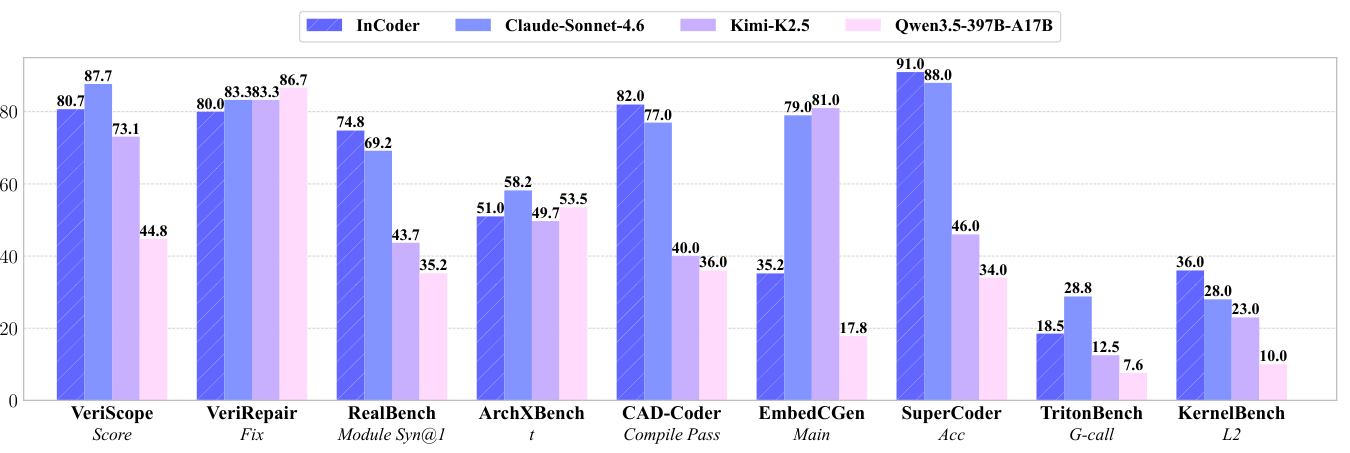
图源:InCoder-32B,Figure 4。原论文图意:InCoder 在 9 个工业 benchmark 上和 Claude-Sonnet-4.6、Kimi-K2.5、Qwen3.5-397B-A17B 等模型对比,突出其在工业代码任务上的整体优势。
论文的工业结果可以拆成两张表来读。第一张偏芯片设计:
| Model | Size | VeriScope Score | VeriRepair Fix (%) | RealBench System Syn@1 | Syn@5 | Module Syn@1 | Syn@5 | Func@1 | Func@5 | ArchXBench n | t |
|---|---|---|---|---|---|---|---|---|---|---|---|
| InCoder | 32B | 80.7 | 80.0 | 10.0 | 23.7 | 74.8 | 83.3 | 62.7 | 70.5 | 3.4 | 51.0 |
表源:InCoder-32B,Table 4 摘录。原论文表意:InCoder-32B 在 Verilog/RTL 相关的分类、修复、综合和功能通过率上显著强于多数开放模型。
第二张偏 GPU、嵌入式、代码优化和 CAD:
| Model | Size | CAD-Coder Comp. | IoU | EmbedCGen Main (%) | SuperCoder Acc. (%) | Spd. | TritonBench G-call | G-exe | T-call | T-exe | KernelBench L1 | L2 | L3 |
|---|---|---|---|---|---|---|---|---|---|---|---|---|---|
| InCoder | 32B | 82.0 | 53.5 | 35.2 | 91.0 | 1.3x | 18.5 | 100.0 | 19.3 | 93.8 | 22.2 | 36.0 | 14.0 |
表源:InCoder-32B,Table 5 摘录。原论文表意:InCoder-32B 在 CAD、embedded C、assembly / code optimization、Triton 和 KernelBench 等任务上表现出更强工业适配性。
工业 benchmark 不能只看平均分。
不同 benchmark 的得分含义差别很大。VeriRepair 是修复率,RealBench 同时看 synthesis 和 function pass,SuperCoder 同时看 accuracy 和 speedup,TritonBench 区分 generation call 和 execution,KernelBench 还按任务层级拆分。把这些数值简单平均会掩盖重要信息:有些任务是“能不能编译”,有些是“功能是否正确”,有些是“正确之后是否足够快”。
错误分析:模型还卡在哪里
论文不只报成功率,也人工检查了 1,882 个失败案例,并给出各工业 benchmark 的错误分布。
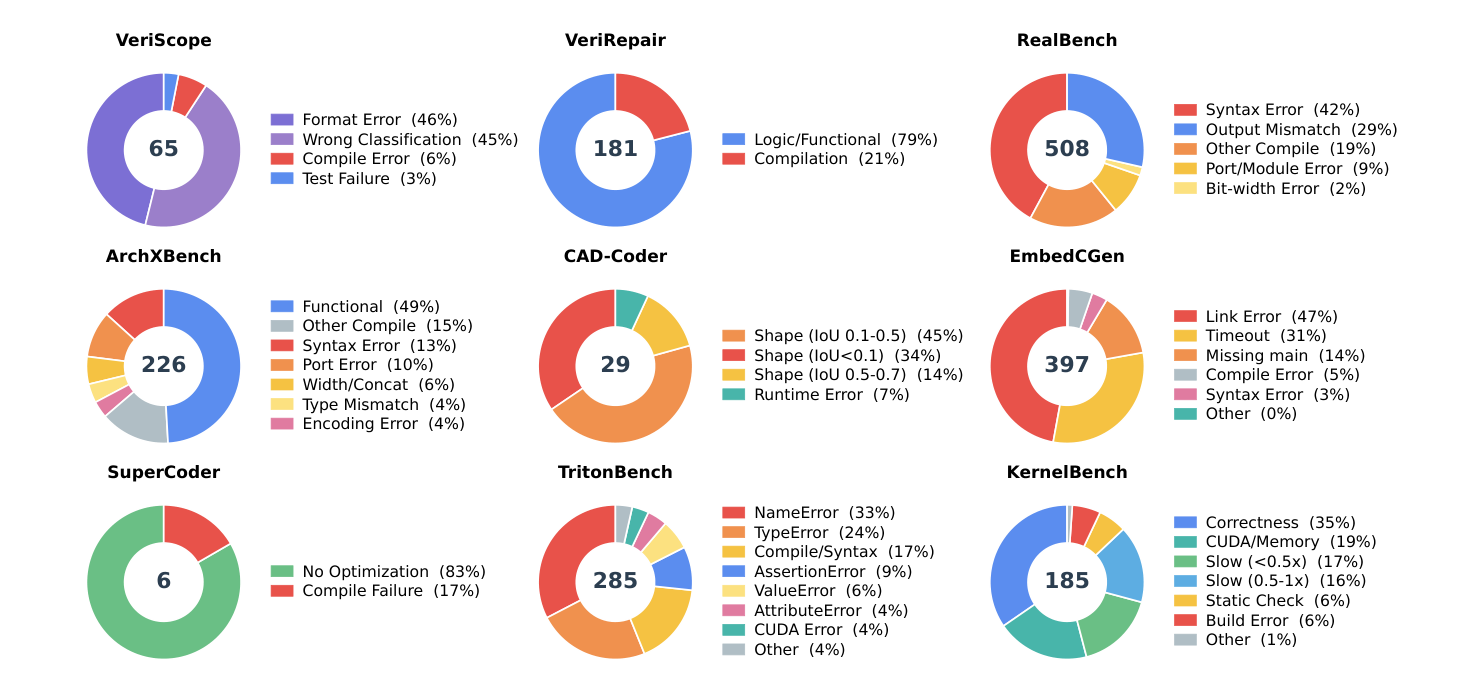
图源:InCoder-32B,Figure 5。原论文图意:作者手动检查 1,882 个失败样本,按 benchmark 统计错误类别,包括格式错误、分类错误、功能逻辑错误、编译/链接错误、timeout、CUDA/memory error 和性能不足等。
几个结论很值得记:
| Benchmark | Main Failure Modes |
|---|---|
| VeriScope | Format Error 46%, Wrong Classification 45% |
| VeriRepair | Logic / Functional 79%, Compilation 21% |
| RealBench | Syntax Error 42%, Output Mismatch 29%, Other Compile 19% |
| EmbedCGen | Link Error 47%, Timeout 31%, Missing main 14% |
| TritonBench | NameError 33%, TypeError 24%, Compile / Syntax 17% |
| KernelBench | Correctness 35%, CUDA / Memory 19%, Slow 33% combined |
这张图的价值在于提醒我们:工业代码模型的失败不是单一形态。Verilog 可能错在格式或模块接口,嵌入式 C 可能卡在链接和主函数,Triton 可能是 Python 名称和类型问题,KernelBench 可能功能正确但性能不够。后续改进也就不能只靠“更多 SFT”,而要按错误类型改数据、工具反馈、reward 或 decoding 策略。
SFT scaling:更多工业 SFT 是否有用
Figure 6 做了 SFT data scaling,从 83M tokens 扩到 250M tokens,观察工业 benchmark 的变化。
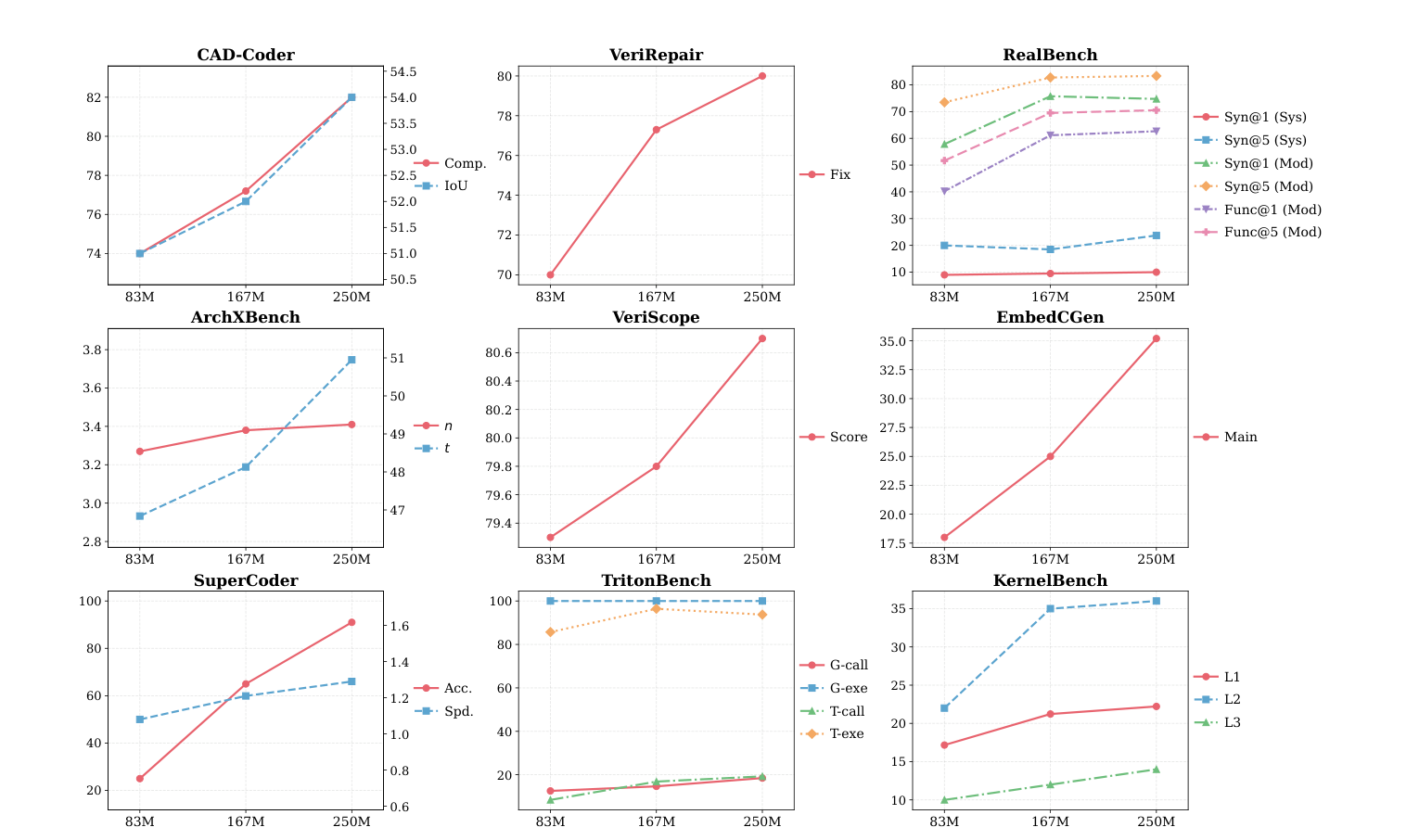
图源:InCoder-32B,Figure 6。原论文图意:随着工业 SFT token 从 83M 增加到 250M,大多数 benchmark 指标提升;少数 RealBench/TritonBench 子指标在最大数据量处有轻微回落,但整体仍显示工业 SFT 数据扩展有效。
Figure 6 怎么读。
这张图不是在说“盲目堆 SFT 一定更好”。更稳的读法是:在执行验证和数据过滤足够强的前提下,工业 SFT 数据规模仍然能推动能力上升。少数指标回落则说明混合比例、任务难度、格式分布和验证信号仍需要精调。工业 post-training 更像数据引擎问题,而不是一次性标注问题。
这篇报告真正教会我们的东西
如果只看模型大小,InCoder-32B 并不夸张;如果只看 benchmark,它也容易被读成“又一个榜单”。更有价值的是它把工业代码模型拆成了一套可复用工程模板:
| Lesson | InCoder Example |
|---|---|
| domain recall matters | 先把稀有工业语料从通用代码海洋里找出来 |
| validation must enter data pipeline | 编译、解析、仿真、性能测试不只用于最终评测,也用于清洗和后训练 |
| long context needs domain-shaped data | 128K 要训练在跨文件工程、日志、规格和工具反馈上 |
| post-training should include failures | 失败日志、counterexample、waveform diff 和 profiler bottleneck 是高价值训练信号 |
| benchmarks should be executable | 工业能力的证据来自可运行工具链,而不只是人工偏好评分 |
这也解释了为什么论文中的 Code-Flow 比单个模型 checkpoint 更重要。InCoder 的能力来自模型、数据、执行环境和评测 harness 的耦合;如果只拿 checkpoint 去一个没有工具链的普通 chat UI 里问答,很难体现它的主要价值。
局限与不能外推
这篇报告也有明显边界:
- 工业 benchmark 多数由作者构建或整合,仍需要第三方复现和更广泛的真实企业任务验证。
- 执行环境虽然比普通代码评测真实,但仍是抽象后的 harness,不等于完整生产环境。
- 错误分析显示模型仍会犯格式、接口、编译、链接、逻辑和性能错误,不能当作无需审核的自动工程师。
- 32B dense model 的训练成本很高,报告中的 4,096 GPUs、15T tokens 和多阶段数据引擎不是轻量 recipe。
- 工业代码强依赖工具链版本、硬件平台和项目约束,离线 benchmark 分数不能直接保证迁移到所有公司内部代码库。
更稳的结论是:InCoder-32B 说明工业代码模型的关键路线已经从“写代码文本”转向“在执行环境中学习和验证工程约束”。它没有终结工业软件工程,但给出了一套很清晰的训练系统蓝图。
站内延伸
- 数据质量、去重与治理:对应 InCoder 的工业代码召回、license/PII 过滤、MinHash 去重和 repo-level consolidation。
- 训练输入管线、packing 与吞吐治理:对应 15T token 预训练、长上下文样本和多任务混合。
- 后训练数据引擎与 Judge 模型:对应 execution-grounded SFT、失败反馈修复和验证过滤。
- Triton 编程模型与自动调优:对应 TritonBench、KernelBench 和 GPU kernel optimization。
- 自定义算子开发与框架集成:对应 CUDA/Triton kernel、PyTorch runtime compilation 和性能验证。
- RAG、Agent 与长上下文系统:对应 agent trajectories、long-context 工程任务和工具调用记录。
阅读结论
InCoder-32B 要按代码模型训练与工业评测读:方法重点是代码流数据、CUDA/grid 范围、SFT scaling 和 midtrain loss;实验看工业 benchmark、错误分布和能力分层。错误分布图比总分更有用,它告诉项目该补语法、API、库知识还是执行反馈;落地时还要补仓库级上下文、工具执行和安全审计。
相关阅读与下一步
- 外部材料:论文标题 arXiv 检索。
- 外部材料:Semantic Scholar 标题检索。
- 外部材料:Papers with Code 检索。
- 站内下一步:论文精读专题。
- Title: 论文专题讲解:InCoder-32B:工业代码基础模型与执行验证训练
- Author: Charles
- Created at : 2026-03-25 09:00:00
- Updated at : 2026-03-25 09:00:00
- Link: https://charles2530.github.io/2026/03/25/ai-files-paper-deep-dives-technical-reports-incoder-32b/
- License: This work is licensed under CC BY-NC-SA 4.0.