

论文专题讲解:Motus:把 latent action、世界模型和 VLA 合到一个生成框架

论文题名: Motus: A Unified Latent Action World Model。
作者: Hongzhe Bi、Hengkai Tan、Shenghao Xie、Zeyuan Wang、Shuhe Huang、Haitian Liu、Ruowen Zhao、Yao Feng、Chendong Xiang、Yinze Rong、Hongyan Zhao、Hanyu Liu、Zhizhong Su、Lei Ma、Hang Su、Jun Zhu。
机构: Tsinghua University;Peking University;Horizon Robotics。项目页另列 Shengshu。
时间 / 主题: 2025-12;具身智能 / latent action world model / MoT / UniDiffuser-style scheduler。
arXiv / 项目: arXiv:2512.13030;PDF:2512.13030;项目页:motus-robotics.github.io/motus。
GitHub / 模型: GitHub:thu-ml/Motus;HF 组织:motus-robotics。
元数据来源与核验口径: 来源:arXiv、项目页、GitHub、HF paper API;Checked Date:2026-06-17;Repro Status:Paper / official code and checkpoints reviewed, independent reproduction not claimed。
Motus 的核心不是“再做一个 VLA”,而是提出一个统一生成框架:同一个模型既能像 VLA 一样从观测和语言出动作,也能像世界模型一样给定动作预测未来观测,还能做 inverse dynamics、video generation,以及 video-action joint prediction。
这篇论文最值得精读的地方在训练配方。它试图回答一个很实际的问题:机器人 action label 稀缺、跨机器人动作空间不统一、互联网视频又没有真实控制量,动作专家怎样像 VLM / VGM 一样获得大规模预训练?Motus 的答案是把 optical flow 当成像素级 delta action,先学 latent action,再用三阶段训练和六层数据金字塔把 web / egocentric / synthetic / task-agnostic / multi-robot / target-robot 数据接起来。
它的训练贡献是什么
| 维度 | 贡献 |
|---|---|
| 统一对象 | 同时覆盖 VLA、WM、IDM、VGM、Video-Action Joint Prediction 五种分布 |
| 架构抓手 | 用 MoT 连接 Video Gen. Model、Action Expert、Understanding Expert,并通过 Tri-model Joint Attention 交换信息 |
| 训练抓手 | 用 UniDiffuser-style scheduler 给视频和动作分配不同 rectified flow timestep / noise scale |
| 动作预训练抓手 | 用 DPFlow 光流和 DC-AE 学 latent action,把 unlabeled video 的运动压成可转移动作先验 |
| 数据抓手 | 三阶段训练配六层数据金字塔,从 web data 到 target-robot demonstrations 逐步提高动作相关性 |
| 主要风险 | 统一建模和强实验结果来自论文与官方材料;仍要单独验证不同 embodiment、真实闭环安全、长 horizon rollout 漂移和第三方复现 |
证据等级与外推边界
| 论文结论 | 主要证据 | 可以吸收 | 不能直接外推 |
|---|---|---|---|
| 一个模型可以切换五种 embodied modeling mode | 架构图、训练算法、附录五种 inference algorithm、VLA / WM / IDM / VGM / joint 实验 | 用 modality timestep 控制“哪些变量干净、哪些变量要生成”是很强的统一接口 | 不能证明所有任务都适合同一个共享模型,尤其是高频力控或强接触任务 |
| latent action 能提升动作专家预训练 | Stage 2 pretrain、data pyramid、RoboTwin ablation、real-world w/o pretrain 对比 | optical flow 是比 RGB reconstruction 更直接的 motion prior,可作为跨 embodiment 中间动作空间 | 光流不等于真实控制因果,遮挡、接触力、末端约束仍可能丢失 |
| 三阶段训练优于从零或只做 Stage 1 | RoboTwin ablation:Rand. 从 77.00 到 81.86 再到 87.02 |
先让 VGM 看机器人动态,再让 action expert 看 latent action,最后对目标机器人 SFT,顺序有工程意义 | 论文没有把所有数据层、所有 loss、所有冻结策略逐项完全消融 |
| Motus 在仿真和真实任务上超过基线 | RoboTwin 50+ tasks、两种真实双臂平台、LIBERO-Long / VLABench 附录 | 结果说明统一预训练对 multi-task manipulation 有收益 | real-world 是 partial success rate,且每任务 100 trajectories;不能等同于开放家庭长期自主 |
| 官方代码和 checkpoint 已发布 | GitHub、HF 模型、README / TRAINING / INFERENCE 文档 | 可作为工程参考和复现实验起点 | 官方 release 不是 independent reproduction,硬件、数据转换和 checkpoint 匹配仍是门槛 |
论文位置
Motus 把现有具身模型拆成五类分布:
| Mode | Distribution | Meaning |
|---|---|---|
| VLA | 给当前观测和语言,直接预测动作 chunk | |
| WM | 给当前观测和动作,预测未来观测 | |
| IDM | 给一段观测轨迹,反推动作 | |
| VGM | 给当前观测和语言,生成未来视频 | |
| Video-Action Joint Prediction | 同时生成未来视频和动作 |
传统路线通常只覆盖其中一两项。VLA 强在出动作,但未必显式建模未来;视频世界模型强在生成未来,但动作接口弱;IDM 可以从想象视频回推动作,却经常依赖级联结构。Motus 的主张是:这些不是五个孤立模型,而是同一组多模态变量在不同条件化方式下的生成问题。
这也是它和 Fast-WAM 的关系。Fast-WAM 问“推理时是否必须显式生成未来视频”;Motus 问得更大:“能不能让动作、视频、语言、理解专家在一个模型里用不同模式切换”。前者更像 WAM 部署效率论文,后者更像 unified embodied foundation model 的训练 recipe。
总体架构
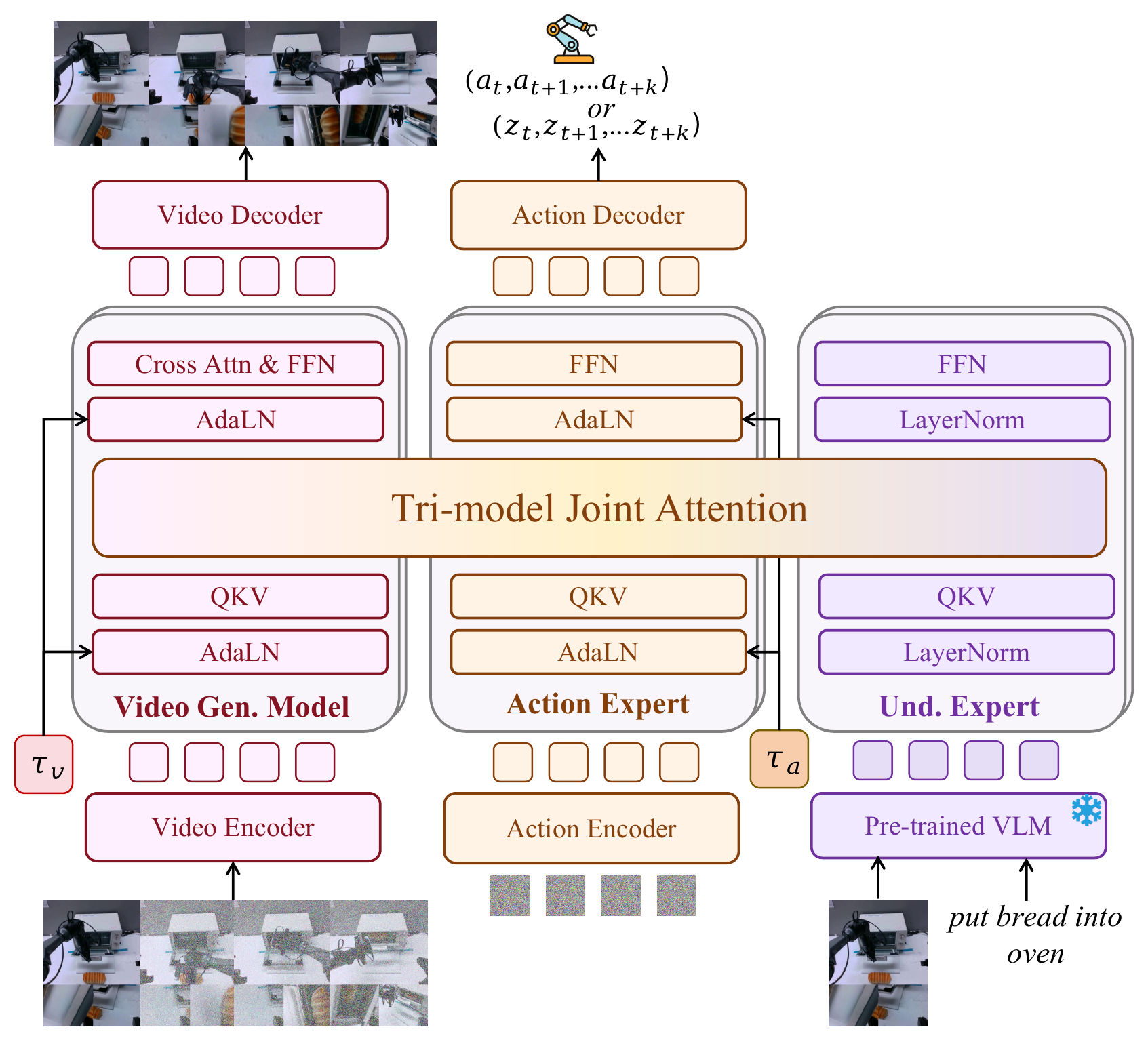
图源:Motus: A Unified Latent Action World Model,Figure 1。原论文图意:Motus 由 Video Gen. Model、Action Expert 和 Understanding Expert 三个专家组成,通过 Tri-model Joint Attention 连接; 与 分别表示视频和动作侧的 rectified flow timestep。
Figure 1 怎么读。
中间横跨三列的是 Tri-model Joint Attention。它的作用不是把三个模型简单拼接,而是让每个专家保留自己的 Transformer / FFN / normalization 结构,同时共享 attention 信息流。Video Gen. Model 负责视频 latent 的生成和解码;Action Expert 负责编码/解码动作或 latent action;Understanding Expert 接入预训练 VLM 的视觉语言理解 token。
这个设计有一个现实动机:如果从零训练一个统一 UWM,需要巨量完全对齐的语言、视频、动作数据;Motus 选择继承已有强先验。VGM 采用 Wan 2.2 5B,理解分支采用 Qwen3-VL-2B,动作专家用与 Wan 同深度的 Transformer block,并用 AdaLN 注入 rectified flow timestep。
| Component | Base / Configuration | Role |
|---|---|---|
| VGM | Wan 2.2 5B | 继承视频生成、物体外观和时序动态先验 |
| VLM | Qwen3-VL-2B | 提供 3D grounding、spatial understanding、object localization 等理解能力 |
| Action Expert | 30 layers, hidden size 1024, 24 heads | 生成 action chunk 或 latent action |
| Understanding Expert | 30 layers, hidden size 512, 24 heads | 把 VLM token 接进统一注意力 |
| Joint Attention | Tri-model Joint Attention | 在三个专家之间交换多模态特征 |
架构表里最重要的是“继承”。Motus 不把视频模型、VLM 和动作头都洗成同一个 backbone,而是在 MoT 结构里保留专家分工。这样做降低了从零训练成本,也减少了统一模型常见的任务互相干扰风险。
统一训练目标
Motus 用 rectified flow 同时预测未来动作和未来观测。对训练样本 ,分别给动作和观测采样 timestep 与噪声:
这里的关键不是公式本身,而是动作和观测可以有不同 timestep: 控制动作侧噪声, 控制视频/观测侧噪声。于是推理时只要设置哪个模态是 clean、哪个模态是 noise,就能切换不同任务。
| Inference Mode | Clean / Conditioned Part | Denoised / Generated Part |
|---|---|---|
| VGM | ,action side kept noisy | |
| World Model | ||
| IDM | ||
| VLA | ,future observation side kept noisy | |
| Video-Action Joint Prediction | and together |
这种读法很接近 UniDiffuser:同一个联合模型,通过噪声水平和条件化方式切出 marginal、conditional、joint distribution。对具身模型来说,这比“先视频生成,再 IDM 出动作”的级联方案更紧,因为模型内部已经共享了动作、视频和理解特征。
Action-Dense Video-Sparse Prediction
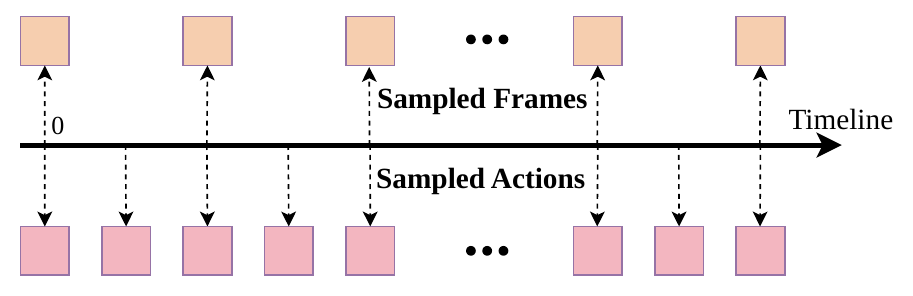
图源:Motus,Figure 2。原论文图意:动作和视频的采样频率不同,动作更密集,视频更稀疏。
机器人控制里 action chunk 通常比视频帧密得多。如果模型同时预测 个动作和 帧视频,视频 token 会压倒 action token,Tri-model Joint Attention 容易偏向视频重建,反而削弱动作预测。
Motus 的处理是 Action-Dense Video-Sparse Prediction:训练和推理时下采样视频帧,让视频 token 数和动作 token 数更平衡。论文给的例子是视频帧率设为动作帧率的六分之一。这个设计看似小,但很重要:统一模型不是把所有模态按原始频率粗暴堆在一起,而是先让 token budget 与任务目标匹配。
Latent Action:把光流变成动作预训练接口
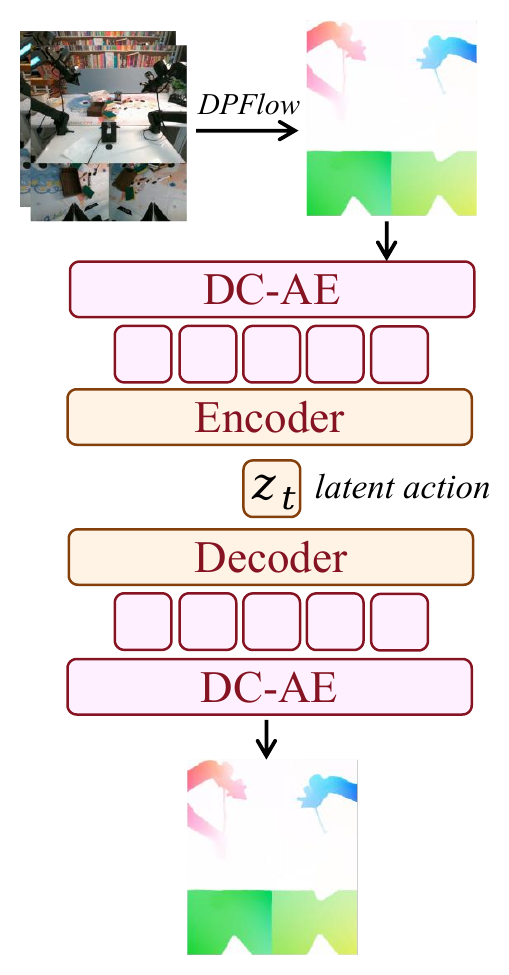
图源:Motus,Figure 3。原论文图意:用 DPFlow 从相邻帧得到 optical flow,把 flow 转成 RGB 图后经 DC-AE 和轻量 encoder 压缩成 latent action,再解码重建 flow。
Figure 3 怎么读。
Motus 把 optical flow 看作像素级 delta action。普通视频里没有机器人关节或末端控制量,但相邻帧之间的像素位移包含运动信息。先用 DPFlow 计算光流,再转成 RGB flow image;DC-AE 负责重建 flow 并编码成 4 x 512 latent tokens;轻量 encoder 再把拼接后的特征投到 14 维,接近常见机器人动作空间尺度。
这一步解决的是 action pretraining 的入口问题:
| Step | Detail | Why it matters |
|---|---|---|
| Optical flow extraction | DPFlow between adjacent frames, then RGB-format flow image | 避开 RGB 外观重建,把目标放在 motion |
| Compression | DC-AE encodes flow into four 512-dimensional tokens | 保留高容量 motion 表示,同时可接生成模型 |
| Control-level projection | lightweight encoder maps to 14-dimensional vector | 让 latent action 尺度靠近机器人动作向量 |
| Weak action supervision | 90% unlabeled reconstruction + 10% labeled trajectories |
用少量真实动作把 latent space 锚到可执行控制分布 |
| Task-agnostic alignment | Curobo randomly samples target robot action space following AnyPos | 不依赖具体任务,也能看到目标机器人可行动作范围 |
Latent Action VAE 的 loss 是:
其中 约束 flow reconstruction,第二项把 latent action 对齐真实动作,KL 项正则 latent space。附录给出的配置是 ,。
这里最容易误读的是“latent action 就是真动作”。更稳的理解是:latent action 是一个 motion-centric bridge。它能从无动作视频里抽取可共享运动先验,但最后仍要在 Stage 3 用目标机器人真实动作做 SFT,才能接到具体 embodiment。
三阶段训练与六层数据金字塔
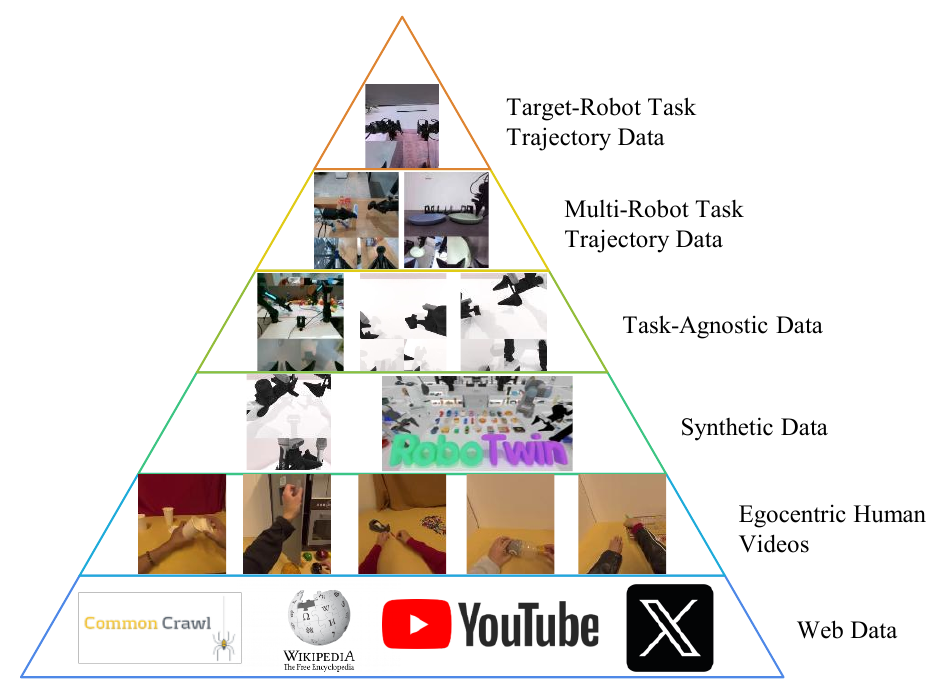
图源:Motus,Figure 4。原论文图意:数据从 Level 1 Web Data 到 Level 6 Target-Robot Task Trajectory Data,越往上数量越少、质量和策略相关性越高;论文说明 Level 3 和 Level 4 的顺序有时可能互换。
Figure 4 怎么读。
金字塔底部是 web data,数量大但离机器人动作远;中间有 egocentric human videos、synthetic data、task-agnostic data 和 multi-robot task trajectories;顶部是 target-robot demonstrations,数量最少但最能决定具体部署动作。Motus 的训练不是一次性混合所有数据,而是按阶段使用不同层级。
Table 1 from the paper can be redrawn as follows, keeping the original English fields:
| Stage | Data | Training |
|---|---|---|
| Pretrained Foundation Models (Off-the-shelf) | Level 1: Web Data | VGM and VLM |
| Stage 1 (Video Generation) | Level 2: Egocentric Human Videos Level 3: Synthetic Data Level 5: Multi-Robot Task Trajectory Data |
Only VGM |
| Stage 2 (Unified Training with Latent Actions) | Level 2: Egocentric Human Videos Level 3: Synthetic Data Level 4: Task-agnostic Data Level 5: Multi-Robot Task Trajectory Data |
Motus (all 3 experts, with latent actions) |
| Stage 3 (SFT) | Level 6: Target-Robot Task Trajectory Data | Motus (all 3 experts, with actions) |
表源:Motus,Table 1。原表含义:三阶段训练如何对应六层数据金字塔。注意论文正文同时说明 Stage 2 中 VLM frozen,因此这里的 “all 3 experts” 更稳的读法是三条专家分支进入联合训练,但预训练 VLM 主体不参与全量更新。
三阶段可以这样理解:
- Stage 1: Learning Visual Dynamics. 只训练 VGM,让 Wan 2.2 5B 的视频生成能力适应机器人操作视频。它先学“机器人任务未来看起来怎样”,不是直接出动作。
- Stage 2: Learning Action Representations. 用 videos、language、latent actions 预训练 Motus,初始化 action expert。这里最关键的是 latent action:动作专家终于能从大规模无动作或异构动作数据里学 motion prior。
- Stage 3: Specializing for the Target Robot. 用 Level 6 目标机器人轨迹做 SFT,把 latent action 和通用运动先验落到真实 action space。
附录 Table 12 gives the dataset details:
| Dataset | Size | Embodiment | Data Level in the Pyramid |
|---|---|---|---|
| Egodex | 230,949 | Human | Level 2: Egocentric Human Videos |
| Agibot | 728,209 | Genie-1 Robot | Level 5: Multi-Robot Task Trajectory Data |
| RDT | 6,083 | Aloha Robot | Level 5: Multi-Robot Task Trajectory Data |
| RoboMind Franka | 9,589 | Franka Robot | Level 5: Multi-Robot Task Trajectory Data |
| RoboMind Aloha | 7,272 | Aloha Robot | Level 5: Multi-Robot Task Trajectory Data |
| RoboTwin | 27,500 | Aloha Robot | Level 3: Synthetic Data |
| Task-Agnostic Data | 1,000 | Aloha Robot | Level 4: Task-Agnostic Data |
| In-house Data | 2,000 | Aloha Robot | Level 6: Target-Robot Task Trajectory Data |
表源:Motus,Table 12。原表含义:列出预训练和微调数据规模、embodiment 与金字塔层级。这里的 size 按论文表格记录,不代表所有数据都公开可下载。
附录 Table 13 gives the training configuration:
| Stages | Stage 1 | Stage 2 | Stage 3 |
|---|---|---|---|
| Batch Size | 256 | 256 | 256 |
| Learning Rate | |||
| Optimizer | AdamW | AdamW | AdamW |
| Weight Decay | 0.01 | 0.01 | 0.01 |
| GPU Hours | ~8000 | ~10000 | ~400 |
表源:Motus,Table 13。原表含义:三阶段训练的 batch size、learning rate、optimizer、weight decay 和 GPU hours。
训练成本读法也要谨慎。Stage 2 的 ~10000 GPU hours 是把 latent action pretraining 做起来的主要成本;Stage 3 的 ~400 GPU hours 则更像目标机器人适配成本。也就是说,Motus 的工程叙事不是“少数据直接成功”,而是“前面用大量跨源 motion prior 预训练,后面用少量目标机器人数据适配”。
官方代码口径下的训练和推理
官方 GitHub README / TRAINING / INFERENCE 文档补充了几个工程细节:
| Item | Official Setting |
|---|---|
| Training runtime | single-node torchrun + DeepSpeed, or SLURM single / multi-node scripts |
| Getting started script | scripts/train.sh with configs/robotwin.yaml |
| Fine-tune checkpoint | Stage 3 sets finetune.checkpoint_path: ./pretrained_models/Motus |
| Resume behavior | when resuming or fine-tuning, WAN and VLM pretrained weights are not reloaded; VAE is still needed |
| From scratch behavior | set both resume.checkpoint_path and finetune.checkpoint_path to null, then load Wan2.2 and Qwen3-VL pretrained weights |
| Training hardware guidance | > 80 GB VRAM, recommended A100 80GB / H100 / B200 |
| Inference memory | with pre-encoded T5 > 24 GB; without pre-encoded T5 about 41 GB |
| Real-world input format | three-view concatenated image: head + left/right wrist cameras |
这部分很适合复现前排雷。第一,Motus 不只是一个轻量 policy head,训练需要大显存和分布式脚本。第二,推理时 T5 是否预编码会直接改变显存口径。第三,real-world inference 要求三视角拼接图像,如果输入格式错了,动作预测差不一定是模型能力问题。
官方 checkpoint 也对应三阶段:
| Model | Use Case | Description |
|---|---|---|
| Motus_Wan2_2_5B_pretrain | Pretrain / VGM Backbone | Stage 1 VGM pretrained checkpoint |
| Motus | Fine-Tuning | Stage 2 latent action pretrained checkpoint |
| Motus_robotwin2 | Inference / Fine-Tuning | Stage 3 RoboTwin2 fine-tuned checkpoint |
这里可以把 Motus checkpoint 理解成“带 latent action 预训练的统一模型”,把 Motus_robotwin2 理解成“已经对 RoboTwin2 动作空间适配过的模型”。如果换真实机器人,最关键的不是直接拿 RoboTwin checkpoint 硬跑,而是数据格式、动作维度、相机拼接和 Stage 3 SFT 是否匹配。
实验设置
RoboTwin 2.0 的实验是多任务训练:50 个代表性 manipulation tasks,每个任务 50 条 clean demonstrations 和 500 条 randomized demonstrations,总计 2,500 clean + 25,000 randomized。随机化包括背景、桌面杂物、桌高扰动和光照变化。所有模型从预训练 checkpoint 出发,在 RoboTwin 上 finetune 40k steps,并按每任务 100 次执行 trial 统计 success rate。
真实实验覆盖 AC-One 和 Agilex-Aloha-2 两个双臂平台。每个任务使用 100 trajectories 训练,同一平台上的任务做 multi-task joint training。因为任务多为可分解长时程任务,论文采用 partial success rate:完成子目标给部分分,完整完成给满分。
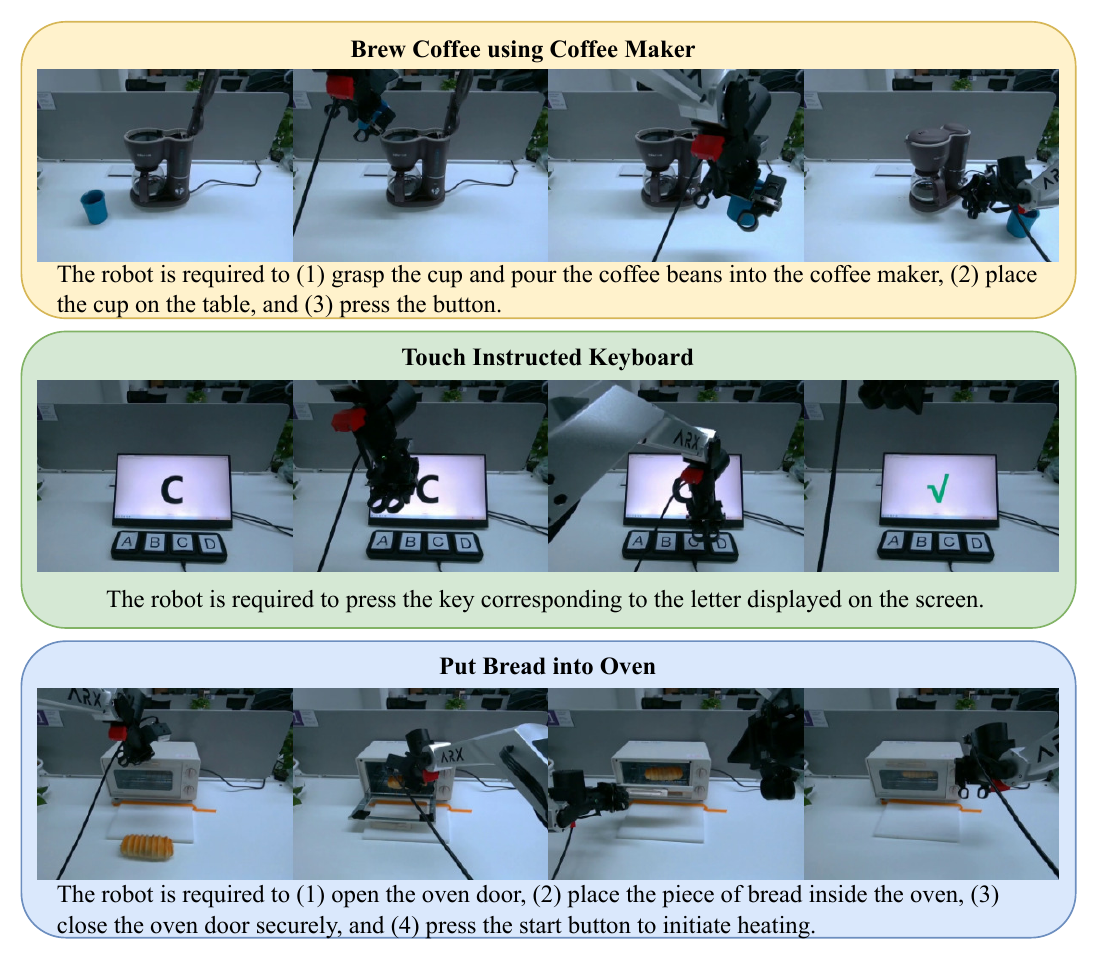
图源:Motus,Figure 5。原论文图意:展示 Brew Coffee using Coffee Maker、Touch Instructed Keyboard、Put Bread into Oven 等真实任务的语言指令和子任务定义。
Figure 5 怎么读。
这张图解释了为什么论文不用纯 success / failure。比如 Put Bread into Oven 至少包含开门、抓面包、放入、关门、按按钮等步骤;Touch Keyboard 要把屏幕识别和末端定位接起来;Brew Coffee 涉及杯子、咖啡机、放置和开关。partial success rate 更能反映长任务在哪个阶段失败,但也意味着它和一次性任务 success rate 不能直接混用。
仿真结果
Table 2 from the paper is very large. The average rows can be redrawn as follows, keeping the original English fields:
| Method | Clean | Rand. |
|---|---|---|
| 42.98 | 43.84 | |
| X-VLA | 72.80 | 72.84 |
| w/o Pretrain | 72.80 | 77.00 |
| Stage1 | 82.86 | 81.86 |
| Motus | 88.66 | 87.02 |
表源:Motus,Table 2。原表含义:RoboTwin 2.0 50+ tasks clean / randomized 设置下的平均 success rate。主文表格列出部分任务和平均值,附录 Table 14 给出含 GO-1 的完整 50 任务版本。
这张表支撑两个结论。第一,Motus 在 randomized 平均值上比 X-VLA 高 14.18 个点,比 高 43.18 个点,所以摘要中写成约 +15% 和 +45%。第二,w/o Pretrain、Stage1 和 Motus 的阶梯差异说明:只做目标数据训练不够,只有视频动态预训练也不够,Stage 2 latent action pretraining 是关键增量。
不过这里也要看边界。所有模型都在 RoboTwin 数据上 finetune 40k steps;这不是零样本仿真泛化。它测的是预训练如何影响有限 finetune 后的 multi-task success rate。
真实机器人结果
Table 3 from the paper can be redrawn as follows, keeping the original English fields:
| Task Description | w/o Pretrain | Motus | |
|---|---|---|---|
| AC-One | |||
| Fold Towel | 4 | 1 | 14.5 |
| Brew Coffee using Coffee Maker | 0 | 0 | 62 |
| Get Water from Water Dispenser | 30 | 8 | 36 |
| Place Cube into Plate | 46 | 60 | 100 |
| Place Cube into Plate(OOD) | 28.125 | 18.75 | 75 |
| Grind Coffee Beans with Grinder | 8 | 0 | 92 |
| Pour Water from Kettle to Flowers | 5 | 5 | 65 |
| Touch Instructed Keyboard | 0 | 100 | 82.5 |
| Put Bread into Oven | 12 | 40 | 42 |
| Average | 14.79 | 25.86 | 63.22 |
| Agilex-Aloha-2 | |||
| Fold Towel | 27.5 | 0 | 39 |
| Get Water from Water Dispenser | 62 | 8 | 96 |
| Pour Water from Kettle to Flowers | 45 | 40 | 47.5 |
| Touch Instructed Keyboard | 72.5 | 85 | 80 |
| Put Bread into Oven | 36 | 0 | 34 |
| Average | 48.60 | 26.60 | 59.30 |
表源:Motus,Table 3。原表含义:两个真实双臂平台上的 partial success rate。AC-One 平均从 的 14.79 到 Motus 的 63.22,Agilex-Aloha-2 平均从 48.60 到 59.30。
真实任务结果有两个值得保留的细节。第一,Motus 平均值明显更高,尤其 AC-One 上差距很大。第二,Motus 不是每个单项都赢,例如 AC-One 的 Touch Instructed Keyboard 被 w/o Pretrain 超过,Agilex-Aloha-2 的 Put Bread into Oven 被 略高。也就是说,论文强证据是平均和多数任务收益,而不是“所有任务无条件碾压”。
消融:训练阶段到底带来什么
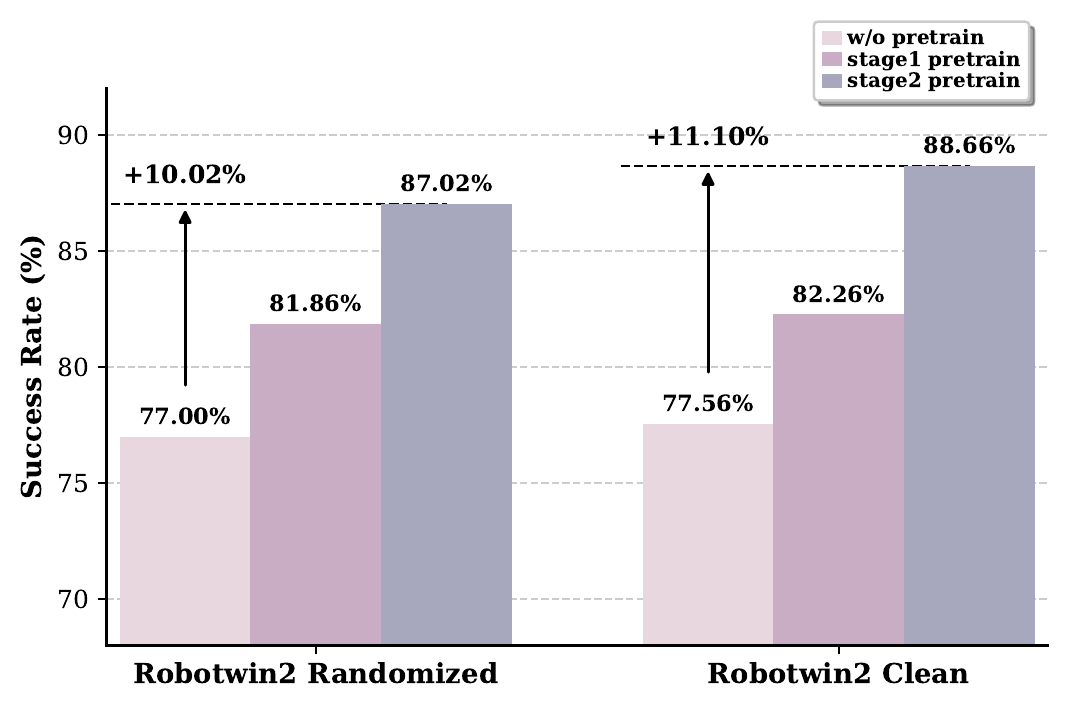
图源:Motus,Figure 6。原论文图意:RoboTwin 2.0 randomized multi-task setting 中,w/o pretrain、Stage1 pretrain、Stage2 pretrain 的总 success rate 对比。
Figure 6 怎么读。
随机化设置里,w/o pretrain 是 77.00%,Stage1 pretrain 是 81.86%,Stage2 pretrain 是 87.02%;clean 设置里分别是 77.56%、82.26%、88.66%。因此 Stage1 主要说明“让 VGM 先适应机器人视频动态有用”,Stage2 进一步说明“latent action 预训练 action expert 有用”。
这张图比最终 SOTA 表更重要,因为它回答了训练 recipe 的因果问题。Motus 的提升不是只来自模型更大或基线更弱,而是在固定同一套模型家族时,逐步加入预训练阶段会持续提升。
附录里的多模式能力
论文附录还单独报告了 Motus 在世界模型、IDM 和 VLA 模式下的结果。
| Platform | FID↓ | FVD↓ | SSIM↑ | LPIPS↓ | PSNR↑ |
|---|---|---|---|---|---|
| Agilex-Aloha-2 | 9.4571 | 49.2848 | 0.88618 | 0.05449 | 26.1021 |
| AC-One | 12.9609 | 73.1325 | 0.84605 | 0.07280 | 24.0379 |
| Avg. | 11.209 | 61.20865 | 0.8661 | 0.063645 | 25.0700 |
表源:Motus,Table 6。原表含义:World Model mode 在两种真实机器人数据上的生成质量指标。
| ResNet18+MLP | DINOv2+MLP | Motus |
|---|---|---|
| 0.044 | 0.122 | 0.014 |
表源:Motus,Table 7。原表含义:IDM mode 在 100 个 RoboTwin 2.0 randomized samples 上的 action MSE。
| Motus (VLA) | Motus (Joint) |
|---|---|
| 83.90 | 87.02 |
表源:Motus,Table 8。原表含义:RoboTwin 2.0 randomized data 上 VLA mode 与 video-action joint prediction mode 的平均 success rate。
这些附录结果说明 Motus 的 unified mode 不是只停留在架构示意。它确实能按不同条件化方式运行。不过也要注意,World Model mode 的图像指标不等同于闭环规划收益;IDM 的 MSE 是 100 samples 上的离线指标;VLA mode 比 joint mode 低 3.12 个点,说明联合预测未来视频和动作仍然可能提供额外上下文。
训练启发
Motus 给具身智能训练路线的启发可以压成四条。
第一,动作专家也需要预训练。很多 VLA 继承了语言和视觉先验,但 action head 往往只靠机器人数据从头学。Motus 通过 latent action 给 action expert 补了一个 scalable pretraining path。
第二,跨 embodiment 不一定要先统一关节或末端动作格式。Motus 先把不同来源数据对齐到 optical-flow motion space,再在目标机器人上做真实动作 SFT。这条路线适合动作空间很杂、但视觉运动模式有共享性的场景。
第三,统一模型的关键不是“所有任务一个 loss”,而是 scheduler。通过 控制哪些模态是噪声、哪些模态是条件,统一模型才真的能切换 VLA、WM、IDM、VGM 和 joint prediction。
第四,视频 token 和 action token 的比例会影响学习重心。Action-Dense Video-Sparse Prediction 提醒我们:多模态统一训练首先是 token budget 和采样率设计问题,不只是模型名义上支持多个模态。
局限和风险
第一,latent action 以 optical flow 为核心,但光流主要描述像素运动。接触力、关节限位、抓取摩擦、遮挡后的物体状态,不一定能被光流完整表达。因此它适合作为 motion prior,不应被当成完整控制状态。
第二,真实机器人实验使用 partial success rate,且每任务 100 trajectories。这个指标更适合拆长任务进度,但不等价于工业部署所需的完整成功率、失败恢复率、安全边界或长时间 unattended operation。
第三,数据金字塔里的多源数据并不都等价可获得。论文列出 in-house data 和多个外部数据集,官方代码发布不代表每个数据源、训练混合比例和所有实验细节都能完全复刻。
第四,统一模型会带来工程复杂度。VGM、VLM、action expert、understanding expert、VAE、T5 预编码、三视角拼接和分布式训练脚本都要对齐。对小团队来说,先复现 Stage 3 fine-tuning 或 RoboTwin inference,比直接重训 Stage 1/2 更现实。
阅读结论
Motus 是一篇很值得放进具身智能专题的前沿系统论文。它的价值不只在分数,而在把“动作专家如何获得大规模预训练”讲成了一个可执行 recipe:optical flow latent action、三阶段训练、六层数据金字塔、MoT 三专家和 UniDiffuser-style scheduler。最可复用的是训练结构和多模式推理接口;最不能过度外推的是开放真实环境长期自主、第三方复现和光流对接触物理的完整表达。下一步最需要看的证据,是官方代码在不同机器人上的独立复现、更多 Stage 2 数据/损失消融,以及 real-world closed-loop failure trace。
- 站内下一步:Fast-WAM:训练时学世界,推理时不生成未来。
- 站内下一步:π0.5:开放世界 VLA。
- 站内下一步:VLA 数据、模型与评测路线图。
- Title: 论文专题讲解:Motus:把 latent action、世界模型和 VLA 合到一个生成框架
- Author: Charles
- Created at : 2026-06-23 09:00:00
- Updated at : 2026-06-23 09:00:00
- Link: https://charles2530.github.io/2026/06/23/ai-files-paper-deep-dives-embodied-ai-motus/
- License: This work is licensed under CC BY-NC-SA 4.0.