

基础知识:MoE 与大模型架构:总参数、激活参数和路由成本

读 DeepSeek、Qwen、Kimi、Gemini、Nemotron 这类技术报告时,最容易被一张模型规模表带偏:Total Params、Activated Params、Experts、Top-k、MLA/GQA、MTP、FP8/FP4 全部挤在一起。真正要读懂它,不是背模型名字,而是先分清:MoE 改的是容量和计算分配,MTP 改的是预测头,Mamba/SSM 改的是序列状态路径,低精度改的是数值和硬件执行。
这一页补的是“读架构表”的前置知识。它不是部署路由教程,而是帮你在技术报告里看懂稀疏专家模型到底怎样训练、怎样算账、怎样影响推理。
可以先把这页当成一张入门地图:它把零散术语连成“输入、变化、输出”三件事。先不用背模型名,先看清哪一步在改变信息,哪一步在改变成本。
核心问题
MoE 最容易被误读成“参数很多,所以能力强;激活参数少,所以推理便宜”。这两个判断都不够。真正要看的是:总参数给了多少容量,router 每个 token 激活了多少专家,训练时专家有没有被均衡使用,推理时 token dispatch 和 all-to-all 有没有把节省的计算吃掉。
因此读 MoE 不要从模型名字开始,而要从一条 token 的路径开始:hidden state 进入 router,router 选出少数 expert,系统把 token 发到对应 expert,expert MLP 算完再合回来。这个路径既是模型结构,也是训练稳定性和硬件成本的来源。
先把核心问题立住
MoE(Mixture of Experts)的核心是:把 Transformer block 里的 dense MLP 换成多个 expert MLP,再用 router 为每个 token 只选择少数几个 expert。
flowchart LR
    X["Token hidden state
h"] --> A["Attention"]
    A --> R["Router / gate"]
    R --> E1["Expert 3"]
    R --> E2["Expert 17"]
    R --> E3["Shared expert
(optional)"]
    E1 --> C["Weighted combine"]
    E2 --> C
    E3 --> C
    C --> Y["Next hidden state"]
这张图的重点是位置和稀疏性。MoE 通常替换 Transformer block 中的 FFN/MLP 子层,而不是 attention 本身。一个 token 不会经过所有专家,只会经过 router 选中的少数专家;这就是为什么 MoE 可以有很大的总参数量,但每个 token 的激活计算量相对小。
MoE 公式怎么读
MoE router 可以看成每个 token 的 Top-K 选择问题。负载均衡 loss 则是在主任务 loss 之外约束 expert 使用分布,避免少数 expert 过热、其他 expert 闲置。更细的算法推导可以读 Datawhale 的 MoE Router 入门。
从复杂度上看,router Top-K 通常要扫描 个 expert 分数,代价约为 到 ,只保留 个 active expert 索引;expert 计算近似随 线性增长,但系统还要额外准备 token dispatch 和 combine buffer。也就是说,MoE 的难点不只在数学上的 top-k,还在稀疏调度、负载均衡和跨设备通信。
最小读法:router 先给 expert 打分,选 top-k 个 expert 处理当前 token,再把这些 expert 的输出按权重合回来。
Dense 与 MoE 的差别
Dense 模型里,每个 token 都经过同一套 MLP 参数;MoE 模型里,每个 token 会被分配给少数 expert。
| 对比项 | Dense MLP | MoE MLP |
|---|---|---|
| 参数使用 | 每个 token 使用同一套 FFN 参数 | 每个 token 只使用 top-k expert 和可能的 shared expert |
| 容量来源 | 增大隐藏维度、层数或 FFN 宽度 | 增加 expert 数量,让不同 token 走不同参数 |
| 单 token 计算 | 接近总 FFN 规模 | 接近被激活 expert 的规模 |
| 训练难点 | 优化稳定、显存、吞吐 | router 负载均衡、expert specialization、通信和稳定性 |
| 推理难点 | attention/KV、batch、kernel | token dispatch、all-to-all、hot expert、expert batch size |
MoE 的一个常见误读是:看到 671B、1T 之类的总参数,就把它等同于每个 token 的计算量。实际要分两层看:
Total Params:模型仓库里一共存了多少参数,代表容量和存储成本。Activated Params:单个 token 前向时大约用了多少参数,更接近 per-token compute。
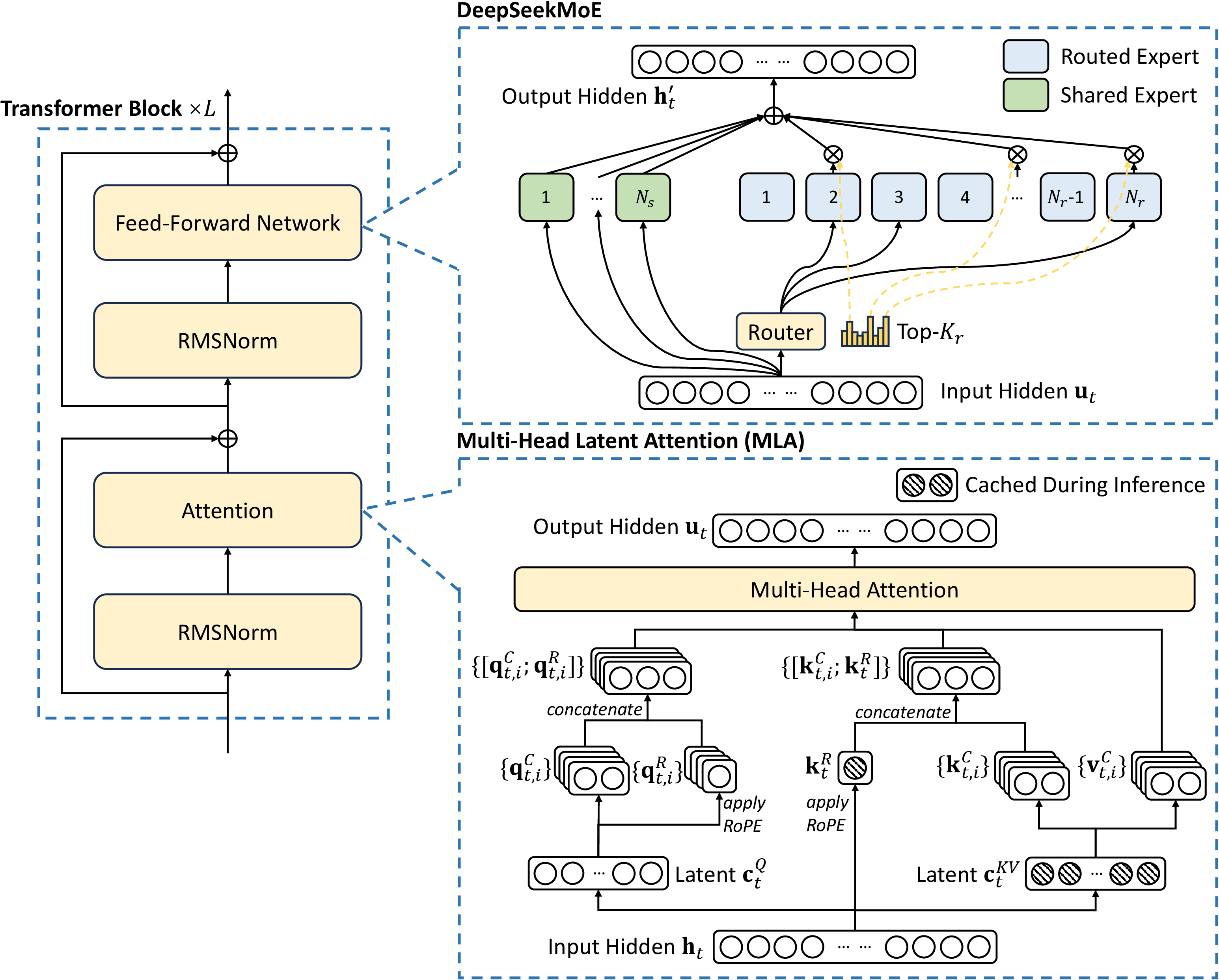
图源:DeepSeek-V3 Technical Report,Figure 2。原论文图意:DeepSeek-V3 的 Transformer block 采用 MLA 和 DeepSeekMoE;MLA 用压缩 latent 降低 KV cache,DeepSeekMoE 由 shared experts 和 routed experts 共同组成。
这张图应先看右侧 DeepSeekMoE 放大框,再回到左侧 Transformer block。shared experts 是所有 token 都能走的公共能力;routed experts 是 router 按 token 选择的专家;MLA 是 attention/KV 路径的压缩,不是 MoE 本身。对应到公式,就是 。最容易误读的是把 MLA 和 MoE 混成一件事:MLA 主要省 KV cache,MoE 主要改变 FFN 容量和激活计算。
一个 token 怎么走过 MoE
MoE 层的计算可以写成:
其中 是 token 的 hidden state, 是 router, 是第 个 expert, 是 top-k 后重新归一化的权重。很多现代 MoE 还会加入 shared expert:
sequenceDiagram
    participant T as Token h
    participant R as Router
    participant D as Dispatch
    participant E as Selected experts
    participant C as Combine
    T->>R: compute routing scores
    R->>D: choose top-k experts
    D->>E: group tokens by expert
    E->>C: expert MLP outputs
    C->>T: weighted sum + residual path
这张流程图里最容易漏掉的是 Dispatch:训练和推理时,token 不是在原地挨个跑 expert,而是会按 expert 分组,再发到对应设备。大规模 MoE 的系统成本,很多时候就卡在 dispatch/combine 和跨卡通信。
架构表先看哪几列
技术报告里的模型表不要从 benchmark 分数开始读,先把下面几列翻译成成本账。
| Field in reports | 应该怎么读 | 常见误读 |
|---|---|---|
Total Params |
所有 dense 权重、expert 权重、embedding 等参数总和 | 误以为每个 token 都会用到全部参数 |
Activated Params |
单个 token 前向实际激活的大致参数量 | 误以为它能单独决定 latency |
# Experts |
总 expert 数量,通常只在 MoE FFN 层出现 | 误以为 expert 越多一定越快 |
Top-k / Activated Experts |
每个 token 选择几个 routed experts | 忽略 top-k 增大会增加计算和通信 |
Shared Experts |
所有 token 都会经过的公共 expert | 把 shared expert 当成普通 routed expert |
Routed Experts |
由 router 动态选择的 expert | 忽略 router 负载不均会造成 hot expert |
Expert Hidden Size |
每个 expert MLP 的中间维度 | 只看 expert 数,不看单个 expert 的宽度 |
Layers |
MoE 是否每层都有,还是只在部分层替换 FFN | 误以为“MoE 模型”代表所有层都是 MoE |
Attention Heads / KV Heads |
attention 路径的计算和 KV cache 成本 | 把 MoE 的节省错误归到 attention 上 |
Context Length |
长上下文会放大 attention、KV 和通信压力 | 只看参数量,不看序列长度 |
Precision |
BF16、FP8、FP4、NVFP4 等数值和硬件路径 | 把存储格式等同于计算格式 |
Parallelism |
TP、PP、DP、EP、CP 如何切分模型和序列 | 忽略 EP/all-to-all 对 MoE 吞吐的影响 |
最短读法是先问四个问题:总参数有多大,单 token 激活多少,每个 token 选几个专家,专家分布在几张卡上。这四个问题答出来后,再看 benchmark 和训练细节才不会被一个规模数字带偏。
Router 训练到底训练什么
MoE 训练不是只把很多 MLP 拼起来。Router 决定 token 走哪些 expert,因此它同时影响模型能力、梯度分配和系统负载。
flowchart TB
    A["Language modeling loss
or multimodal loss"] --> B["Selected experts get gradients"]
    A --> C["Router scores get gradients"]
    C --> D["Expert specialization"]
    C --> E["Load balancing"]
    E --> F["Avoid hot experts
avoid dropped tokens"]
    D --> G["Capacity grows without dense compute growth"]
| 训练细节 | 为什么重要 | 读论文时要找什么 |
|---|---|---|
| Router softmax / sigmoid | 决定 token 到 expert 的概率分配 | router logits、top-k、是否重新归一化 |
| Top-k selection | 决定单 token 计算量和 expert 覆盖 | top-1、top-2、top-8 等设置 |
| Load balancing loss | 避免所有 token 挤到少数 expert | auxiliary loss、balance coefficient、token fraction |
| Auxiliary-loss-free balancing | 用动态 bias 等方式平衡负载,减少主目标干扰 | 是否报告无辅助损失路由或 bias update |
| Capacity factor | 限制每个 expert 一步能接多少 token | overflow、dropless routing、token dropping |
| Shared expert | 承担通用模式,给 routed experts 留出专业化空间 | shared/routed expert 数量和激活方式 |
| Expert parallelism | expert 分布在不同设备上 | EP group、all-to-all、communication overlap |
| Router stability | 防止训练早期 expert collapse | router z-loss、初始化、warmup、噪声策略 |
常见的 load balancing 直觉是:如果 expert 收到的 token 比例是 ,router 给它的平均概率是 ,那么训练会惩罚“高概率但负载不均”的分布。论文公式可能不同,但目标通常类似:
这里的重点不是背公式,而是理解:MoE 需要一套机制保证专家被充分使用,否则总参数再大也只是摆设。
为什么 Active Params 仍不等于延迟
Activated Params 更接近单 token 计算量,但它仍然不是实际延迟。推理延迟还受下面这些因素影响:
flowchart LR
    A["Input tokens"] --> B["Attention / KV cache"]
    B --> C["Router"]
    C --> D["All-to-all dispatch"]
    D --> E["Expert GEMM"]
    E --> F["All-to-all combine"]
    F --> G["Next layer"]

    B -.-> H["Context length"]
    D -.-> I["Network topology"]
    E -.-> J["Expert batch size"]
    F -.-> K["Load balance"]
| 成本项 | 对 MoE 的影响 |
|---|---|
| Attention / KV cache | MoE 通常不减少 attention 的 prefill 或 decode KV 读写成本 |
| All-to-all communication | expert 放在不同卡上时,token dispatch/combine 会引入通信 |
| Expert batch size | 每个 expert 收到的 token 太少,GEMM 会变碎,GPU 利用率下降 |
| Hot experts | 少数 expert 过热会拖慢整个 batch |
| Decode batch | 自回归 decode 每步 token 少,MoE 通信和调度开销更明显 |
| Quantization support | expert 权重低比特不代表 router、activation、通信都低成本 |
| Kernel fusion | router、dispatch、expert MLP、combine 是否融合会影响真实吞吐 |
所以读技术报告时,不要只看“active params 比 dense 小”。还要看作者有没有报告 tokens/s、latency、MFU、通信重叠、batch setting、context length 和硬件拓扑。
MoE 和其他结构不要混
大模型报告常把 MoE、MTP、Mamba、MLA/GQA、Muon、FP8/FP4 放在同一段里。它们属于不同层。
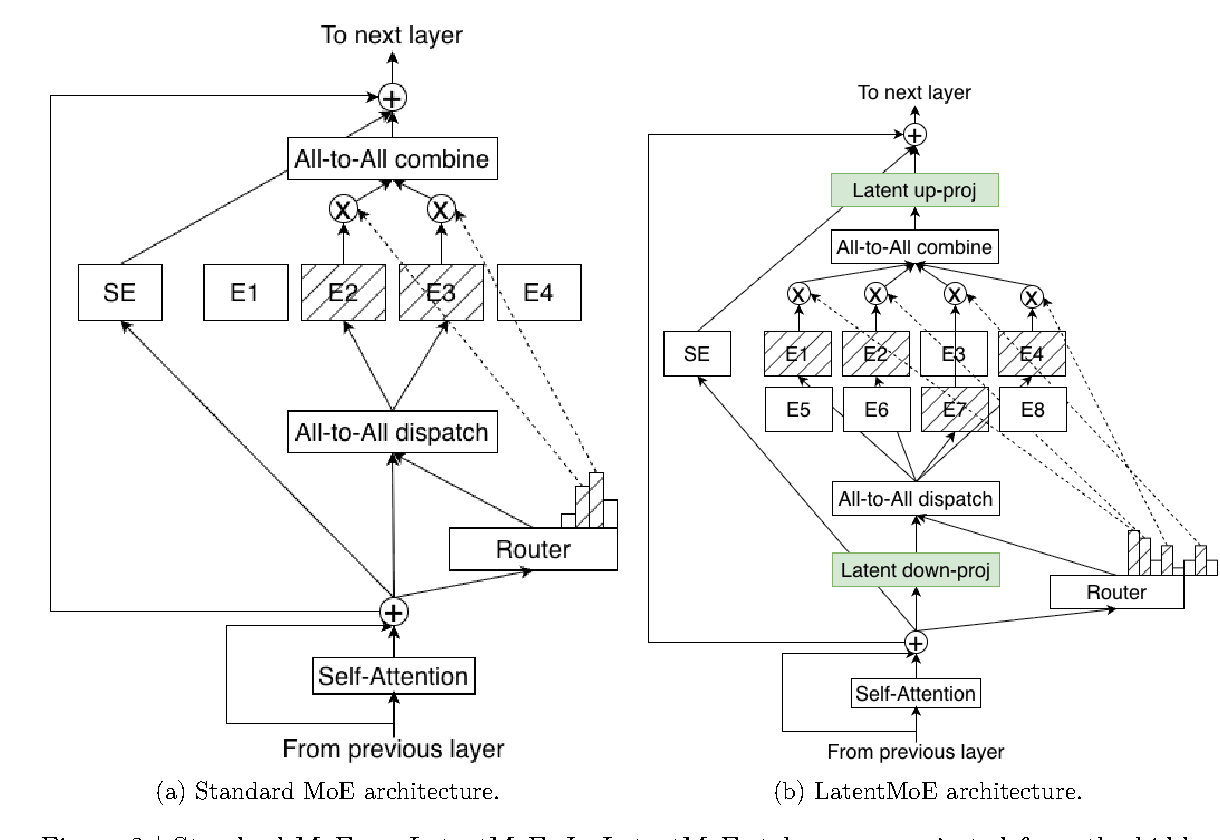
图源:Nemotron 3 Super Technical Report,Figure 3。原论文图意:LatentMoE 用 latent routing 组织专家选择,并把稀疏专家能力接入大模型主干。
再看 Nemotron 图,是为了提醒读者不要把某一个模型的 MoE 画法套到所有报告上。读这类图时先找 router 或 latent routing 的位置,再看 token/hidden state 如何进入专家;不同报告里的细节会变,但核心总是 token 表示、router、专家计算和 combine。它帮助你读懂“专家怎么被选中”,而不是只看模型表里的专家数量。
| 名词 | 改的是哪一层 | 主要解决什么 | 不要误解成 |
|---|---|---|---|
| MoE | FFN/MLP 容量与稀疏激活 | 用更大总容量服务不同 token | 直接减少 attention 或 KV cache |
| MTP | 预测头和训练目标 | 训练模型预测未来多个 token,服务投机或规划信号 | 一种 MoE 路由方法 |
| Mamba / SSM | 序列建模路径 | 用 recurrent state 降低长序列状态成本 | 一种专家模型 |
| GQA / MLA | Attention 和 KV 表示 | 降低 KV cache 或 attention 表示成本 | MoE 的替代品 |
| FP8 / FP4 / NVFP4 | 数值格式与硬件执行 | 降低显存、带宽或提升 GEMM 吞吐 | 自动提升模型能力 |
| Muon / MuonClip | 优化器更新几何 | 稳定或提升大规模预训练效率 | 推理加速技术 |
| EP / all-to-all | 分布式执行 | 把 expert 分到多卡并完成 token 交换 | 模型结构本身 |
如果一篇报告说“模型是 Mamba-MoE、带 shared-weight MTP、支持 FP8/NVFP4”,可以按这条路径拆:
flowchart TB
    A["Backbone path
Attention / Mamba / Hybrid"] --> B["Capacity path
Dense FFN or MoE"]
    B --> C["Prediction path
LM head / MTP head"]
    C --> D["Training path
optimizer / data / precision"]
    D --> E["Serving path
KV / routing / quant / parallelism"]
训练相关细节怎么补读
MoE 技术报告里和训练最相关的不是“用了多少专家”本身,而是下面这条链:
MoE 的训练 recipe 往往比架构名更关键。一个专家数更多的模型,如果 router 负载不稳、expert batch 太碎、低精度保护不足,真实训练效率可能反而更差。读报告时要把训练数据、router 分布、expert specialization、load balance 和系统吞吐连起来看。
系统读法:从专家到硬件
MoE 的系统执行通常会引入 Expert Parallelism(EP):不同 expert 放在不同 GPU 上,token 根据 router 结果被发到对应设备。
flowchart LR
    subgraph GPU0
        A0["tokens"] --> R0["router"]
        E0["expert 0/1"]
    end
    subgraph GPU1
        A1["tokens"] --> R1["router"]
        E1["expert 2/3"]
    end
    R0 --> X["all-to-all dispatch"]
    R1 --> X
    X --> E0
    X --> E1
    E0 --> Y["all-to-all combine"]
    E1 --> Y
读系统表时要特别看:
- EP group size:expert 分在多少张卡上;
- all-to-all 是否和 expert GEMM overlap;
- expert batch 是否足够大;
- router 和 dispatch 是否 fused;
- prefill 和 decode 是否分别报告;
- benchmark 的 batch size、context length、hardware topology 是否公开;
- 训练吞吐和推理吞吐是否混在一个结论里。
技术报告应该怎样拆
读一篇大模型技术报告时,先按下面顺序把 claim 拆开。这样做不是为了机械打勾,而是避免把“模型规模、训练 recipe、系统吞吐、后训练效果”混成一个结论。
- 结构表:是 dense、MoE、hybrid MoE,还是 Mamba-MoE?MoE 出现在多少层?
- 参数表:
Total Params和Activated Params分别是多少?top-k 是多少? - 专家表:shared experts、routed experts、expert hidden size、capacity 或 dropless 设置是什么?
- 训练表:数据 mixture、训练 token、optimizer、precision、router balance 策略是否讲清?
- 系统表:TP/PP/DP/EP/CP 如何组合?有没有 all-to-all、MFU、tokens/s、latency?
- 后训练表:SFT、reward、RL、distillation 是否改变能力结论?
- 证据表:benchmark、ablation、safety、system profiling 分别支持哪类 claim?
| 报告类型 | 重点看什么 | 回到本站哪里读 |
|---|---|---|
| DeepSeek-V3 / V4 | DeepSeekMoE、MLA、auxiliary-loss-free routing、FP8、MTP、并行训练 | DeepSeek-V3 讲解、DeepSeek-V4 讲解 |
| Qwen3 / Qwen3.5-Omni | dense/MoE 版本、thinking、omni 模态、后训练和部署边界 | Qwen3 讲解、Qwen3.5-Omni 讲解 |
| Kimi K2 | 大规模 MoE、MuonClip、agentic data、tool-use 后训练 | Kimi K2 讲解、优化与训练入门 |
| Nemotron 3 Super | Mamba-heavy hybrid backbone、LatentMoE、shared-weight MTP、NVFP4/FP8 | Nemotron 3 Super 讲解、Mamba 与混合 SSM 架构 |
| Gemini 2.5 / System Card | sparse MoE、long context、dynamic thinking、安全与产品证据 | Gemini 2.5 讲解、数据划分与评测指标 |
最容易犯的六个错
| 错误读法 | 更稳的读法 |
|---|---|
| 总参数越大,推理一定越慢 | 先看 activated params,再看 attention/KV、通信、batch 和硬件 |
| Activated params 小,所以 latency 一定低 | MoE 可能被 all-to-all、hot expert、碎 GEMM 卡住 |
| Expert 越多,能力一定越强 | 还要看数据、router、负载均衡、训练 token 和后训练 |
| MoE 省的是所有计算 | MoE 主要稀疏化 FFN,attention/KV 仍要单独处理 |
| Shared expert 是可有可无的细节 | shared expert 会影响通用知识和 routed expert 专业化 |
| MoE Serving 路由和模型内 MoE router 是一回事 | 前者是请求/模型级调度,后者是 token/expert 级模型结构 |
外部精读
- The Sparsely-Gated Mixture-of-Experts Layer:MoE router、top-k、capacity 和 load balancing 的早期经典来源。
- GShard:把稀疏专家、自动并行和大规模训练放到系统语境里。
- Switch Transformer:top-1 routing、capacity factor 和负载均衡的入门读物。
- Hugging Face: Mixture of Experts Explained:适合用图和直觉理解 expert、router、capacity 和推理代价。
- DeepSpeed MoE Tutorial:从系统角度理解 expert parallelism、通信和训练配置。
读完这一页,再读技术报告时应该能做到:看到一张模型表,先把参数容量、激活计算、路由训练、通信成本和证据强度拆开,而不是被一个大模型规模数字带着走。
- Title: 基础知识:MoE 与大模型架构:总参数、激活参数和路由成本
- Author: Charles
- Created at : 2025-06-21 09:00:00
- Updated at : 2025-06-21 09:00:00
- Link: https://charles2530.github.io/2025/06/21/ai-files-foundations-moe-and-large-model-architecture-basics/
- License: This work is licensed under CC BY-NC-SA 4.0.