

论文专题讲解:DMD:一步扩散蒸馏

- 论文:
One-step Diffusion with Distribution Matching Distillation - 方法:
Distribution Matching Distillation,简称DMD - 链接:arXiv:2311.18828
- 版本:2023-11-30 首次提交,2024-10-04 更新到 v4
- 会议:CVPR 2024
- 项目页:DMD
- 关键词:one-step diffusion、distribution matching、fake score、real score、reverse KL、regression loss、Stable Diffusion distillation
这篇论文是后来 DMD2、CausVid、Phased DMD 一系列少步扩散蒸馏方法的基础。它的核心思想很直接:不要强迫学生模型逐步复刻 teacher 的采样轨迹,而是让学生的一步输出分布看起来像 teacher 的多步输出分布。
论文把这个目标落成两个损失:
- Distribution Matching Loss:用 real score 和 fake score 的差异近似 reverse KL 梯度,把生成器输出往真实扩散分布推;
- Regression Loss:预先生成一批 noise-image pairs,用 LPIPS 让一步生成器保持 teacher 输出的大尺度结构,防止 mode collapse / mode dropping。
论文位置
传统扩散加速主要有两类:
| Route | Main idea | Limitation |
|---|---|---|
| Fast samplers | keep the same pretrained denoiser and improve ODE/SDE integration | very few steps often collapse in quality |
| Trajectory distillation | train a student to mimic teacher noise-to-image trajectories | each target pair requires expensive teacher sampling, and exact trajectory matching is too hard |
| DMD | match output distribution with score difference, plus a regression regularizer | one-step model is fast, but training needs fake score model and paired teacher outputs |
DMD 的关键转向是:它不再问“同一个 noise 经过 teacher 50 步会到哪里,student 一步是否也到那里”,而是问“student 产生的一批图像整体上是否落在 teacher / real data 分布里”。这也是它和 Phased DMD 的关系:Phased DMD 后来要解决的 SGTS 退化、SNR 子区间、MoE phase 等问题,都建立在 DMD 这套 real/fake score 差分框架上。
方法总览
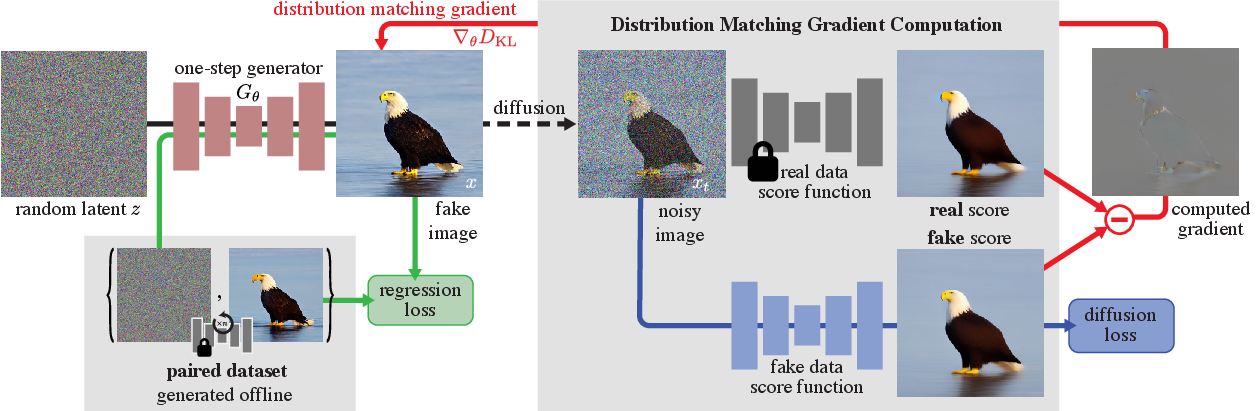
图源:One-step Diffusion with Distribution Matching Distillation,Figure 2。原论文图意:一步生成器 从随机噪声生成 fake image;一条支路用预计算 noise-image pairs 做 regression loss,另一条支路把 fake image 加噪后分别送入 real score diffusion model 和 fake score diffusion model,用两者差异形成 distribution matching gradient。
这张图最容易被误读成“DMD 只是给一步生成器加了一个扩散判别器”。更准确的读法是:它同时有一条分布级路径和一条配对回归路径。分布级路径从 generator 产生的 fake image 出发,加噪到 ,再分别送入 frozen real score model 和 trainable fake score model;两个 score 的差值给 generator 一个“往 teacher/data 分布移动”的方向。
另一条 regression 路径则完全不同:它不关心一批样本整体像不像 teacher 分布,而是拿同一个 noise 对齐 teacher deterministic sampler 生成的 。这条路径像安全绳,防止纯 reverse-KL 分布匹配出现 mode dropping 或结构漂移。理解 DMD 时要把这两条信号分开:score difference 负责真实感和分布对齐,regression loss 负责保住 teacher 对同一 noise 的大尺度语义映射。
DMD 的训练图可以拆成四个对象:
| Object | Meaning | Updated? |
|---|---|---|
| Base diffusion model / | pretrained diffusion teacher, estimates real score | frozen |
| One-step generator | same denoiser architecture, no time conditioning, maps noise directly to image | trainable |
| Fake diffusion model | estimates score of current generator distribution | trainable |
| Paired dataset | noise and deterministic teacher output | precomputed |
最终训练时,生成器同时收到两类信号:
1 | distribution matching gradient: |
这使 DMD 同时具备两种性格:distribution matching 让图像变真实,regression loss 让它不要丢掉 teacher 对同一 noise 的结构映射。
为什么不用纯轨迹回归
如果只用 teacher 采样得到的 训练一步生成器,本质上是在学习一个复杂的 noise-to-image 映射:
这个映射非常难学。teacher 的多步采样轨迹在高维空间里很复杂,学生一步网络要同时学到全局构图、局部纹理、语义对齐和随机性,很容易输出模糊或结构不稳定的图像。
DMD 的判断是:轨迹回归可以做 regularizer,但不能作为唯一目标。真正决定视觉质量的是分布级约束:学生输出应该落在 teacher / real data 的高密度区域,而不是只和单个 teacher sample 做点对点拟合。
DMD 的 Score 差分
设一步生成器输出:
DMD 想最小化 fake distribution 到 real distribution 的 reverse KL:
对 求梯度时,会出现两个 score:
其中:
直觉上:
| Score | Effect |
|---|---|
| pulls fake samples toward high-density regions of real / teacher distribution | |
| prevents all fake samples from collapsing into the same nearest real mode | |
| move toward realism while spreading across fake modes |
这个设计和 GAN 的判别器不同。DMD 不训练一个 binary discriminator,而是用 diffusion model 估计 noised distribution 的 score。
为什么要先加噪再算 Score
干净图像空间里,fake distribution 和 real distribution 很可能几乎不重叠。此时 对 fake sample 可能接近 0,score 会不稳定。
DMD 的做法是把 fake sample 加噪:
加噪后,real 和 fake 的分布会在 ambient space 里有更大重叠,score matching 才稳定。
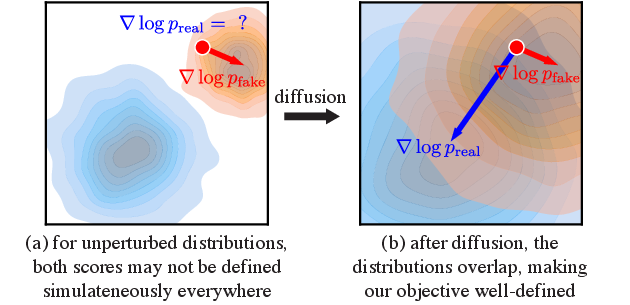
图源:One-step Diffusion with Distribution Matching Distillation,Figure 4。原论文图意:未加噪时 real / fake distributions 可能不重叠;经过 diffusion perturbation 后,distribution matching objective 在空间中更好定义。
左侧直觉是 real distribution 和 fake distribution 在原始图像空间里可能几乎不重叠,这时直接比较梯度很容易得到不稳定或没意义的方向。加上 diffusion perturbation 后,两个分布被高斯噪声“抹宽”,在同一个 ambient space 里产生更大重叠,score difference 才能提供连续的移动方向。DMD 不是在原图上硬判真假,而是在不同噪声强度下比较 real score 和 fake score,让 generator 逐步靠近 teacher / data 分布。
real score 由冻结 teacher diffusion model 给出:
fake score 由动态训练的 fake diffusion model 给出:
生成器的 distribution matching 梯度近似为:
注意符号:实现里通常把这个方向写成一个可反传的 surrogate loss;核心仍然是 fake score 和 real score 的差。
Fake Score 为什么要动态训练
fake distribution 会随着 更新不断变化。因此 不能是固定模型,而要持续跟踪当前生成器输出。
它用标准 denoising objective 训练:
这里的 clean target 不是真实数据,而是当前 generator 的 fake image。也就是说, 学的是“当前 fake distribution 被加噪后的 score”。这点后来在 DMD2、CausVid、Phased DMD 中都保留下来,只是训练对象从图像扩展到视频、因果学生或 SNR 子区间。
Regression Loss 的作用
DMD 不能只靠 distribution matching。论文用二维 toy 分布说明了原因。
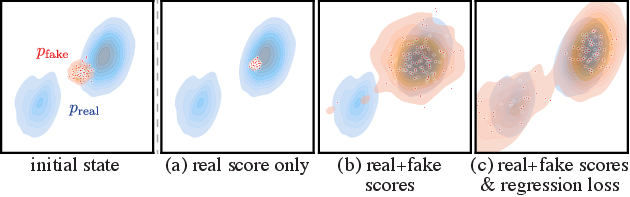
图源:One-step Diffusion with Distribution Matching Distillation,Figure 3。原论文图意:只最大化 real score 会让 fake samples 塌到最近模式;有 distribution matching 但无 regression loss 时覆盖更好但仍会漏掉模式;完整目标加上 regression loss 后能恢复两个目标模式。
这张图不是为了证明二维 toy 分布本身,而是在解释 DMD 为什么还需要 regression loss。只用 real score 时,generator 会被拉向最近的高密度区域,结果很容易把多个 noise 都映射到同一个 mode。加入 fake score 后,目标变成 real/fake score difference,样本不再只是往最近真实 mode 冲,也会受到当前 fake 分布密度梯度的校正,因此 mode coverage 变好。
但 reverse KL 仍然有 mode-seeking 倾向:它宁愿覆盖少数高质量 mode,也不一定主动覆盖所有 mode。regression loss 的作用是给每个 noise 一个 teacher anchor,让不同 noise 保持不同的输出结构。读这张图时可以记成三层约束:real score 提供真实方向,fake score 提供分布校正,paired regression 提供多样性锚点。
reverse KL 天然有 mode-seeking 倾向。即使 real/fake score 差分能改善纯 real score 的塌缩,它仍可能只覆盖一部分模式。DMD 因此预计算一批 teacher samples:
其中 是 teacher diffusion model 用 deterministic ODE solver 从同一个 noise 采样得到的图像。然后训练:
论文默认 使用 LPIPS,最终生成器目标是:
除特别说明外使用 。这个 loss 有两个作用:
- 保留 teacher 对同一 noise 的大尺度结构和语义;
- 抑制 distribution matching 的 mode dropping。
这也是 DMD 和普通 GAN-like distribution matching 的区别之一:它不是纯 unpaired 训练,而是混合了 unpaired distribution gradient 和 paired teacher regression。
Classifier-Free Guidance 怎么蒸馏
text-to-image diffusion 通常依赖 CFG。DMD 的处理方式是:先用带 CFG 的 teacher 生成 paired dataset,再把 guided model 的 mean prediction 用作 real score。
具体做法:
| Part | Treatment |
|---|---|
| Paired dataset | generated by guided teacher with a fixed guidance scale |
| Real score | derived from guided model prediction |
| Fake score | same formulation as before |
| Generator | trained for a fixed guidance scale |
| Inference | no extra CFG needed if the generator has absorbed that guidance scale |
这点很重要:DMD 的文本模型不是在 inference 时再做 classifier-free guidance,而是在训练中把固定 guidance scale 蒸馏进一步生成器。优点是推理非常快;缺点是灵活性下降,用户不能自由调 guidance scale。
训练流程
论文 Algorithm 1 可以压缩成下面的训练循环。
1 | initialize G from real diffusion model |
在 LAION / Stable Diffusion 设置中,论文还会把 paired batch 生成的 拼进 distribution matching 的 fake samples 里:
1 | x = concat(x, x_ref) if dataset is LAION else x |
这个细节说明:text-to-image 蒸馏里,paired teacher 数据不只是回归分支的 regularizer,也参与了 distribution matching 的 fake image pool。
关键实现细节
论文附录给出了更接近代码的实现。distribution matching loss 的核心可以理解成:
1 | timestep = randint(min_dm_step, max_dm_step, [bs]) |
fake score denoising loss 是:
1 | loss = mean(weight * (pred_fake_image - x) ** 2) |
这里的 weighting_factor 和主文公式略有不同,是为了适配 mean prediction 实现。主文里的权重设计是:
其中 是通道数, 是空间位置数。它的目的不是改变优化目标,而是让不同噪声水平下的梯度幅度更稳定。
训练配置细节
CIFAR-10
| Item | Detail |
|---|---|
| Teacher | EDM edm-cifar10-32x32-cond-vp / edm-cifar10-32x32-uncond-vp |
| Noise schedule | , , 1000 bins |
| Paired dataset | 100K noise-image pairs for class-conditional, 500K for unconditional |
| Teacher sampler | deterministic Heun, 18 steps, |
| Optimizer | AdamW |
| Learning rate | 5e-5 |
| Weight decay | 0.01 |
| Adam betas | (0.9, 0.999) |
| Warmup | 500 steps |
| GPUs | 7 GPUs |
| Batch size | 392 |
| Regression batch | same number of noise-image pairs as generated batch |
| Regression loss | LPIPS with VGG backbone, images upsampled to 224 x 224 |
| 0.25 for class-conditional, 0.5 for unconditional | |
| Loss weights | distribution matching = 1, fake denoising = 1 |
| Iterations | 300K |
| Gradient clipping | L2 norm 10 |
| Dropout | disabled |
ImageNet-64
| Item | Detail |
|---|---|
| Teacher | EDM edm-imagenet-64x64-cond-adm |
| Noise schedule | , , 1000 bins |
| Paired dataset | 25K noise-image pairs |
| Teacher sampler | deterministic Heun, 256 steps |
| Optimizer | AdamW |
| Learning rate | 2e-6 |
| Weight decay | 0.01 |
| Adam betas | (0.9, 0.999) |
| Warmup | 500 steps |
| GPUs | 7 GPUs |
| Batch size | 336 |
| Regression loss | LPIPS with VGG backbone, images upsampled to 224 x 224 |
| 0.25 | |
| Loss weights | distribution matching = 1, fake denoising = 1 |
| Iterations | 350K |
| Training precision | mixed precision |
| Gradient clipping | L2 norm 10 |
| Dropout | disabled |
LAION-Aesthetic 6.25+
| Item | Detail |
|---|---|
| Teacher | Stable Diffusion v1.5 |
| Dataset | LAION-Aesthetic 6.25+, around 3M images |
| Paired dataset | 500K noise-image pairs |
| Teacher sampler | deterministic PNMS, 50 steps |
| Guidance scale | 3 |
| Optimizer | AdamW |
| Learning rate | 1e-5 |
| Weight decay | 0.01 |
| Adam betas | (0.9, 0.999) |
| Warmup | 500 steps |
| GPUs | 72 GPUs |
| Distribution matching batch | 2304 total |
| Regression batch | 1152 total |
| Regression VAE | Tiny VAE decoder for memory |
| Regression loss | LPIPS with VGG backbone |
| 0.25 | |
| Loss weights | distribution matching = 1, fake denoising = 1 |
| Iterations | 20K |
| Memory optimizations | gradient checkpointing, mixed precision |
| Gradient clipping | L2 norm 10 |
| Wall-clock | around 36 hours on 72 A100 GPUs |
LAION-Aesthetic 6+
| Item | Detail |
|---|---|
| Teacher | Stable Diffusion v1.5 |
| Dataset | LAION-Aesthetic 6+, around 12M images |
| Paired dataset | 12M noise-image pairs |
| Teacher sampler | deterministic PNMS, 50 steps |
| Guidance scale | 8 |
| Optimizer | AdamW |
| Learning rate | 1e-5 |
| Weight decay | 0.01 |
| Adam betas | (0.9, 0.999) |
| Warmup | 500 steps |
| Memory optimizations | gradient checkpointing, mixed precision |
| Gradient clipping | L2 norm 10 |
| Wall-clock | about 2 weeks on roughly 80 A100 GPUs |
论文还记录了 LAION-Aesthetic 6+ 的训练日志。这张表对理解 text-to-image 大规模蒸馏很有价值,因为它暴露了几个真实调参点:regression pairs 数量、regression weight、max distribution matching step、VAE 类型、DM batch 和 regression batch。
Training Logs for the LAION-Aesthetic 6+ Dataset
表格按论文附录原始英文格式重绘。
| Version | #Reg. Pair | Reg. Weight | Max DM Step | VAE-Type | DM BS | Reg. BS | Cumulative Iter. | FID |
|---|---|---|---|---|---|---|---|---|
| V1 | 2.5M | 0.1 | 980 | Small | 32 | 16 | 5400 | 23.88 |
| V2 | 2.5M | 0.5 | 980 | Small | 32 | 16 | 8600 | 18.21 |
| V3 | 2.5M | 1 | 980 | Small | 32 | 16 | 21100 | 16.10 |
| V4 | 4M | 1 | 980 | Small | 32 | 16 | 56300 | 16.86 |
| V5 | 6M | 1 | 980 | Small | 32 | 16 | 60100 | 16.94 |
| V6 | 9M | 1 | 980 | Small | 32 | 16 | 68000 | 16.76 |
| V7 | 12M | 1 | 980 | Small | 32 | 16 | 74000 | 16.80 |
| V8 | 12M | 1 | 500 | Small | 32 | 16 | 80000 | 15.61 |
| V9 | 12M | 1 | 500 | Large | 16 | 4 | 127000 | 15.33 |
| V10 | 12M | 0.75 | 500 | Large | 16 | 4 | 149500 | 15.51 |
| V11 | 12M | 0.5 | 500 | Large | 16 | 4 | 162500 | 15.05 |
| V12 | 12M | 0.25 | 500 | Large | 16 | 4 | 165000 | 14.93 |
表源:One-step Diffusion with Distribution Matching Distillation,Appendix Table 5。原论文表格要点:Max DM Step 是 distribution matching loss 注入噪声的最大 timestep;Small 表示 Tiny VAE decoder,Large 表示 SDv1.5 标准 VAE decoder;DM BS 和 Reg. BS 分别表示 distribution matching 和 regression loss batch size。
这张表不是普通 leaderboard,而是一次真实训练过程中逐步改 recipe 的记录。重点看三个变量:Reg. Weight、Max DM Step 和 VAE decoder。前半段把 regression weight 从 0.1 提高到 1,FID 快速下降,说明早期如果没有足够强的 teacher-path anchor,一步 generator 很难稳定学到语义结构。
后半段把 Max DM Step 从 980 降到 500,再把 Tiny VAE decoder 换成标准 VAE decoder,说明 distribution matching 的噪声范围和解码器质量都会影响最终 FID。最后又逐步降低 regression weight 到 0.25,说明训练后期要释放分布匹配信号,让模型不被 deterministic teacher path 绑得太死。这张表实际给出了一条工程策略:先用回归稳结构,再用分布匹配提质量。
这张训练日志有几个工程信号:
Reg. Weight从 0.1 提到 1,FID 大幅下降,说明早期需要强回归约束稳定 teacher 对齐;Max DM Step从 980 降到 500 后,FID 从 16.80 到 15.61,说明过高噪声并非总是最好,distribution matching 的 timestep range 需要调;- 从 Tiny VAE 换到标准 VAE 后,batch size 被迫下降,但 FID 继续改善;
- 后期把
Reg. Weight降回 0.25,FID 最好到 14.93,说明先强约束结构、后释放 distribution matching 是有用训练策略。
实验结果
ImageNet-64
表格按论文原始英文格式重绘。
| Method | # Fwd Pass ↓ | FID ↓ |
|---|---|---|
| BigGAN-deep | 1 | 4.06 |
| ADM | 250 | 2.07 |
| Progressive Distillation | 1 | 15.39 |
| DFNO | 1 | 7.83 |
| BOOT | 1 | 16.30 |
| TRACT | 1 | 7.43 |
| Meng et al. | 1 | 7.54 |
| Diff-Instruct | 1 | 5.57 |
| Consistency Model | 1 | 6.20 |
| DMD (Ours) | 1 | 2.62 |
| EDM† (Teacher) | 512 | 2.32 |
表源:One-step Diffusion with Distribution Matching Distillation,Table 1。原论文表格要点:DMD 在 ImageNet-64 上以 1 forward pass 达到 2.62 FID,接近 512 forward pass 的 EDM teacher,并显著优于当时其他一步蒸馏方法。
论文强调 DMD 和 teacher 的差距只有约 0.3 FID,但推理 forward pass 从 512 降到 1。这是它最强的 class-conditional 结果。
Ablation Study
表格按论文原始英文格式重绘。
| Training loss | CIFAR | ImageNet |
|---|---|---|
| w/o Dist. Matching | 3.82 | 9.21 |
| w/o Regress. Loss | 5.58 | 5.61 |
| DMD (Ours) | 2.66 | 2.62 |
| Sample weighting | CIFAR |
|---|---|
| 3.60 | |
| 3.71 | |
| Eq. 8 (Ours) | 2.66 |
表源:One-step Diffusion with Distribution Matching Distillation,Table 2。原论文表格要点:distribution matching 和 regression loss 都不可省;论文提出的 sample weighting 比 DreamFusion / ProlificDreamer 常用权重更稳。
这张消融说明:
- 没有 distribution matching,ImageNet FID 退化到 9.21,说明只靠 regression 不够真实;
- 没有 regression,CIFAR FID 退化到 5.58,且容易 mode collapse;
- 权重设计不是装饰项,它直接影响跨 timestep 梯度稳定性。
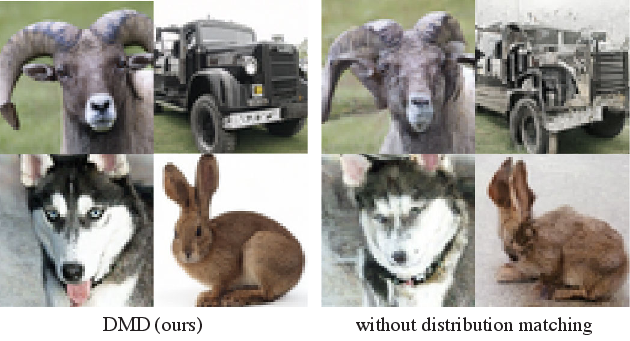
图源:One-step Diffusion with Distribution Matching Distillation,Figure 5 上半部分。原论文图意:左侧为 DMD,右侧为去掉 distribution matching objective 的 baseline;后者 realism 和结构完整性明显较差。
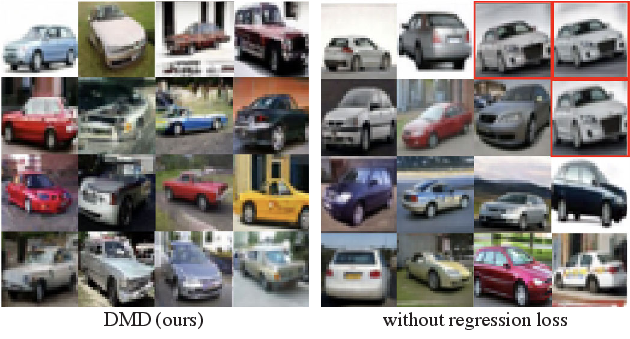
图源:One-step Diffusion with Distribution Matching Distillation,Figure 5 下半部分。原论文图意:左侧为 DMD,右侧为去掉 regression loss 的 baseline;后者出现 mode collapse / diversity loss,例如大量灰色汽车。
ImageNet 图主要说明 distribution matching 不能删:没有它,样本会失去真实感和结构完整性,说明单纯回归 teacher pairs 不足以学好整体分布。CIFAR 图主要说明 regression loss 不能删:没有 paired anchor,generator 容易把多个 noise 映射到相似结果,表现为 mode collapse 或 diversity loss。把两张图合起来看,DMD 的核心不是某一个 loss 单独强,而是 distribution matching 管真实分布,regression 管 noise-to-image 的结构对应。
MS COCO-30K, guidance scale 3
表格按论文原始英文格式重绘。
| Family | Method | Resolution ↑ | Latency ↓ | FID ↓ |
|---|---|---|---|---|
| Original, unaccelerated | DALL·E | 256 | - | 27.5 |
| Original, unaccelerated | DALL·E 2 | 256 | - | 10.39 |
| Original, unaccelerated | Parti-750M | 256 | - | 10.71 |
| Original, unaccelerated | Parti-3B | 256 | 6.4s | 8.10 |
| Original, unaccelerated | Make-A-Scene | 256 | 25.0s | 11.84 |
| Original, unaccelerated | GLIDE | 256 | 15.0s | 12.24 |
| Original, unaccelerated | LDM | 256 | 3.7s | 12.63 |
| Original, unaccelerated | Imagen | 256 | 9.1s | 7.27 |
| Original, unaccelerated | eDiff-I | 256 | 32.0s | 6.95 |
| GANs | LAFITE | 256 | 0.02s | 26.94 |
| GANs | StyleGAN-T | 512 | 0.10s | 13.90 |
| GANs | GigaGAN | 512 | 0.13s | 9.09 |
| Accelerated diffusion | DPM++ (4 step)† | 512 | 0.26s | 22.36 |
| Accelerated diffusion | UniPC (4 step)† | 512 | 0.26s | 19.57 |
| Accelerated diffusion | LCM-LoRA (4 step)† | 512 | 0.19s | 23.62 |
| Accelerated diffusion | InstaFlow-0.9B | 512 | 0.09s | 13.10 |
| Accelerated diffusion | UFOGen | 512 | 0.09s | 12.78 |
| Accelerated diffusion | DMD (Ours) | 512 | 0.09s | 11.49 |
| Teacher | SDv1.5† | 512 | 2.59s | 8.78 |
表源:One-step Diffusion with Distribution Matching Distillation,Table 3。原论文表格要点:DMD 在 zero-shot MS COCO-30K 上以 0.09s latency 达到 11.49 FID,明显优于其他加速扩散方法,并比 SDv1.5 teacher 快约 30 倍。
MS COCO-30K, guidance scale 8
表格按论文原始英文格式重绘。
| Method | Latency ↓ | FID ↓ | CLIP-Score ↑ |
|---|---|---|---|
| DPM++ (4 step)† | 0.26s | 22.44 | 0.309 |
| UniPC (4 step)† | 0.26s | 23.30 | 0.308 |
| LCM-LoRA (1 step)† | 0.09s | 77.90 | 0.238 |
| LCM-LoRA (2 step)† | 0.12s | 24.28 | 0.294 |
| LCM-LoRA (4 step)† | 0.19s | 23.62 | 0.297 |
| DMD (Ours) | 0.09s | 14.93 | 0.320 |
| SDv1.5† (Teacher) | 2.59s | 13.45 | 0.322 |
表源:One-step Diffusion with Distribution Matching Distillation,Table 4。原论文表格要点:在高 guidance scale 8 设置下,DMD 仍能以一步 0.09s 达到 14.93 FID 和 0.320 CLIP-Score,接近 SDv1.5 teacher。
这里尤其能看出“把 CFG 蒸馏进 generator”的价值。LCM-LoRA 一步速度相同,但 FID 非常差;DMD 在同样 0.09s 下保留了更接近 teacher 的图文对齐和视觉质量。
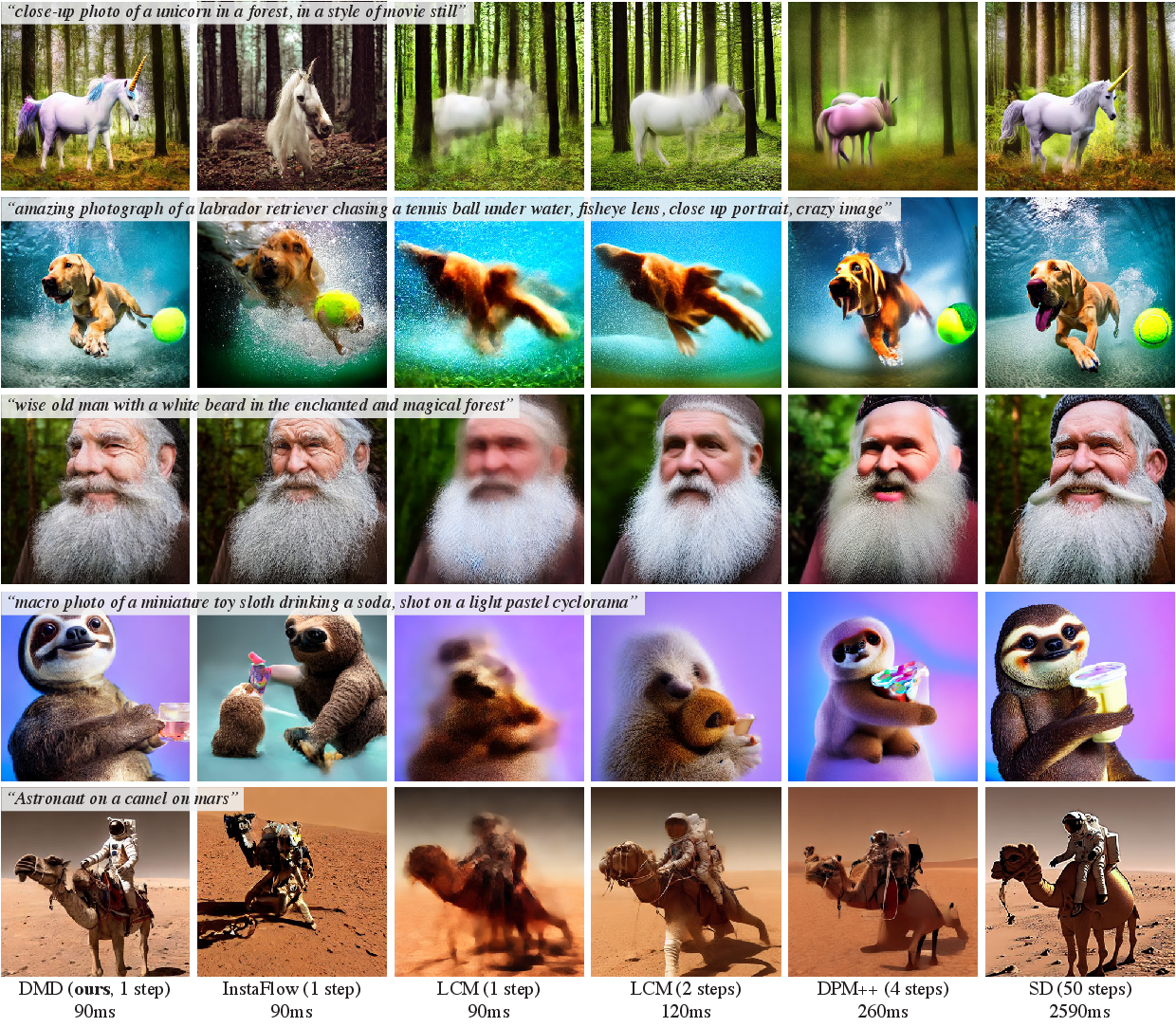
图源:One-step Diffusion with Distribution Matching Distillation,Figure 6。原论文图意:对比 DMD、InstaFlow、LCM、DPM++ 和 Stable Diffusion 在相同 prompt 下的图像质量与延迟;DMD 一步 90ms,质量接近 50-step SD。
这张图把 latency 和视觉质量放在同一处比较。DMD 的卖点不是“比所有方法都快”,而是在一步 90ms 的预算里尽量保住多步 Stable Diffusion 的语义结构、主体完整性和局部细节。读这种 qualitative comparison 时要同时看三点:同一 prompt 下是否遵循文本,复杂结构是否完整,失败样本是否集中在某类 prompt 上。单张好图不能证明上线可用,但它能帮你定位少步蒸馏最常牺牲的质量维度。
CIFAR-10 补充结果
论文附录还报告 CIFAR-10。重点结论是:DMD class-conditional 达到 2.66 FID,unconditional 为 3.77 FID。
| Family | Method | # Fwd Pass ↓ | FID ↓ |
|---|---|---|---|
| Diffusion + Distillation | DMD (Ours) | 1 | 3.77 |
| Diffusion + Distillation | DMD-conditional (Ours)† | 1 | 2.66 |
| Diffusion | EDM† (Teacher) | 35 | 1.84 |
表源:One-step Diffusion with Distribution Matching Distillation,Appendix Table 6 节选。原论文表格要点:DMD 在 CIFAR-10 一步生成上接近强扩散 teacher,并优于多数一步蒸馏基线;完整表还包含 GAN、fast sampler 和其他 distillation 方法。
和 Phased DMD 的关系
| Dimension | DMD | Phased DMD |
|---|---|---|
| Target | one-step generator | few-step generator |
| Main object | image generation, class-conditional and text-to-image | large image/video distillation |
| Generator structure | one denoiser-like generator, no time conditioning | multiple SNR phase experts / MoE-style generator |
| Fake score target | clean fake sample | intermediate phase sample , requiring subinterval score matching |
| Stability tool | regression loss and sample weighting | progressive phase training, subinterval score objective, optional SGTS |
| Main risk | mode dropping, high memory from fake score + generator | SGTS one-step degeneration, video motion loss |
DMD 是“score 差分 + regression regularizer”的原型。Phased DMD 保留了这套思想,但发现当目标变成 few-step、大视频模型和 MoE teacher 时,直接套用 DMD2 / SGTS 会损失动态和多样性,于是把 score matching 目标推广到 SNR 子区间。
最值得复用的设计经验
1. Distribution matching 需要 fake score
只用 teacher score 会把样本拉向最近 real mode,容易 collapse。fake score 提供“从当前 fake 分布里散开”的方向,这是 DMD 比单纯 score distillation 更完整的地方。
2. Regression loss 是防塌缩的结构锚点
DMD 不是纯分布匹配。paired teacher outputs 虽然数量不大,但能固定大尺度结构、保留 noise-to-image 的多样性,尤其对 one-step 生成很重要。
3. Timestep weighting 影响很大
DMD 的 score difference 来自不同噪声水平。若不同 timestep 的梯度幅度不平衡,训练会不稳定。论文提出的 weight 让梯度幅度更一致,带来可见 FID 改善。
4. CFG 可以被蒸馏,但会固定成一种风格
DMD 可以把 guidance scale 3 或 8 蒸馏进 generator,使推理无需额外 CFG。但这也意味着模型更像一个固定 guidance 的 fast preview model,而不是可自由调 guidance 的完整 diffusion pipeline。
5. 一步生成不是免费午餐
推理 0.09s 很快,但训练成本高:LAION text-to-image 需要 72 到 80 张 A100、预计算 50-step teacher outputs、同时训练 generator 和 fake diffusion model。DMD 是把推理成本前移到训练端。
局限与风险
- 仍和 teacher 有质量差距:论文自己也承认一步模型和更细采样路径的 teacher 仍有差距。
- 训练显存重:generator 和 fake score model 都要微调,训练时还要跑 real/fake denoisers,内存压力大。
- 依赖 teacher 能力:teacher 的文本、细节和小人脸问题会被学生继承。
- guidance scale 固定:text-to-image 模型在特定 CFG 下训练,推理灵活性不如原始扩散模型。
- regression pairs 预计算成本高:LAION 6+ 高 guidance 实验生成了 12M pairs,本身就是一笔很大的 teacher sampling 成本。
- 主要验证图像,不是视频:DMD 原论文不解决视频长时一致、动作动态和 causal rollout,这些问题后来才在 CausVid / Phased DMD 等工作里展开。
读完应该记住什么
DMD 的关键贡献是把扩散蒸馏从“学生复刻 teacher 轨迹”推进到“学生匹配 teacher 分布”。它用两个 diffusion score estimator 近似 reverse KL 梯度:
1 | real score: frozen pretrained diffusion model |
如果只记一个工程结论,就是:一步扩散生成器要同时有分布级 realism 信号和 teacher-pair structure 信号。缺前者会不真实,缺后者会掉模式。
参考资料
- Yin et al. One-step Diffusion with Distribution Matching Distillation. arXiv:2311.18828.
- 官方项目页:DMD.
- 论文 HTML 版本:ar5iv:2311.18828.
- Title: 论文专题讲解:DMD:一步扩散蒸馏
- Author: Charles
- Created at : 2025-10-13 09:00:00
- Updated at : 2025-10-13 09:00:00
- Link: https://charles2530.github.io/2025/10/13/ai-files-paper-deep-dives-diffusion-dmd/
- License: This work is licensed under CC BY-NC-SA 4.0.