

论文专题讲解:Video Prediction Policy:预测视觉表征训练机器人策略

- 论文:
Video Prediction Policy: A Generalist Robot Policy with Predictive Visual Representations - 链接:arXiv:2412.14803
- 代码:roboterax/video-prediction-policy
- 关键词:predictive visual representations、text-guided video prediction、inverse dynamics、CALVIN、MetaWorld、real-world robots
VPP 的核心观点很漂亮:很多视觉策略只编码当前图像,而视频扩散模型内部包含“未来会怎样”的预测表征。把这些 predictive visual representations 拿来当 policy 的视觉条件,可以让机器人从视频模型的动态先验中受益。
论文位置
GR-2 是“视频预训练 + 机器人轨迹微调”;DreamZero 是“joint video-action prediction”;VPP 介于两者之间:它先训练文本引导的视频预测模型,然后用视频模型的中间表征训练逆动力学 policy。
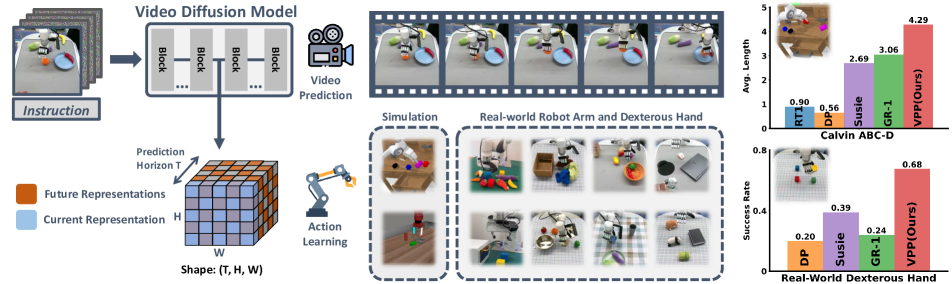
Figure source: Video Prediction Policy, Figure 1. 原论文图意:视频 diffusion model 内部表征同时包含当前信息和未来预测信息;VPP 基于这些表征在多个 benchmark 上提升机器人策略表现。
两阶段训练
论文流程很清晰:
1 | Stage 1: train Text-guided Video Prediction (TVP) |
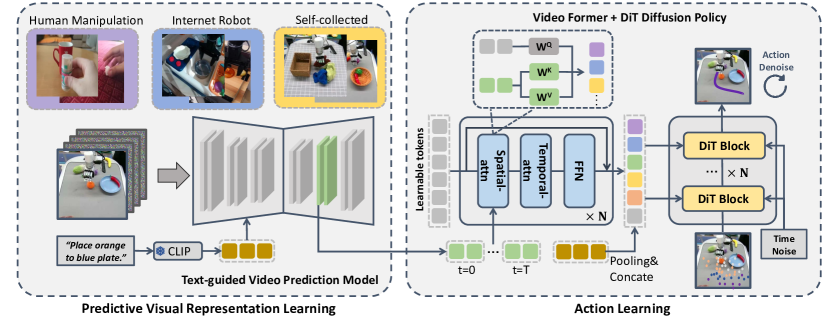
Figure source: Video Prediction Policy, Figure 3. 原论文图意:VPP 先从预训练视频 foundation model 出发训练 text-guided video prediction model,再基于 TVP 内部预测表征学习机器人动作。
为什么用中间表征,而不是完整生成视频
论文的关键工程选择是:VPP 把视频 diffusion model 主要当作 vision encoder,而不是完整 denoiser。它只做 single forward step,得到并不清晰但含有未来运动趋势的中间表征。
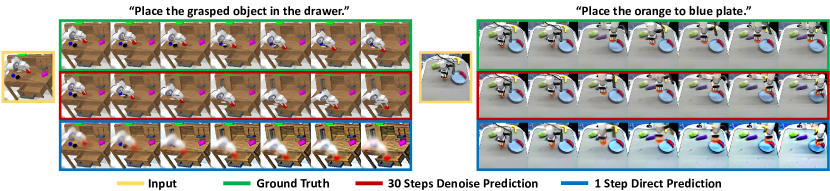
Figure source: Video Prediction Policy, Figure 5. 原论文图意:比较 ground-truth video、完整 denoised video 和 one-step forward predictions;one-step 纹理不清晰,但已经包含物理演化信息。
这个选择非常具身:机器人 policy 不需要每次生成好看的未来视频,它需要低延迟、对动作有用的表示。中间表征比完整视频便宜,也比普通静态视觉 encoder 更有动态信息。
数据与训练细节
VPP 的 TVP 训练数据包括:
| Data source | Scale / role |
|---|---|
| Something-Something-V2 human manipulation | 193,690 human manipulation trajectories |
| Internet robotic manipulation datasets | 179,074 high-quality trajectories |
| CALVIN ABC | downstream long-horizon robot data |
| MetaWorld | 50 tasks, oracle trajectories |
| Real-world robot datasets | Panda arm and xArm + XHand tasks |
论文记录 TVP 训练约 two days on eight NVIDIA A100 GPUs。动作策略阶段再用 TVP 的中间预测表征训练 diffusion action model。
英文原表中 Table 9 给出 dataset scales and sample ratios;这里不逐项全文搬表,但保留一个工程重点:VPP 不是把所有数据均匀混合,而是根据数据规模和质量设置采样概率。
实验结果
VPP 在 CALVIN 和 MetaWorld 上验证了 predictive visual representations 的价值。
| Benchmark | Setup | Main claim |
|---|---|---|
| CALVIN | ABC→D, five chained tasks | VPP improves average task completion length |
| MetaWorld | 50 tasks with language-conditioned policy | VPP improves average success rate over strong baselines |
| Real-world Panda | 30+ tasks, 6 skills, about 2000 trajectories | predictive representations transfer to real robot |
| xArm + XHand | 100+ tasks, 13 skills, about 4000 trajectories | dexterous manipulation and tool-use settings |
Table 1 from the paper can be redrawn as follows, keeping the original English fields:
| Category | Method | Annotated Data | 1 | 2 | 3 | 4 | 5 | Avg. Len ↑ |
|---|---|---|---|---|---|---|---|---|
| Direct Action Learning Method | RT-1 | 100%ABC | 0.533 | 0.222 | 0.094 | 0.038 | 0.013 | 0.90 |
| Direct Action Learning Method | Diffusion Policy | 100%ABC | 0.402 | 0.123 | 0.026 | 0.008 | 0.00 | 0.56 |
| Direct Action Learning Method | Robo-Flamingo | 100%ABC | 0.824 | 0.619 | 0.466 | 0.331 | 0.235 | 2.47 |
| Future Prediction Related Method | Uni-Pi | 100%ABC | 0.560 | 0.160 | 0.080 | 0.080 | 0.040 | 0.92 |
| Future Prediction Related Method | MDT | 100%ABC | 0.631 | 0.429 | 0.247 | 0.151 | 0.091 | 1.55 |
| Future Prediction Related Method | Susie | 100%ABC | 0.870 | 0.690 | 0.490 | 0.380 | 0.260 | 2.69 |
| Future Prediction Related Method | GR-1 | 100%ABC | 0.854 | 0.712 | 0.596 | 0.497 | 0.401 | 3.06 |
| 3D Method | 3D Diffuser Actor | 100%ABC | 0.938 | 0.803 | 0.662 | 0.533 | 0.412 | 3.35 |
| Ours | VPP (ours) | 100%ABC | 0.957 | 0.912 | 0.863 | 0.810 | 0.750 | 4.29 |
| Data Efficiency | MDT | 10%ABC | 0.408 | 0.131 | 0.034 | 0.008 | 0.001 | 0.58 |
| Data Efficiency | GR-1 | 10%ABC | 0.672 | 0.371 | 0.198 | 0.108 | 0.069 | 1.41 |
| Data Efficiency | VPP (ours) | 10%ABC | 0.878 | 0.746 | 0.632 | 0.540 | 0.453 | 3.25 |
表源:Video Prediction Policy,Table 1。原表含义:CALVIN ABC→D zero-shot long-horizon evaluation,1 到 5 表示连续完成第 1 到第 5 个任务的比例,Avg. Len 是平均完成链长。最值得注意的是,VPP 不用 depth / point cloud,仍把平均链长从 3D Diffuser Actor 的 3.35 推到 4.29;只用 10%ABC 标注数据时也达到 3.25。
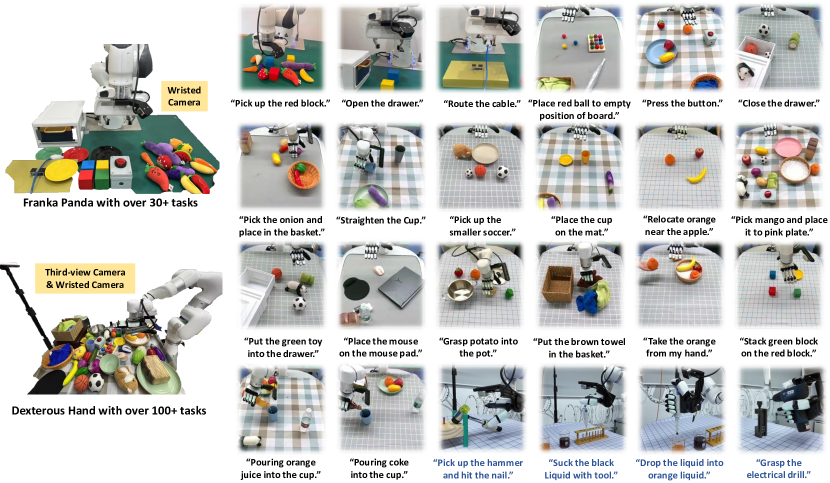
Figure source: Video Prediction Policy, Figure 7. 原论文图意:展示 Panda arm 和 xArm + 12-DoF XHand 两个真实硬件平台及任务可视化。
论文还可视化了 predictive representations:
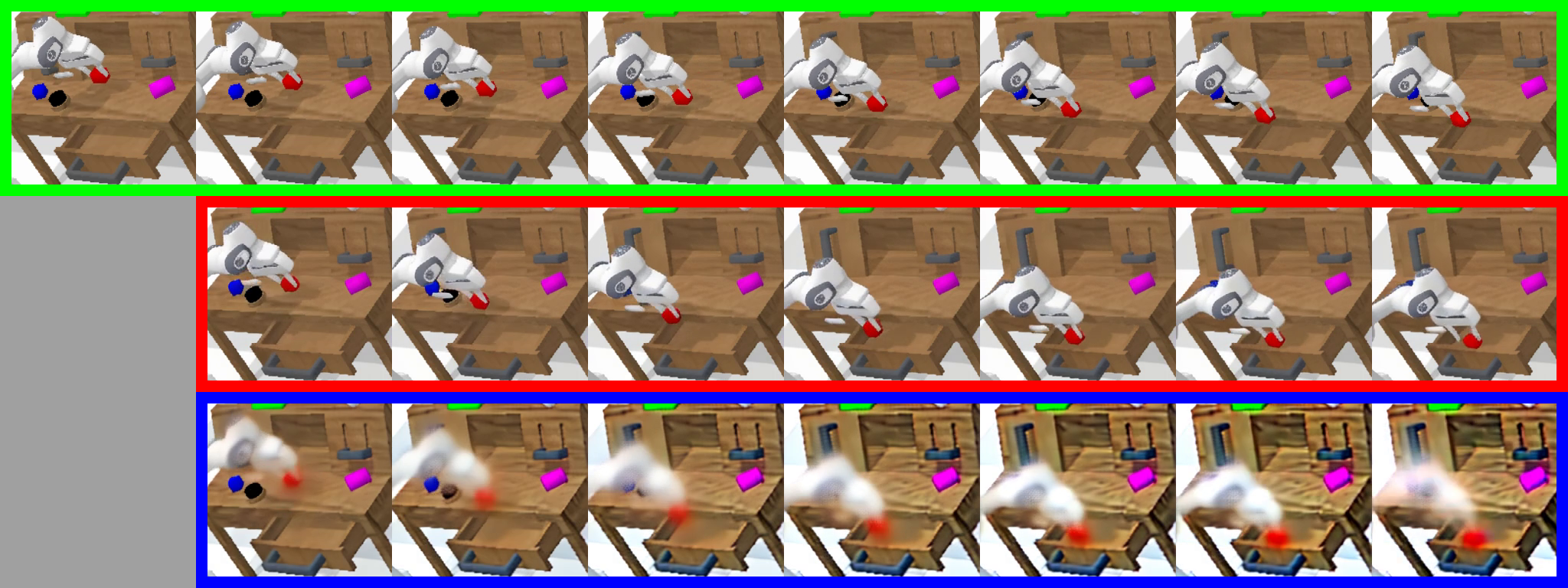
Figure source: Video Prediction Policy, Figure 12. 原论文图意:绿色是真实未来,红色是预测未来,蓝色是 predictive representations 的可视化;即便细节不精确,运动趋势已经出现。
训练细节要点
| Detail | VPP choice | Why it matters |
|---|---|---|
| Video backbone | Stable Video Diffusion + CLIP text features | 从视频 foundation model 继承动态先验 |
| TVP objective | text-guided video prediction | 让模型按语言预测操作未来 |
| Policy input | intermediate predictive representation | 避免完整视频生成成本 |
| Inference | single forward step as encoder | 低延迟,适合控制 |
| Action model | diffusion inverse dynamics | 从预测表征生成动作 |
| Training compute | two days on 8 A100 for TVP | 说明路线相对可复现 |
| Real robots | Panda 30+ tasks / xArm + XHand 100+ tasks | 验证不是只在仿真有效 |
和 GR-2、DreamZero 的区别
| Dimension | GR-2 | VPP | DreamZero |
|---|---|---|---|
| Video role | pre-training and future video prediction | predictive representation encoder | joint video-action generation |
| Action learning | robot trajectory fine-tuning | inverse dynamics from TVP features | action latent co-denoising |
| Deployment | trajectory + WBC | policy from visual representation | WAM as closed-loop policy |
| Main insight | web video helps robot manipulation | future-aware visual features help policy | world-action model can be zero-shot policy |
VPP 的独特位置在于:它不要求每次部署都生成高质量未来视频,也不把视频和动作完全合并到一个大生成器里,而是把视频模型内部的“未来感”抽出来给策略用。
局限
VPP 的表征依赖 TVP 的预测质量。若 TVP 在新场景里预测错误动态,policy 也会被误导。另外,它的真实机器人数据仍以可控平台和任务集合为主,开放家庭长时任务、无效指令拒绝、跨房间记忆等问题还需要其他机制。
参考链接
- Title: 论文专题讲解:Video Prediction Policy:预测视觉表征训练机器人策略
- Author: Charles
- Created at : 2025-11-03 09:00:00
- Updated at : 2025-11-03 09:00:00
- Link: https://charles2530.github.io/2025/11/03/ai-files-paper-deep-dives-embodied-ai-video-prediction-policy/
- License: This work is licensed under CC BY-NC-SA 4.0.