

论文专题讲解:EAGLE:Feature-level Draft 的投机推理

这页先按“论文证据节点”读:先问它解决哪一个瓶颈,再看核心图表、实验 setting 和不能外推的边界。背景概念先回 论文专题讲解 和 推理。
前置:不必先读完所有相关论文,但要知道本篇的输入、训练/推理路径和评测口径分别对应什么。
主线关系:读完后把结论回填到「推理」路线里,判断它改变的是机制、成本、数据配方、评测口径,还是仍停留在前沿假设。
- 论文:
EAGLE: Speculative Sampling Requires Rethinking Feature Uncertainty - 链接:arXiv:2401.15077
- 版本:2024-01-26 首版,2025-03-04 修订为 v3
- 代码:GitHub: SafeAILab/EAGLE
- 关键词:speculative sampling、feature-level autoregression、feature uncertainty、tree attention、Autoregression Head、lossless acceleration
EAGLE 是 EAGLE 系列的第一块地基。它解决的问题不是“再找一个更小的 LLM 当 draft model”,而是:能不能用 target LLM 已经算出来的高层 feature 来生成草稿,从而避免小 draft model 太慢、太弱、还要重新预训练的问题?
它的答案是 feature-level autoregression:用 target LLM 的 second-to-top-layer feature 作为连续表示,让一个很小的 Autoregression Head 预测下一步 feature,再复用 target LLM 的 LM head 采样 token。为了处理采样随机性带来的 feature uncertainty,EAGLE 又把提前一位的 token sequence 输入 draft model,让 draft model 知道上一轮到底采到了哪个 token。
它的效率贡献是什么
| Dimension | EAGLE |
|---|---|
| Saved cost | Target LLM autoregressive decoding steps、per-token parameter reads、single-request latency |
| Main idea | Draft in feature space, then reuse the target LM head to obtain draft tokens |
| Architecture | Frozen target embedding + frozen target LM head + trainable Autoregression Head |
| Key fix | Use feature sequence plus shifted-token sequence to handle sampling-induced feature uncertainty |
| Training role | Train only a small draft head on ShareGPT with regression + classification loss; target LLM remains frozen |
| Inference role | Lossless speculative sampling when standard target-model verification is used |
| Main risk | Speedup depends on draft overhead, tree attention implementation, batch size, and draft data coverage |
| Connect to | EAGLE-2、EAGLE-3、缓存、路由与投机解码、MTP 与投机解码 |
证据等级与外推边界
EAGLE 的证据包括方法图、输入消融、训练数据消融、tree attention 消融、多模型多任务 speedup,以及 batch/throughput 分析。它证明 feature-level draft 是有效路线,但还保留了 static draft tree 和 feature prediction constraint,这正是后续 EAGLE-2、EAGLE-3 分别继续推进的地方。
| 论文结论 | 证据来源 | 证据等级 | 可外推到高效推理 | 不能直接外推 |
|---|---|---|---|---|
| Feature-level draft 比 token-level draft 更有效 | Figure 4 / Figure 8 输入消融 | Mechanism + ablation | draft 不一定要是完整小 LLM,也可以接 target feature | 不代表所有中间层 feature 都适合作草稿 |
| Shifted-token 输入能缓解 feature uncertainty | Figure 3 / Figure 4 / Figure 8 | Mechanism + ablation | 多步 draft 要把采样结果纳入下一步输入 | 不能完全消除递归 feature error |
| Tree attention 提高 acceptance length | Figure 7 / Table 5 | Ablation | tree draft 能用同样 forward 次数验证更多候选 | tree mask 和 token 数增加会带来额外开销 |
| 训练成本低于重训 draft LLM | 训练设置:68K ShareGPT、0.24B-0.99B trainable params | Training recipe | 可作为服务端低成本 draft head 训练参考 | target/domain 改变后仍需重新校准 |
| batch 越大加速越收缩 | Table 7 | System evidence | speculative 更适合 decode 计算资源空闲的小 batch | 大 batch、高吞吐服务不一定保持单请求 speedup |
论文位置:为什么不用普通小 LLM 做 Draft
经典 speculative sampling 用一个小 draft model 先生成候选 token,再让 target LLM 一次性并行验证。问题是,小模型如果太小,接受率不够;如果够强,自己的 forward overhead 又会变大。对 13B 级模型,用 7B 当 draft 可能还不如直接 vanilla decoding。
EAGLE 的判断是:target LLM 在上一轮 forward 已经产生了非常有用的 feature。与其再训练一个完整小 LLM,不如训练一个轻量 Autoregression Head,沿着 target feature 的轨迹预测下一步。
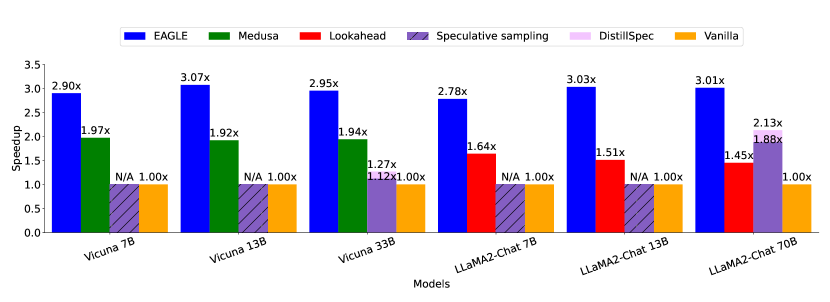
图源:EAGLE,Figure 1。原论文图意:temperature=0 的 MT-bench 上,EAGLE 相比 Medusa、Lookahead、speculative sampling 等方法取得更高 speedup;论文只比较不微调 backbone 且保持输出分布不变的方法。
输入输出:输入是 target LLM 的 hidden features 和当前上下文,输出是 draft tokens 及 target verification 结果。
效率机制:把草稿生成放在 feature level,减少目标模型完整 decode 次数,收益取决于 acceptance rate。
对主线意义:它说明 rollout/agent 服务里的解码成本可以用投机路径压低,但必须保留质量回归。
不能证明什么:EAGLE speedup 不能证明任务答案更好,也不能证明长链路 agent 或世界模型规划更可靠。
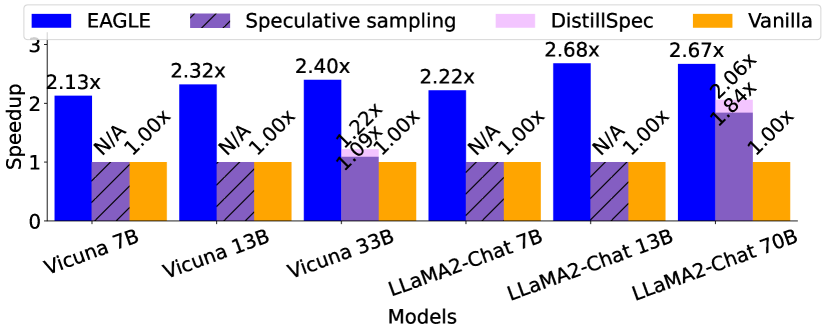
图源:EAGLE,Figure 2。原论文图意:temperature=1 的 MT-bench 上,Lookahead 仅限 greedy decoding,Medusa 非贪心生成不保证 lossless,因此 EAGLE 不与这些非 lossless 设置直接比较。
EAGLE 先证明 feature-level draft 可行;EAGLE-2 发现 EAGLE 的 static draft tree 仍会浪费候选预算,于是改成 dynamic draft tree;EAGLE-3 发现 feature prediction constraint 会限制 draft model 表达能力,于是改成 direct token prediction + training-time test。
核心问题:Feature Uncertainty
Feature-level draft 看起来很自然,但有一个麻烦:token 是离散采样的,feature 是连续轨迹。如果当前 token 可能采到 am,也可能采到 always,那么下一步 feature 应该沿哪条分支走?只看前一 feature ,draft model 无法知道实际采样结果。
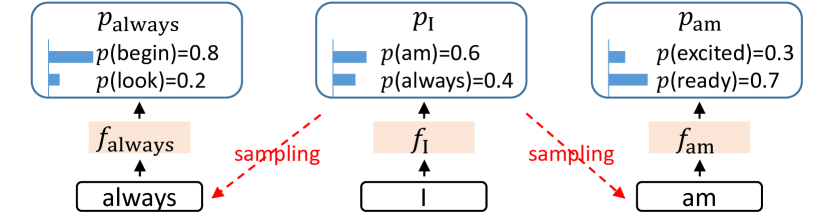
图源:EAGLE,Figure 3。原论文图意:在 token I 后,采样结果可能是 am 或 always,对应不同 feature sequence;仅靠 预测下一 feature 会产生歧义。
EAGLE 的修正是把 token sequence 向前移动一个 time step 输入 draft model。也就是说,预测下一 feature 时,不只看 feature prefix,还看上一轮实际采出来的 token。论文把这个输入称为 feature&shifted-token。
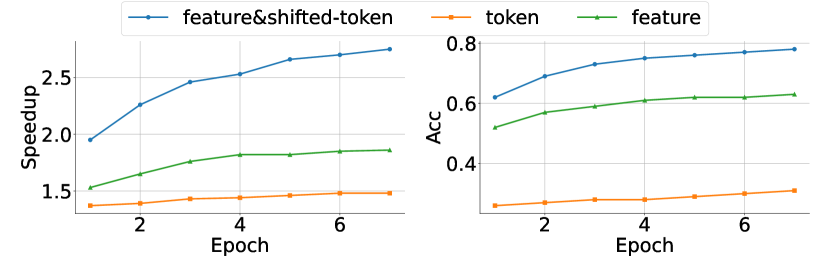
图源:EAGLE,Figure 4。原论文图意:在 Vicuna 7B + MT-bench + temperature=0 上,feature-level draft 优于 token-level draft;加入 shifted-token 后进一步提升 speedup。
这张图就是 EAGLE 的方法动机:feature 比 token 更规则,但 feature 需要知道采样分支;shifted-token 提供了这个分支信息。
Drafting Phase:EAGLE 到底预测什么
EAGLE 与其他 draft 方法的区别在 drafting phase。普通 speculative sampling 和 Lookahead 从 token 到 token;Medusa 从 target feature 直接预测多个未来 token;EAGLE 从 feature + shifted token 预测下一步 feature,再经 LM head 得到 token。
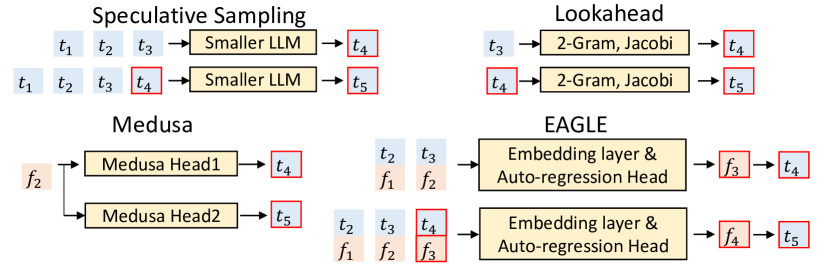
图源:EAGLE,Figure 5。原论文图意:对比 speculative sampling、Lookahead、Medusa 和 EAGLE 如何 draft 第四、第五个 token;红框是 draft model 的预测部分。
每一列都在问同一个问题:草稿 token 从哪里来。Speculative sampling 用小 LLM,Lookahead 用 n-gram 风格搜索,Medusa 从 target feature 直接出多 token,EAGLE 则先预测下一步 feature 再复用 LM head。红框越贴近 target model 内部接口,draft model 越不像一个完整小模型。
EAGLE 的 draft model 包含三块:
| Module | Trainable | Role |
|---|---|---|
| Embedding layer | No | Reuses target LLM embedding to embed shifted token sequence |
| Autoregression Head | Yes | FC layer + decoder layer; predicts next feature |
| LM Head | No | Reuses target LLM LM head to map predicted feature to token distribution |
输入输出流程可以写成:
1 | feature sequence F_{1:i} |
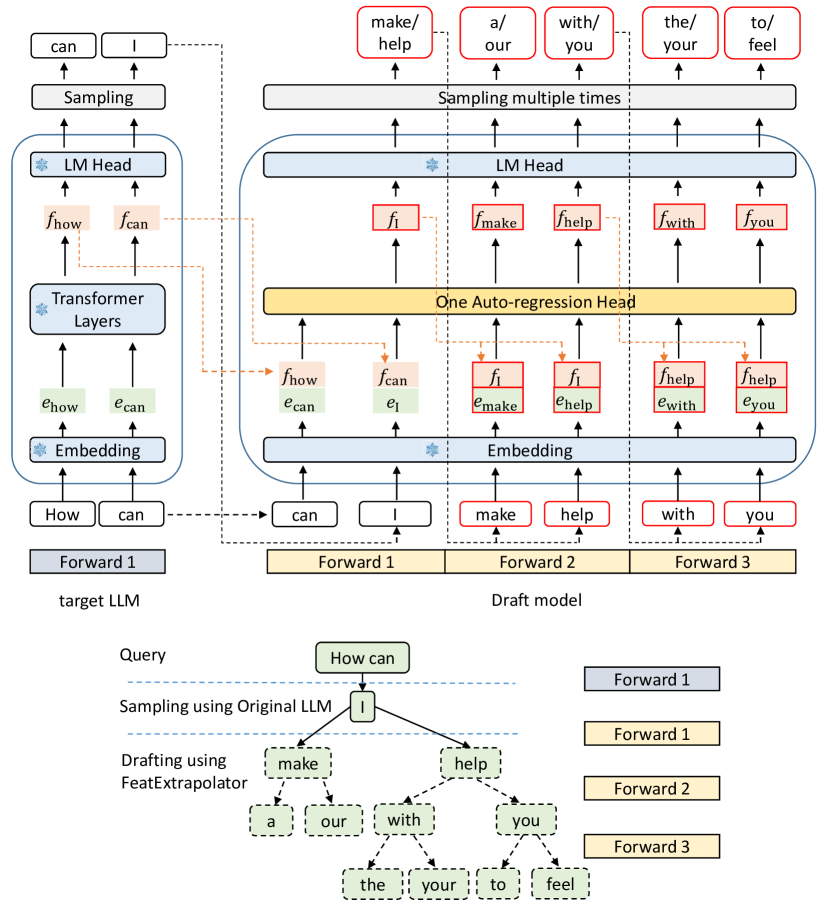
图源:EAGLE,Figure 6。原论文图意:绿色块是 token embedding,橙色块是 feature,红框是 draft model prediction,蓝色雪花模块复用 frozen target LLM 参数。
绿色是 shifted token embedding,橙色是 target LLM 的 feature,红框是唯一训练的 draft head,蓝色雪花表示复用并冻结 target 模型组件。图想证明的是 draft head 的计算很轻,并且和 target LM head 对齐;最终输出仍要经过 target verification 才保持 lossless。
EAGLE 还用 tree attention 生成 tree-structured draft。比如 Figure 6 里用 3 次 draft forward 生成 10-token tree,然后 target LLM 一次性并行验证候选树。
训练细节:这里是 EAGLE 真正的成本优势
EAGLE 训练时固定 target LLM,只训练 Autoregression Head。论文强调,对 LLaMA2-Chat 70B,EAGLE 只训练少于 1B 参数,用不超过 70K 条 ShareGPT 对话,4 张 A100 40G 上 1-2 天完成;7B、13B、33B 对应训练甚至可以在 RTX 3090 服务器上完成。它还提到训练大约使用 2B-4B tokens,而 TinyLLaMA 这类小 LLM 预训练需要约 3000B tokens,量级完全不同。
| Training component | Detail |
|---|---|
| Target LLM | Fixed; not fine-tuned |
| Training dataset | ShareGPT, 68,000 dialogue iterations |
| Learning rate | 3e-5 |
| Optimizer | AdamW |
| Adam betas | (0.9, 0.95) |
| Gradient clipping | 0.5 |
| Trainable params for 7B target | 0.24B |
| Trainable params for 13B target | 0.37B |
| Trainable params for 33B target | 0.56B |
| Trainable params for 70B target | 0.99B |
| Trainable params for Mixtral 8x7B | 0.28B |
| 70B training cost | 1-2 days on 4x A100 40G |
Loss:Feature Regression + Token Classification
EAGLE 的 draft target 首先是 feature,所以用 Smooth L1 regression loss:
但 feature prediction 只是中间目标,最终目的是让 LM head 采到 target LLM 会接受的 token。因此论文又加入 classification loss:
最终训练目标是:
论文说明 classification loss 的数值通常比 regression loss 大一个数量级,所以设置 。
噪声增强:提前暴露 Feature Error
EAGLE 推理时会自回归使用自己预测的 feature,错误会累积。训练时为了让 Autoregression Head 对 feature error 更鲁棒,论文对 target LLM feature 加入均匀噪声:
这点和后来的 EAGLE-3 有清晰延续关系:EAGLE 用 feature noise 做鲁棒性增强,EAGLE-3 则更进一步,把 test-time 多步递归过程直接搬进训练。
训练数据消融:固定 ShareGPT 已经够用吗
EAGLE 理想上可以用 target LLM 自己生成的文本训练 draft head,但那会显著增加成本。论文比较了固定 ShareGPT 数据和 target LLM 生成回答的数据。
| Training data | Speedup | |
|---|---|---|
| Fixed dataset | 2.78x | 3.62 |
| Data generated by target LLM | 2.88x | 3.75 |
表源:EAGLE,Table 6。原论文表意:在 LLaMA2-Chat 7B + MT-bench + temperature=0 上,target LLM 生成数据略好,但增益有限,因此固定 ShareGPT 数据能显著降低训练成本。
这张表很重要:EAGLE 的低成本不是完全没代价,而是一个取舍。固定数据足够让 feature draft 起效,但后续 EAGLE-3 会重新强调:如果要继续 scale draft model,训练数据和训练分布会再次变关键。
实验设置
论文主要评估单 batch latency,也补充了 batch size 和 throughput:
| Category | Details |
|---|---|
| Models | Vicuna 7B/13B/33B, LLaMA2-Chat 7B/13B/70B, Mixtral 8x7B Instruct-v0.1 |
| Tasks | MT-bench, HumanEval, GSM8K, Alpaca |
| Metrics | Speedup ratio, average acceptance length , acceptance rate |
| Quality evaluation | Not evaluated separately because standard verification preserves target LLM output distribution |
| Batch / throughput | Batch-size experiments on Vicuna 7B and LLaMA2-Chat 70B |
Table 1:HumanEval、GSM8K、Alpaca 上的速度
| T | Model | HumanEval Speedup | HumanEval | GSM8K Speedup | GSM8K | Alpaca Speedup | Alpaca |
|---|---|---|---|---|---|---|---|
| 0 | V 7B | 3.33x | 4.29 | 3.01x | 4.00 | 2.79x | 3.86 |
| 0 | V13B | 3.58x | 4.39 | 3.08x | 3.97 | 3.03x | 3.95 |
| 0 | V 33B | 3.67x | 4.28 | 3.25x | 3.94 | 2.97x | 3.61 |
| 0 | LC 7B | 3.17x | 4.24 | 2.91x | 3.82 | 2.78x | 3.71 |
| 0 | LC 13B | 3.76x | 4.52 | 3.20x | 4.03 | 3.01x | 3.83 |
| 0 | LC 70B | 3.52x | 4.42 | 3.03x | 3.93 | 2.97x | 3.77 |
| 1 | V 7B | 2.39x | 3.43 | 2.34x | 3.29 | 2.21x | 3.30 |
| 1 | V13B | 2.65x | 3.63 | 2.57x | 3.60 | 2.45x | 3.57 |
| 1 | V 33B | 2.76x | 3.62 | 2.77x | 3.60 | 2.52x | 3.32 |
| 1 | LC 7B | 2.61x | 3.79 | 2.40x | 3.52 | 2.29x | 3.33 |
| 1 | LC 13B | 2.89x | 3.78 | 2.82x | 3.67 | 2.66x | 3.55 |
| 1 | LC 70B | 2.92x | 3.76 | 2.74x | 3.58 | 2.65x | 3.47 |
表源:EAGLE,Table 1。原论文表意:V 表示 Vicuna,LC 表示 LLaMA2-Chat;EAGLE 在 temperature=0 时通常更快,在 HumanEval 代码任务上 speedup 最高。
代码任务更容易加速,是因为固定模板和局部模式更多,draft token 更容易被 target LLM 接受。
Table 2:MT-bench 的接受长度和 Feature Error 鲁棒性
| T | Model | ||||||
|---|---|---|---|---|---|---|---|
| 0 | Vicuna 7B | 3.94 | 0.79 | 0.74 | 0.72 | 0.73 | 0.67 |
| 0 | Vicuna 13B | 3.98 | 0.79 | 0.74 | 0.72 | 0.74 | 0.70 |
| 0 | Vicuna 33B | 3.68 | 0.74 | 0.69 | 0.67 | 0.67 | 0.66 |
| 0 | LLaMA2-Chat 7B | 3.62 | 0.76 | 0.69 | 0.67 | 0.68 | 0.68 |
| 0 | LLaMA2-Chat 13B | 3.90 | 0.77 | 0.69 | 0.69 | 0.70 | 0.71 |
| 0 | LLaMA2-Chat 70B | 3.81 | 0.75 | 0.69 | 0.65 | 0.64 | 0.64 |
| 1 | Vicuna 7B | 3.17 | 0.71 | 0.68 | 0.66 | 0.66 | 0.65 |
| 1 | Vicuna 13B | 3.20 | 0.73 | 0.68 | 0.68 | 0.67 | 0.69 |
| 1 | Vicuna 33B | 3.22 | 0.71 | 0.67 | 0.64 | 0.64 | 0.64 |
| 1 | LLaMA2-Chat 7B | 3.30 | 0.71 | 0.66 | 0.66 | 0.66 | 0.64 |
| 1 | LLaMA2-Chat 13B | 3.45 | 0.73 | 0.69 | 0.66 | 0.67 | 0.67 |
| 1 | LLaMA2-Chat 70B | 3.46 | 0.73 | 0.67 | 0.64 | 0.66 | 0.65 |
表源:EAGLE,Table 2。原论文表意: 是 average acceptance length; 表示输入 feature 完全精确时的接受率, 到 表示输入中包含不同数量不精确 feature 时的接受率。
这张表说明两件事。第一,EAGLE 每轮 target forward 平均可以接受约 3.2-4.5 个 token。第二, 高于 ,说明 feature error 确实伤害 draft;但从 到 下降不大,说明噪声增强和 shifted-token 让模型对误差累积有一定鲁棒性。
MoE、量化编译和 Batch Size
EAGLE 在 Mixtral 8x7B 上只有 1.50x speedup。论文解释是 MoE speculative verification 不像 dense decoder 那样天然复用所有权重读取:vanilla 每个 token 只读少数专家,而一次验证多个 draft token 可能读更多专家,收益会变小。
| Speedup | ||||||
|---|---|---|---|---|---|---|
| 1.50x | 3.25 | 0.67 | 0.62 | 0.61 | 0.64 | 0.63 |
表源:EAGLE,Table 3。原论文表意:Mixtral 8x7B Instruct-v0.1 在 MT-bench、temperature=0 上的 speedup、 和 acceptance rate。
EAGLE 也可以和底层加速叠加。论文把 EAGLE 接到 gpt-fast 上,展示了量化和编译加速可以继续叠加:
| Precision | FP16 | int4 |
|---|---|---|
| Vanilla (Huggingface) | 24.5 tokens/s | N/A |
| gpt-fast | 55.1 tokens/s | 106.9 tokens/s |
| EAGLE + gpt-fast | 100.2 tokens/s | 160.4 tokens/s |
表源:EAGLE,Table 4。原论文表意:LLaMA2-Chat 7B + MT-bench + temperature=0 下,EAGLE 与 gpt-fast 结合可进一步提升 generation speed。
但 batch size 上来后,single-request speedup 会下降:
| Batch size | 1 | 2 | 3 | 4 | Throughput |
|---|---|---|---|---|---|
| Vicuna 7B | 2.90x | 2.87x | 2.65x | 2.76x | 1.97x |
| LLaMA2-Chat 70B | 3.01x | 2.81x | 2.50x | 2.40x | 1.99x |
表源:EAGLE,Table 7。原论文表意:MT-bench、temperature=0 下,batch size 增大时 speedup ratio 下降,但最大吞吐仍约有 2x 提升。
这就是 speculative decoding 的典型系统边界:小 batch decode 时 GPU 计算资源空着,draft/verify 更容易把空闲算力转成速度;大 batch 时 target LLM 已更接近饱和,draft 和 tree attention 的额外 token 会开始竞争资源。
Tree Attention:为什么一轮能验更多 token
EAGLE 使用 tree attention 生成和验证 tree-structured draft。相比 chain draft,tree attention 不增加 target LLM 和 draft model 的 forward 次数,但会让每次 forward 处理更多候选 token。
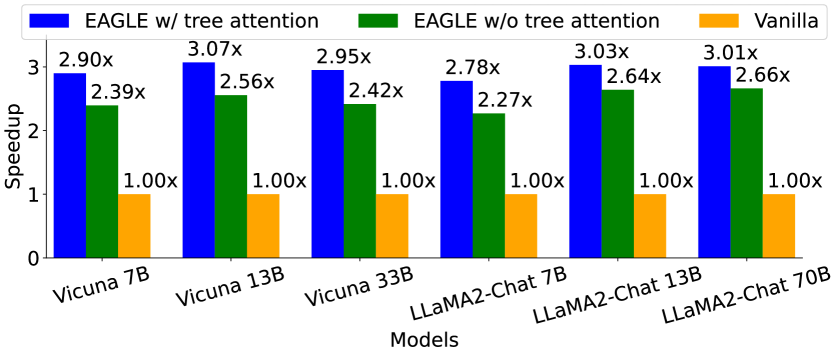
图源:EAGLE,Figure 7。原论文图意:MT-bench、temperature=0 上,使用 tree attention 的 EAGLE 比 chain draft 有更高 speedup。
| Vicuna Size | Chain | Tree | LLaMA2-Chat Size | Chain | Tree |
|---|---|---|---|---|---|
| 7B | 3.20 | 3.94 (+0.74) | 7B | 3.00 | 3.62 (+0.62) |
| 13B | 3.23 | 3.98 (+0.75) | 13B | 3.18 | 3.90 (+0.68) |
| 33B | 2.97 | 3.68 (+0.71) | 70B | 3.12 | 3.81 (+0.69) |
表源:EAGLE,Table 5。原论文表意:tree attention 将 average acceptance length 提高约 0.6-0.8。
Appendix 还给了 EAGLE 使用的静态树结构:

图源:EAGLE,Figure 9。原论文图意:左侧是使用 tree attention 时的 draft structure,右侧是不使用 tree attention 的 chain draft structure。
论文也承认这棵树不是严格优化出来的,而是基于直觉:高概率分支应该更深、更宽。这个限制后来直接变成 EAGLE-2 的切入点:tree shape 应该随 context 动态调整。
输入消融:Feature、Token、Shifted-token 谁重要
Figure 8 是 EAGLE 最关键的消融之一:
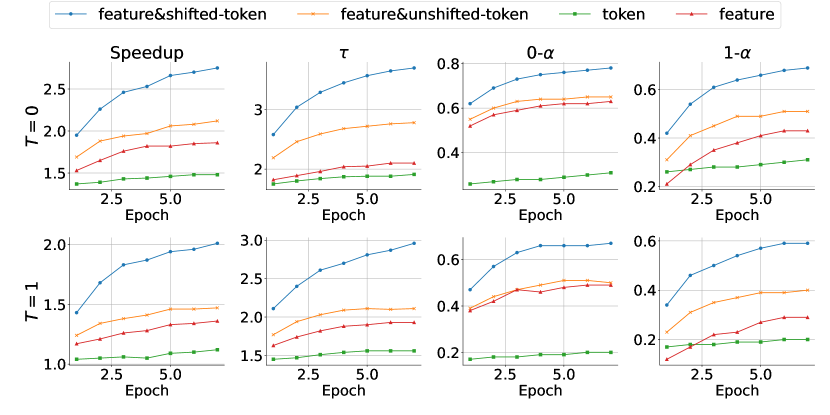
图源:EAGLE,Figure 8。原论文图意:Vicuna 7B + MT-bench 上比较 feature&shifted-token、feature&unshifted-token、token、feature 四类 draft input;指标包括 speed、、、。
可以拆成三个结论:
- 在 draft model 参数量有限时,feature input 通常比 token input 更有效;
- feature 和 token 融合会提升性能,因为 token 是离散且无误差的,可以缓解 feature error accumulation;
- shifted-token 是最大增益来源,因为它把实际采样结果告诉下一步 feature predictor。
局限与工程风险
第一,EAGLE 的 static draft tree 仍然粗糙。论文自己也说树结构是直觉设计,不是严格优化;后续 EAGLE-2 正是沿着这个缝隙做 dynamic draft tree。
第二,feature prediction constraint 后来被证明会限制数据规模继续转成 speedup。EAGLE-3 放弃 feature regression,改成 direct token prediction,并用 training-time test 处理多步分布偏移。
第三,EAGLE 对 batch size 敏感。它适合小 batch、长输出、decode-bound 的在线交互;大 batch throughput 场景仍有收益,但 speedup 会收缩。
第四,MoE 上收益较弱。对 Mixtral 8x7B,vanilla decoding 每 token 只读少数专家,而 speculative verification 可能触发更多专家,这会削弱 dense 模型上那种“多 token 一次验证”的收益。
项目启发
EAGLE 最值得带走的不是某个 speedup 数字,而是一个设计范式:
Draft model 不必是完整语言模型,它可以是贴着 target model feature 接口训练出来的服务端预测头。
这个思路对高效推理很实用:如果 target model 的内部表示可以稳定导出,那么推理加速可以发生在 hidden-state interface,而不是只在 token interface。代价是系统必须一起管理 feature cache、draft head、tree attention、verification mask 和接受率观测。
落地时可以用这张 checklist:
| Question | Why it matters |
|---|---|
| Feature 接口是否稳定 | EAGLE 依赖 target model second-to-top-layer feature 和 LM head |
| Draft head 是否便宜 | 如果 draft overhead 太高,接受率提升也转不成 speedup |
| Shifted-token 是否对齐采样 | 多步 feature draft 必须知道上一轮采样结果 |
| Tree attention 是否正确实现 | 分支 token 只能看祖先,不能互相泄漏上下文 |
| 训练数据是否覆盖目标流量 | 固定 ShareGPT 成本低,但专业域/工具流量可能需要重训或校准 |
| batch 分桶是否开启 | 小 batch 长输出优先,饱和大 batch 要单独测 throughput |
把 EAGLE、EAGLE-2、EAGLE-3 连起来看,会看到一条很清楚的演化线:先找到 feature-level draft 这个低成本接口,再让 draft tree 按上下文动态分配预算,最后把 draft model 的训练分布改得更接近真正的多步推理。
- 回到论文总入口:论文专题讲解,用同一套 claim / 图表 / 边界口径横向比较。
- 把本篇结论接回主题:推理。
- 按导航顺序继续:EAGLE-2:动态 Draft Tree。
- Title: 论文专题讲解:EAGLE:Feature-level Draft 的投机推理
- Author: Charles
- Created at : 2025-11-06 09:00:00
- Updated at : 2025-11-06 09:00:00
- Link: https://charles2530.github.io/2025/11/06/ai-files-paper-deep-dives-inference-eagle/
- License: This work is licensed under CC BY-NC-SA 4.0.