

论文专题讲解:SLA / SLA2:DiT 稀疏线性 Attention

- 主论文:
SLA: Beyond Sparsity in Diffusion Transformers via Fine-Tunable Sparse-Linear Attention - 后续改进:
SLA2: Sparse-Linear Attention with Learnable Routing and QAT - 链接:arXiv:2509.24006 / arXiv:2602.12675v1
- 代码:thu-ml/SLA
- 团队:Tsinghua University、UC Berkeley
- 关键词:Diffusion Transformer、video generation、sparse attention、linear attention、learnable routing、QAT、low-bit attention、FlashAttention、GPU kernel、Wan2.1
这两篇论文讨论的是视频 DiT 里一个很基础但很工程化的问题:attention 既是长序列视频生成的瓶颈,又很难直接靠稀疏或线性化单独解决。 SLA 先把 attention 权重分成三类:少数关键块精确算,大量边缘块用 linear attention 补偿,极小块直接跳过。SLA2 则继续追问:这个三分法能不能不靠手工规则,低比特 attention 能不能和 sparse-linear attention 一起训练出来。
因此这篇讲解把两篇合在一起看:SLA 是 sparse-linear attention 的第一版,证明“高秩少数精确算、低秩多数便宜补”这条路线可行;SLA2 是第二版,补上可学习路由、比例混合和 QAT,让它更接近可部署的高稀疏注意力方案。
论文位置
标准 attention 是:
它的问题是 和 attention weight matrix 都是 ,复杂度随序列长度平方增长。LLM 长上下文会遇到这个问题,视频 DiT 更明显,因为视频 latent token 同时包含时间和空间维度,序列长度经常达到 10K 到 100K。
已有加速路线大致分两类:
| Route | Basic idea | Main issue in video DiT |
|---|---|---|
| Sparse attention | 只计算重要 attention blocks | 稀疏率太高会损质量;block mask 和 kernel 也有开销 |
| Linear attention | 用 feature map 把 attention 改成 | 对完整 softmax attention 的高秩部分近似差,视频质量容易崩 |
SLA 的判断是:这两类路线各自失败,是因为它们都试图用一种结构覆盖整个 attention matrix。实际上,attention weights 里少数大权重是高秩的,适合 sparse exact attention;大量剩余小权重是低秩的,适合 linear attention。
两篇论文的关系可以这样理解:
| Paper | Main question | Main answer |
|---|---|---|
| SLA | Sparse attention 和 linear attention 能否在视频 DiT 里互补? | 用 block-level 权重预测把 attention 划成 critical / marginal / negligible,critical 走 sparse FlashAttention,marginal 走 linear compensation,再用短步数 fine-tuning 适配 |
| SLA2 | SLA 的手工路由和补偿公式是否足够合理?还能不能叠加低比特 attention? | 用 learnable router 学路由,用可学习比例 直接混合 sparse / linear 分支,并用 QAT 训练 sparse + low-bit attention |
SLA:核心观察与方法
关键观察:attention 不是简单“稀疏”
论文先看 Wan2.1 中的 attention weight 分布。大多数权重很小,但不能简单把它们全删掉,因为中间权重虽然单个不大,数量很多,合起来会影响输出。

图源:SLA: Beyond Sparsity in Diffusion Transformers via Fine-Tunable Sparse-Linear Attention,Figure 1。原论文图意:左图展示 Wan2.1 attention weights 的分布,约 8.1% 为 critical,约 46.5% 为 marginal,约 45.4% 为 negligible;右图说明只跳过最小 45% 权重误差很小,但只保留最大约 8% 会导致输出误差显著增大。
绿色 negligible 权重可以跳过;红色 critical 权重要精确算;黄色 marginal 权重是难点。它们不够大到值得 full attention,但直接丢掉又会带来明显误差。SLA 的关键不是“更激进地稀疏”,而是承认中间权重需要一种便宜但可训练的补偿。
论文进一步用 stable rank 观察 attention matrix。完整 attention 和 top weights 部分仍然高秩,而去掉 top 8% 后,剩余 bottom 92% 的 stable rank 很低。

图源:SLA,Figure 3。原论文图意:Wan2.1 attention weights 可分成 top-8% 高秩部分和 bottom-92% 低秩部分;前者适合 sparse attention,后者适合 low-rank / linear attention。
这就是 SLA 名字里的 “Sparse-Linear”:不是把 sparse attention 和 linear attention 机械相加,而是让它们分别处理 attention matrix 的不同结构。
方法:critical / marginal / negligible 三分法
SLA 先按 query/key block 估计一个压缩 attention weight matrix。论文用 mean pooling 压缩 token 维度,再计算一个 block-level 的 。然后每个 block 被分成三类:
| Category | Block label | Computation | Complexity role |
|---|---|---|---|
| Critical | large predicted weight | Sparse FlashAttention | 对少数关键块做精确 计算 |
| Marginal | middle predicted weight | Linear Attention | 用 低秩补偿中间权重 |
| Negligible | tiny predicted weight | Skip | 直接省掉计算 |

图源:SLA,Figure 4。原论文图意:左侧展示 SLA 的 high-level idea:先预测压缩 attention weights,再把 block 分成 critical / marginal / negligible;右侧展示 forward algorithm:critical blocks 用 Sparse FlashAttention,marginal blocks 用 Linear Attention,negligible blocks skip。
SLA 的输出可以理解成两部分:
其中 来自 sparse FlashAttention,处理 critical blocks; 来自 linear attention,处理 marginal blocks;Proj 是一个可学习线性投影,用来减小 softmax attention 与 linear attention 的分布不匹配。
论文特别强调,SLA 里的 linear attention 更像 trainable compensation,而不是对 marginal softmax attention 的精确近似。完整 softmax attention 的高秩结构很难被 linear attention 表达,所以 SLA 把高秩 critical 部分交给 sparse exact attention,只让 linear attention 负责低秩剩余结构,并通过 fine-tuning 让模型适配。
为什么需要微调
SLA 不是纯 training-free 稀疏推理方法。它把原模型 attention 替换成 SLA 后,需要用接近预训练分布的数据微调少量 steps。
原因有两层:
Proj等新增/调整路径需要学习;- linear attention 与 softmax attention 的输出分布不同,模型需要重新适配这种 residual-like 补偿。
论文的训练设定如下:
| Item | Setting |
|---|---|
| Main video model | Wan2.1-1.3B |
| Fine-tuning dataset | 20,000 5-second videos collected from websites such as Pexels and Common Crawl |
| Video resolution | 480p |
| Fine-tuning steps | 2,000 |
| Batch size | 64 |
| Activation function in SLA linear component | softmax |
| Fine-tuning cost note | less than 0.1% of Wan-style pre-training cost |
| Image appendix model | LightningDiT-1.03B |
| Image appendix data | ImageNet |
这组细节很关键:SLA 的目标不是重新预训练一个视频模型,而是给已有 DiT 做 attention replacement 后的轻量适配。对工程团队来说,这意味着它更像“模型加速后处理 / post-training adaptation”,而不是从零建模方案。
forward / backward 和 kernel
SLA 的工程重点是把 sparse 和 linear 两条路径融合到同一个 GPU kernel,并且同时支持 forward 和 backward。
forward 的关键优化是:对 linear attention 路径预先计算每个 key/value block 的中间量。当某个 query block 遇到 marginal block 时,不需要重新做完整 attention,只需要把已经预计算好的 linear contribution 加进来。
训练时 backward 也要处理两部分梯度:
| Path | Forward role | Backward role |
|---|---|---|
| Sparse FlashAttention | 对 critical blocks 做 exact softmax attention | 沿 FlashAttention 的分块 softmax 推导回传 梯度 |
| Linear Attention | 对 marginal blocks 做低秩补偿 | 通过预计算的 linear attention 中间量聚合梯度 |
| Projection | 缓解 softmax / linear 分布错配 | 学习补偿路径如何与 sparse 输出合并 |
这也是为什么论文不是只报 FLOPs。稀疏方法常见陷阱是理论 FLOPs 下降,但 GPU 上因为索引、block map、mask 判断和 kernel launch 开销不降反升。SLA 把 forward/backward 都融合,是为了让 attention reduction 真正转成 wall-clock speedup。
SLA 实验结果
实验设置和指标
视频实验主线使用 Wan2.1-1.3B。评测不只看速度,也看生成质量。
| Evaluation aspect | Metrics |
|---|---|
| Video quality | VBench dimensions: Imaging Quality (IQ), Overall Consistency (OC), Aesthetic Quality (AQ), Subject Consistency (SC) |
| Preference / quality | Vision Reward (VR), Aesthetic Video Quality (VA), Techniqual Video Quality (VT) |
| Efficiency | FLOPs, attention kernel FLOPS, end-to-end generation latency |
| Image appendix | FID on ImageNet with LightningDiT |
论文比较的 baseline 包括 VSA、VMoBa、training-free Sparge-F、trainable Sparge-T,以及 ablation 中的 Linear Only、Sparse Only、L+S。
主要结果:95% sparsity 但质量接近 full attention
论文 Table 1 的核心结果如下,保留原英文列名:
| Method | VA | VT | IQ | OC | AQ | SC | VR | FLOPs | Sparsity |
|---|---|---|---|---|---|---|---|---|---|
| Full Attention | 76.78 | 82.88 | 62.5 | 23.3 | 56.1 | 93.0 | 0.059 | 52.75T | 0% |
| Sparge-F | 0.002 | 0.026 | 26.0 | 4.6 | 35.7 | 85.1 | -0.216 | 7.91T | 85% |
| Sparge-T | 73.83 | 77.87 | 61.9 | 22.7 | 55.4 | 93.1 | 0.014 | 7.38T | 84% |
| VMoBa | 32.33 | 35.79 | 58.0 | 18.8 | 46.2 | 89.9 | -0.175 | 7.91T | 85% |
| VSA | 55.37 | 64.61 | 60.6 | 22.4 | 51.9 | 83.6 | -0.069 | 5.92T | 89% |
| SLA | 76.96 | 83.92 | 62.2 | 23.6 | 55.9 | 93.1 | 0.048 | 2.74T | 95% |
表源:SLA,Table 1。原论文表意:SLA 在 95% sparsity 下 FLOPs 大幅降低,同时视频质量指标接近 Full Attention,并显著优于 sparse-only baseline。
从表里看,SLA 的重点不是单个质量指标超过 full attention,而是它在 2.74T FLOPs 下保持了接近 full attention 的 VA/VT/IQ/OC/AQ/SC,而其他稀疏方法在更高 FLOPs 或更低 sparsity 下质量明显下降。

图源:SLA,Figure 2。原论文图意:在 Wan2.1 上对比 Full Attention、Linear Only、Sparse Only 和 SLA,SLA 在 95% sparsity 下保持接近 full attention 的视频质量;Linear Only 和 Sparse Only 出现明显质量退化。
效率:attention 变得接近不再是瓶颈
论文在 RTX 5090 上比较 attention kernel 和端到端生成延迟。

图源:SLA,Figure 6。原论文图意:SLA 在 forward attention kernel 上相对 FlashAttention2 达到 13.7x speedup;端到端视频生成中 attention latency 从 97s 降到 11s,整体 E2E speedup 为 2.2x。
这张图说明一个系统事实:即使 attention kernel 加速很多,端到端不一定等比例加速,因为视频生成里还有 VAE、MLP、norm、sampling loop、数据搬运等其他部分。SLA 把 attention 从 97s 降到 11s 后,剩下的 62s “Others” 成为主要时间,整体速度提升约 2.2x。也就是说,SLA 的成功会把瓶颈推向 attention 之外的模块。
消融:为什么不是 Linear Only / Sparse Only / L+S
论文 Table 2 对 SLA 的融合策略、linear activation 和参数选择做了消融,核心部分如下:
| Method | VA | VT | IQ | OC | AQ | SC | VR | FLOPs | Sparsity |
|---|---|---|---|---|---|---|---|---|---|
| Full Attention | 76.78 | 82.88 | 62.5 | 23.3 | 56.1 | 93.0 | 0.059 | 52.75T | 0% |
| Linear Only | 0.042 | 0.099 | 39.5 | 3.6 | 28.8 | 90.7 | -0.213 | 0.10T | 100% |
| Sparse Only | 64.00 | 70.50 | 57.2 | 21.8 | 51.7 | 88.7 | -0.073 | 7.91T | 85% |
| L+S | 29.65 | 41.15 | 58.6 | 18.8 | 45.3 | 87.1 | -0.105 | 5.37T | 90% |
| SLA (softmax) | 76.96 | 83.92 | 62.2 | 23.6 | 55.9 | 93.1 | 0.048 | 2.73T | 95% |
表源:SLA,Table 2。原论文表意:Linear Only 质量崩溃,Sparse Only 不够省,直接相加的 L+S 也不稳定;SLA 的分类、投影和微调融合才是关键。
这个消融非常重要。它说明 SLA 不是“把两个 attention 输出加起来”的朴素 ensemble,而是需要:
- block-level 重要性预测;
- critical / marginal / negligible 的路由;
- 对 linear component 做可学习投影;
- 替换 attention 后进行短步数 fine-tuning。
图像生成附录:不是只对 Wan2.1 有效
论文还在 LightningDiT-1.03B / ImageNet 上做了图像生成实验:
| Method | FID | FLOPs | Sparsity |
|---|---|---|---|
| Full Attention | 31.87 | 12.88G | 0% |
| SpargeAttn-F | 206.11 | 3.66G | 71.57% |
| SpargeAttn-T | 46.05 | 3.16G | 75.45% |
| VSA(2D) | 35.75 | 3.62G | 75.00% |
| VMoBA(2D) | 39.45 | 3.22G | 75.00% |
| SLA | 31.49 | 1.73G | 87.50% |
表源:SLA,Table 3。原论文表意:SLA 在图像 DiT 中也能以更高 sparsity 和更低 FLOPs 保持接近甚至略优于 Full Attention 的 FID。
不过,论文主战场仍是视频生成。图像实验更像泛化验证:SLA 的 attention decomposition 不只存在于 Wan2.1 视频 DiT,也能迁移到图像 DiT。
SLA2:从手工分解到可训练路由
后续改进解决什么
SLA2 的出发点不是推翻 SLA,而是把 SLA 里两个比较“工程经验化”的地方改成可训练目标。
第一,SLA 的 sparse 分支并不等价于原 full attention 的 masked 子矩阵。设 full attention probability 为 ,mask 为 ,理想分解是:
但是 sparse attention 会在 masked positions 内重新归一化。对每个 query row,若被 mask 选中的概率和为 ,那么 sparse branch 实际得到的是近似 ,而不是 。这会带来一个 row-wise scaling mismatch。SLA 用 Proj(O^l) 试图补偿这个错配,但 linear 分支既要近似 ,又要补 sparse 分支的 scale error,任务变得不干净。
第二,SLA 用 attention-weight magnitude 的启发式 top-k 路由决定哪些 block 进 sparse branch、哪些交给 linear branch。这个规则直观但不一定最优,因为“权重大”不完全等于“必须精确算”,“权重中等”也不一定就是 linear branch 最容易拟合的低秩部分。
SLA2 的总体 pipeline 如下:
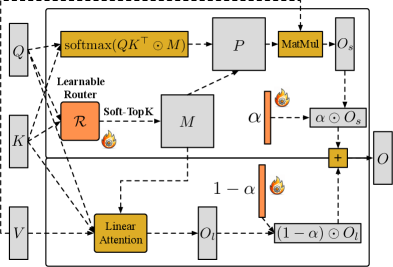
图源:SLA2: Sparse-Linear Attention with Learnable Routing and QAT,Figure 1。原论文图意:SLA2 用 learnable router 产生 sparse mask,再用 learnable ratio 混合 sparse attention output 和 linear attention output;sparse 分支还可以通过 QAT 引入 low-bit attention。
SLA2 的公式:从 Proj 补偿改成比例混合
SLA2 把输出写成:
其中:
| Symbol | Meaning |
|---|---|
| 由 mask 选中的 sparse softmax attention 输出 | |
| 对 剩余部分的 linear attention 输出 | |
| 每个 query 的 learnable ratio,用来控制 sparse / linear 两个分支的混合比例 | |
| learnable sparse-attention mask predictor,也就是 SLA2 的 router |
这个改动很小,但含义很关键。SLA 是:
SLA2 是:
前者把错配交给一个 projection 去学,后者直接把 sparse branch 的 row-wise probability mass 放进公式里。对学习来说,SLA2 的目标更明确: 对应被 sparse branch 负责的 , 对应 linear branch 负责的 。
Learnable routing:SLA2 不再只按权重大小硬切
SLA 的路由大致是:pool ,算 compressed attention weights,然后按 top 进 sparse branch,bottom skip,中间交给 linear attention。SLA2 保留“先降采样再决定 block mask”的工程思路,但把路由函数改成可学习的 。
论文对 的设计有三个直观理由:
- 路由输入用 ,因为 attention pattern 由 决定, 不影响 softmax weight 的形成。
- 先对 做 mean pooling,避免 router 自己产生 级别开销。
- 在 pooled 上加 learnable projections,使 top-k 选择不只是原始 attention magnitude 的启发式排序,而是能学出更适合 sparse / linear 分解的表示。
可以把 SLA2 的 router 看成“可学习的 block sparse mask 生成器”。它不是让每个 token 自由选择任意路径,而是在保留 block-sparse kernel 友好的结构下,让模型学会哪些块应该留给 sparse exact attention,哪些块更适合被 linear branch 吸收。
| Design point | SLA | SLA2 | Why it matters |
|---|---|---|---|
| Sparse / linear split | attention-weight magnitude heuristic | learnable router | 少依赖全局手工阈值,能按模型、层和时刻学路由 |
| Branch combination | 修正 sparse branch row-wise normalization mismatch | ||
| Linear branch role | marginal blocks compensation | direct sparse-linear decomposition component | 目标更干净,不需要同时补 sparse scale error |
| Low-bit attention | not central | sparse + low-bit attention with QAT | 进一步减少 sparse branch 的算子和带宽成本 |
| Scale validation | Wan2.1-1.3B main result | Wan2.1-1.3B and Wan2.1-14B | 更关注大模型和高分辨率视频生成部署 |
SLA2 的训练:两阶段路由 + QAT
SLA2 比 SLA 更像一个训练出来的 attention replacement,而不是只靠 kernel 替换。论文强调 two-stage training,原因是 router 里最终用于推理的 hard top-k 不可导;如果一开始就直接端到端训练,路由不稳定会让后续 fine-tuning 很难收敛。
| Stage | What is trained | Routing form | Main purpose |
|---|---|---|---|
| Stage 1: router initialization | learnable projections in and learnable ratio | differentiable SoftTop-k | 让 router 先学到合理 sparse / linear 分解,避免 hard routing 冷启动 |
| Stage 2: end-to-end fine-tuning | full diffusion model with SLA2 attention | hard Top-k, aligned with inference | 让训练路径和推理路径一致,恢复生成质量 |
| QAT path | low-bit sparse attention forward; FP16 backward | quantized forward simulation | 让模型适配 low-bit attention 的量化误差 |
QAT 细节也值得单独看。SLA2 的 low-bit attention 主要放在 sparse attention branch 的 forward 中:先量化 ,算低比特 后反量化得到 score;softmax 后再量化 ,计算低比特 ,最后反量化回 FP16 输出。训练时 forward 使用 low-bit attention,backward 仍保持 FP16,这样既让模型看到推理时的量化噪声,又避免低比特 backward 破坏训练稳定性。
| Tensor / step | SLA2 QAT treatment | Reason |
|---|---|---|
| quantize before score matmul, then dequantize score | 加速 sparse score computation,同时让训练感知量化误差 | |
| quantize before value aggregation, then dequantize output | 加速 sparse attention output computation | |
| Backward | keep FP16 | 降低训练不稳定和梯度误差 |
| Fine-tuning | quantization-aware, not pure post-training quantization | 让 diffusion model 主动适配 low-bit sparse attention |
这里和很多 LLM KV cache 量化的直觉类似:当 sparse-linear attention 已经把理论 FLOPs 压得很低时,真正的部署瓶颈会越来越受内存带宽、数据格式转换和 kernel 实现影响。QAT 的意义不是“多一个压缩技巧”,而是把 low-bit attention 作为模型训练时就要适配的计算路径。
SLA2 的实验结论
SLA2 报告的主结果是:在视频 diffusion models 上可以达到 97% attention sparsity,并实现约 18.6x attention runtime speedup,同时保持生成质量。论文还强调,考虑 linear branch 以后,97% sparsity 约等价于 96.7% computation savings。
和 SLA 相比,SLA2 的效率结论更激进:
| Method | Key sparsity | Attention speedup | E2E note |
|---|---|---|---|
| SLA | 95% | 13.7x forward attention kernel speedup on RTX 5090 | Wan2.1-1.3B-480P 上约 2.2x E2E speedup |
| SLA2 | 97% | 18.6x / 18.7x attention runtime speedup reported | Wan2.1-1.3B-480P 上 attention latency 从 97s 降到约 7s,约 2.30x E2E;Wan2.1-14B-720P 上约 4.35x E2E |
SLA2 的结果不要只理解成“稀疏率从 95% 到 97%”。更重要的是它把三件事合在一起:
- 用 error analysis 指出 SLA 的 sparse branch scaling mismatch;
- 用 learnable router 和 让分解目标更直接;
- 用 QAT 把 low-bit sparse attention 纳入训练,而不是在训练后硬量化。
这也解释了为什么 SLA2 在更大模型 Wan2.1-14B 上仍然有价值:模型越大、分辨率越高,attention 的 kernel 时间和显存/带宽压力越明显,可学习路由和 low-bit branch 的收益越容易转成端到端收益。
和 FlashAttention、Sparse Attention、Linear Attention 的关系
| Method family | What changes | Exactness | Training needed | Position |
|---|---|---|---|---|
| FlashAttention | 改数据流,不改 attention 数学 | exact | no | SLA 的 critical blocks 仍借助 FlashAttention 风格精确计算 |
| Sparse Attention | 跳过低重要度 blocks | approximate | often no / sometimes yes | SLA 保留 sparse exact path,但不把 marginal blocks 简单丢掉 |
| Linear Attention | 改 attention 公式到 | approximate | usually yes | SLA 只把 linear attention 用作低秩补偿 |
| SLA | sparse exact + linear compensation + skip | approximate but fine-tuned | yes, few steps | 在视频 DiT 上用短微调换高 sparsity 和端到端加速 |
| SLA2 | learnable sparse-linear routing + ratio mixing + QAT | approximate but trained for deployment path | yes, two-stage fine-tuning + QAT | 把 SLA 的手工路由和 projection 补偿改成可学习目标,并叠加 low-bit attention |
如果用一句话概括:FlashAttention 是 exact attention 的 kernel 优化;SLA / SLA2 是 允许模型适配的新 attention 算法 + kernel 优化 + 训练后适配流程。它们不是同一层问题。
工程启发
- 不要只看 sparsity。理论跳过 95% attention blocks,不代表端到端就 20x 加速;必须看 kernel fusion、backward、其他模块占比和采样 loop。
- 近似 attention 最好给模型适配机会。training-free 稀疏在质量上容易到瓶颈,SLA 用 2000 steps fine-tuning 换来更高 sparsity,SLA2 进一步用两阶段训练让 router 和 hard top-k 推理路径对齐。
- 视频 DiT 的 attention 结构有分层性。少量高秩 critical blocks 和大量低秩 residual blocks 应该用不同计算处理。
- 线性 attention 不一定适合单独替代 softmax,但可以作为低秩补偿路径;SLA2 的 混合说明补偿路径最好和 attention probability mass 对齐。
- 路由策略本身值得训练。简单 top-k magnitude 是强 baseline,但不一定给 linear branch 留下最容易低秩近似的残差。
- 低比特 attention 要和模型一起适配。SLA2 的 QAT 提醒我们,部署路径里的量化误差不能只靠 PTQ 硬扛,尤其是视频生成这种误差会被采样过程放大的场景。
- 加速成功后瓶颈会转移。SLA 把 attention latency 压到 11s 后,系统下一步应盯 VAE、MLP、采样器、I/O 和其他 kernel;SLA2 在 14B/720P 上的收益也说明大模型高分辨率场景更容易吃到 attention 优化红利。
局限
SLA 的结论不要过度外推。
- 它需要微调,不能简单替换 kernel 就上线。
- SLA 的主要实验证据来自 Wan2.1-1.3B 和 LightningDiT;SLA2 扩展到 Wan2.1-1.3B 和 Wan2.1-14B,但其他 DiT、其他分辨率、其他采样器仍要重新验证。
- 数据分布要接近预训练/部署分布。论文用 20,000 条 5 秒 480p 视频微调,如果目标域差异大,适配成本和质量风险可能变化。
- 端到端加速受系统其他部分限制。attention 不是唯一瓶颈,尤其在短序列或强 VAE/MLP 占比场景里收益会缩小。
- SLA2 的 learnable router 和 QAT 会引入额外训练复杂度。router 冷启动、SoftTop-k 到 hard Top-k 的训练/推理一致性、low-bit kernel 可用性,都需要工程回归。
- 这是近似 attention。对需要严格数值等价、训练稳定性极敏感或已有精细对齐的视频模型,要做充分回归。
结论
SLA 最值得记住的不是“95% sparsity”这个数字,而是它给近似 attention 提供了一个更合理的分解方式:高秩少数精确算,低秩多数便宜补,极小部分直接跳过,再用短微调让模型适配。 SLA2 的价值则是把这个思路继续工程化:用 learnable router 替代手工路由,用 修正 sparse / linear 分解公式,用 QAT 把 low-bit attention 纳入训练。
对高效训练学习来说,这条线把四个常被分开讨论的主题接了起来:attention 数学结构、稀疏/低秩近似、可学习路由、GPU kernel / low-bit 部署效率。读完这篇后,看任何 attention 加速论文都应该追问五个问题:它省的是理论 FLOPs 还是 wall-clock?质量是否在同等 sparsity 下比较?路由是手工规则还是可训练目标?是否需要微调或 QAT?端到端瓶颈是否真的还在 attention?
参考链接
- 论文:SLA: Beyond Sparsity in Diffusion Transformers via Fine-Tunable Sparse-Linear Attention.
- 后续论文:SLA2: Sparse-Linear Attention with Learnable Routing and QAT.
- SLA 原图 HTML:ar5iv:2509.24006.
- SLA2 Figure 1 见论文 PDF:arXiv:2602.12675.
- 官方代码:thu-ml/SLA.
- Title: 论文专题讲解:SLA / SLA2:DiT 稀疏线性 Attention
- Author: Charles
- Created at : 2025-11-12 09:00:00
- Updated at : 2025-11-12 09:00:00
- Link: https://charles2530.github.io/2025/11/12/ai-files-paper-deep-dives-foundations-sla-sparse-linear-attention/
- License: This work is licensed under CC BY-NC-SA 4.0.